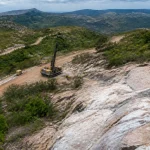
An alpine mining development area in Carinthia, Austria, near the Wolfsberg lithium project.

Critical Metals Corp.’s proposed acquisition of European Lithium Ltd. is moving into the formal Australian court process, with the first hearing scheduled for September 15 as the companies seek to advance an all-stock transaction valued at approximately $835 million.
European Lithium lodged a draft scheme booklet with the Australian Securities and Investments Commission on August 26, according to the company update reported by Business News Today. At the hearing, the Supreme Court of Western Australia is expected to consider whether European Lithium can convene separate meetings of its shareholders and listed optionholders to vote on the proposed takeover.
The hearing is an important procedural milestone, but it is not the final court approval of the acquisition. If the court grants the requested orders, the securityholder meetings are expected to take place in mid-October. Completion is targeted for early November, subject to shareholder, optionholder, regulatory and further court approvals.
The deal would bring European Lithium’s Wolfsberg project in Austria into the Nasdaq-listed Critical Metals group while giving Critical Metals full ownership of the Tanbreez rare earth project in Greenland.

What the first court hearing will decide
The proposed transaction is being implemented through two interdependent schemes of arrangement under Part 5.1 of the Australian Corporations Act: one covering European Lithium shares and another covering its listed options.

At the September hearing, European Lithium is expected to ask the Western Australian court to:
- Approve the convening of shareholder and optionholder meetings.
- Review the proposed scheme documentation and explanatory materials.
- Permit the distribution of the scheme booklet to eligible securityholders.
- Set the framework for the votes that will determine whether the transaction proceeds.
The court’s role at this stage is primarily procedural. It will not replace the securityholder vote or determine whether the transaction offers investment value. A second court hearing would generally be required after the meetings if the schemes receive the necessary approvals.

The process therefore creates several decision points for investors. The first is whether the court allows the meetings to proceed. The second is whether shareholders and optionholders approve the schemes. The final stages include satisfaction of outstanding conditions and a further application to the court for implementation.
European Lithium’s latest timetable represents a shift from earlier guidance that had pointed to completion during September. The revised schedule reflects the time required for ASIC review, distribution of the scheme booklet, securityholder meetings and final court consideration.
Deal value is indicative, not a fixed cash offer
The approximately $835 million headline value refers to an all-stock acquisition rather than a cash purchase price. Under the original transaction terms, European Lithium shareholders were to receive 0.035 Critical Metals shares for every European Lithium share held.
The companies later amended the exchange mechanism to introduce a floating ratio linked to Critical Metals’ 20-day Nasdaq volume-weighted average share price before the scheme meeting.
| Critical Metals reference price | Exchange ratio for European Lithium shareholders |
|---|---|
| At or below $8 | 0.045 CRML shares per EUR share |
| Between $8 and $16 | Adjusted progressively |
| At or above $16 | 0.025 CRML shares per EUR share |
The floating structure means the final number of Critical Metals shares issued will depend on the company’s share price during the relevant measurement period. A lower Critical Metals share price would result in a higher exchange ratio, while a higher share price would reduce the number of shares issued.
That structure distributes some market risk between the two shareholder groups, but it also makes the final economics harder to assess before the scheme meeting. The $835 million value should therefore be viewed as an announced transaction estimate rather than a guaranteed cash valuation.
European Lithium shareholders are expected to own approximately 41% of the combined company after completion. The final ownership split may be affected by the exchange ratio, changes in the number of eligible securities and the treatment of European Lithium’s outstanding options.
Critical Metals’ May transaction announcement said the structure would also address European Lithium’s existing 31% holding in Critical Metals. European Lithium held approximately 45.5 million Critical Metals shares at the time of the announcement, creating a cross-holding that the companies said could complicate the public float and trading profile of the Nasdaq-listed group.
Wolfsberg gives the deal its lithium and European battery-materials exposure

Processing equipment reflects the conversion of hard-rock lithium feedstock into battery materials.
European Lithium’s principal asset is the Wolfsberg Lithium Project in Carinthia, approximately 270 kilometers south of Vienna. The project is designed to produce lithium products for European battery and electric-vehicle supply chains and is located near established road and rail infrastructure.
European Lithium has described Wolfsberg as Europe’s first fully permitted lithium mine. The project has also been linked to downstream and offtake arrangements for battery-grade lithium hydroxide, giving the acquisition significance beyond the ownership transfer itself.
The project’s development history stretches back decades. According to European Lithium’s project history, the deposit was discovered by Minerex in 1981, followed by extensive exploration, underground development and technical studies. A mining licence was granted in 2011.
For Critical Metals, the proposed acquisition offers exposure to the European lithium market at a time when governments and automakers are attempting to reduce reliance on imported battery materials. The company already has a strategic minerals portfolio centered on rare earths through Tanbreez. Adding Wolfsberg would give it a second major asset tied to electrification and industrial supply-chain security.
However, the project is not free from regulatory risk. Separate proceedings in Austria have required the environmental assessment process to be revisited, according to reporting cited in the latest transaction coverage. That review is distinct from the Australian court process, but it could affect Wolfsberg’s development timetable, capital requirements and final investment decision.
The distinction matters: approval of the corporate transaction would determine who owns and controls Wolfsberg, while Austrian environmental and project-level proceedings could influence when and how the mine is developed.
Full Tanbreez ownership is the rare-earth rationale
The takeover would also allow Critical Metals to consolidate its ownership of Tanbreez, a rare earth project in southern Greenland.
Critical Metals currently controls 92.5% of Tanbreez, while European Lithium owns the remaining 7.5%. Acquiring European Lithium would therefore remove the minority interest and place the entire project under one corporate owner.
That could simplify decisions on financing, engineering, permitting, offtake and future strategic partnerships. It would also eliminate the need to coordinate development plans between two related but separately listed companies.
Tanbreez has attracted attention because of its reported heavy rare earth potential. Heavy rare earth elements are used in advanced magnets, defense systems, electronics and other technologies, and Western governments are seeking alternative supply sources as China remains dominant across much of the global rare earth processing chain.
The strategic value of the project is also linked to logistics. Critical Metals has said Tanbreez benefits from access to deep-water fjords and year-round shipping routes into the North Atlantic. Those features could be relevant to future concentrate exports, although infrastructure development, processing capacity and commercial financing remain critical execution questions.
Critical Metals has also announced a long-term offtake agreement with REalloys covering rare earth concentrate from Tanbreez. The agreement provides a potential commercial pathway, but an offtake contract does not by itself establish a producing operation or remove the need for substantial project investment.
Investor risks extend beyond the court timetable

Lithium core samples and transaction documents illustrate the parallel corporate and project risks facing the deal.
The September hearing may clarify the timetable, but investors still face several risks before the acquisition can be completed.
Securityholder approval
The court must first allow the meetings to proceed, after which shareholders and optionholders will vote. The transaction could be delayed or terminated if the required voting thresholds are not met.
Regulatory and court conditions
The schemes remain subject to additional court approval, ASIC review and other regulatory consents. The companies must also satisfy or waive remaining conditions under the scheme implementation deed.
Wolfsberg environmental review
The Austrian environmental assessment process remains separate from the merger. Any additional conditions, delays or appeals could increase the time and capital needed to bring the lithium project into production.
Share-price volatility and dilution
Because the transaction is settled in Critical Metals shares, movements in the Nasdaq-listed stock affect the effective value received by European Lithium holders and the number of shares issued. The floating exchange ratio reduces some exposure to price movements but does not eliminate dilution or valuation risk.
Financing and execution
Critical Metals said European Lithium held approximately A$306 million in cash as of March 31, while Critical Metals reported standalone cash of about $124 million in its transaction materials. The scheme also includes a minimum net cash and liquid-assets condition for European Lithium of A$330 million.
Those balances could strengthen the combined group, but the two companies still face the capital demands associated with mine construction, processing infrastructure, environmental compliance and downstream development.
The broader lithium market outlook covered by Skillings is another factor. Lithium prices have recovered from earlier lows but remain cyclical. A weaker price environment could affect project economics, financing terms and the timing of investment decisions at Wolfsberg.
What investors will watch next
The immediate catalyst is the first court hearing on September 15. If the court approves the meeting process, attention will shift to the scheme booklet, the independent expert’s assessment and the proposed voting materials.
The next key steps are expected to be:
- Court consideration of the meeting orders.
- Distribution of the final scheme booklet.
- Shareholder and optionholder meetings in mid-October.
- A second court application after the votes.
- Satisfaction of remaining regulatory and transaction conditions.
- Targeted implementation in early November.
The acquisition would give Critical Metals a broader critical-minerals platform spanning Austrian lithium and Greenland rare earths. It would also consolidate Tanbreez ownership and potentially improve the group’s balance-sheet flexibility.
But the transaction’s strategic logic does not remove the practical risks. The value of the combined company will ultimately depend on whether Wolfsberg and Tanbreez can secure funding, complete their regulatory pathways and move toward commercial production.
For now, the September hearing marks progress toward that outcome, not completion of the deal.
Shareable social snippets
LinkedIn: Critical Metals Corp.’s proposed $835 million all-stock acquisition of European Lithium is moving toward a September 15 court hearing in Western Australia. The deal would bring the Wolfsberg lithium project into the Nasdaq-listed group and consolidate 100% ownership of Greenland’s Tanbreez rare earth project. The key risks remain securityholder approval, Austrian environmental review, share-price volatility and project financing.
X: Critical Metals’ proposed $835M all-stock takeover of European Lithium is headed for a Sept. 15 court hearing. The deal would add Wolfsberg lithium in Austria and consolidate 100% of Tanbreez rare earths in Greenland. Next milestones: court orders, October votes and targeted November completion.