Komatsu’s commissioning of its 1,000th ultra-class autonomous haul truck marks a transition point for mining technology. Autonomous haulage is no longer primarily a pilot program for a handful of major iron ore mines. It is becoming a repeatable operating model for copper, gold and other large-scale surface operations.

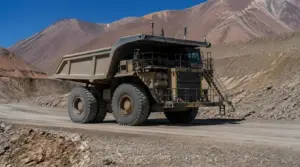
The milestone truck, a 290-metric-ton Komatsu 930E-5AT, was deployed at Barrick’s Nevada Gold Mines operation in the United States. Komatsu said its FrontRunner Autonomous Haulage System has moved more than 11.5 billion metric tons of material since commercial deployment began in 2008.
The economic significance is broader than the truck count. A thousand-unit installed base creates operating data, trained personnel, supplier support and implementation experience. It also gives mine planners greater confidence that autonomy can support production targets rather than simply demonstrate technical feasibility.

Autonomous haulage is moving from isolated trials toward repeatable fleet-scale deployment.
Why the 1,000-truck milestone matters
The FrontRunner fleet has operated across North America, South America, Australia and Europe, according to Komatsu. It now covers more than one commodity and operating environment, including the Nevada gold deployment.

Komatsu reports zero system-related injuries across the commercial FrontRunner fleet. That is a company-reported safety measure, not proof that autonomous mines are risk-free. The system still depends on safe road design, communications, maintenance, geofencing and procedures for interactions with manned equipment.
The productivity case is based on consistency. Autonomous trucks can operate through shift changes without driver handovers, maintain controlled speeds and reduce unnecessary acceleration and braking. Komatsu says FrontRunner is designed to harmonize speed, reduce idle time and stabilize haul cycles.
Its product information also cites an average 40% improvement in tire and brake life and a 13% reduction in overall maintenance when trucks operate within the system’s design envelope. These figures should be treated as performance benchmarks rather than universal outcomes. Haul-road quality, gradients, payload, climate and maintenance discipline all influence the result.
The economic bridge: utilization before electrification
For most existing mines, the initial return from autonomy is more likely to come from utilization and reliability than from a complete energy transformation.
Industry and company case studies commonly place autonomous utilization gains in the 15% to 30% range compared with comparable conventional fleets. Some operating benchmarks show autonomous trucks reaching approximately 20.5 to 22 operating hours per day, compared with roughly 16.5 to 18.5 hours for manually operated fleets.
The reason is not simply that software allows trucks to run longer. Autonomous fleets reduce several sources of variability:
- Shift-change delays
- Inconsistent driving behavior
- Excessive idling
- Harsh braking and acceleration
- Unplanned interaction between vehicles
- Fatigue-related productivity losses
- Dispatch decisions made without full fleet visibility
A mine moving 200 million tonnes annually does not necessarily gain 20% more saleable production from a 20% utilization improvement. The result may instead be lower fleet requirements, more flexibility during maintenance, or greater ability to feed a constrained processing plant.
That distinction is important for capital planning. Autonomy creates value only when the mine can use the additional truck hours. If the crusher, shovel fleet, concentrator or rail system is already the bottleneck, autonomous haulage may shift congestion elsewhere.
Labor: fewer drivers, more technical roles
Autonomy changes labor demand rather than eliminating the workforce altogether.
The number of people required inside haul-truck cabs declines, while demand increases for:
- Remote-control operators
- Fleet dispatch specialists
- Electrical and battery technicians
- Network and cybersecurity personnel
- Sensor and software technicians
- Reliability engineers
- Safety-assurance and systems-integration specialists
This transition can lower labor cost per tonne, particularly at remote operations with high wages, FIFO logistics and persistent recruitment challenges. It can also create social and political risk if workers are displaced without credible retraining or redeployment pathways.
Freeport-McMoRan’s Bagdad copper mine provides a useful example of a managed transition. The company reported moving more than 200 haul-truck drivers into other positions, including shovel operations, autonomous-system support and information technology, during its conversion program.
The practical lesson is that workforce planning should begin before trucks arrive. Operators must define who can stop the fleet, who can authorize a restart and how emergency response works when the person supervising the operation is no longer sitting in the vehicle.

Control rooms move mining work from individual truck cabins to fleet supervision and exception management.
Cabless electric trucks change the design brief
The next phase of autonomous mining is not limited to driverless versions of conventional diesel equipment. China is providing some of the clearest examples of cabless, battery-electric haulage.
At the Yimin open-pit coal mine in Inner Mongolia, a fleet of 100 autonomous electric haul trucks has operated with Huawei 5G-Advanced connectivity and automated battery swapping, according to reporting by Electrek. The trucks are reported to carry up to 90 tons and use swappable 568-kWh lithium iron phosphate batteries. Battery swaps are reported to take approximately five minutes, with an operational success rate above 98%.
Those figures are project-specific and should not be applied to every electric mining truck. They do show how energy replenishment becomes part of fleet dispatch. The question is no longer only whether a truck can complete a haul cycle, but whether it can do so while maintaining an efficient battery state and avoiding charging queues.
A separate International Mining report described the AT-150, a 136-ton-class bidirectional cabless electric autonomous truck deployed at China’s SPIC South pit. Project claims include energy consumption approximately 65% below a conventional diesel truck of similar tonnage and an equipment deployment rate above 85%.
Again, those are reported project results rather than an industry-wide standard. The value of cabless design is nevertheless clear. Removing the operator cabin allows manufacturers to optimize space for batteries, sensors, cooling systems and control hardware. Bidirectional driving can also reduce the need for turning space on constrained haul roads.

Cabless electric trucks combine autonomous control, battery systems and new mine-site infrastructure.
Regional adoption will not be uniform
Australia remains the most mature market for large-scale autonomous haulage. High labor costs, remote operations and established mining-specific safety frameworks have helped create a strong business case. Western Australia introduced an early code of practice for autonomous mining, followed by other states.
Canada and Chile have similar advantages in mining expertise and large-scale operations, but vendors and operators must navigate distinct certification, labor and safety requirements. Mine layouts, communications networks and emergency procedures often need to be approved on a site-specific basis.
China is advancing quickly in cabless electric haulage, supported by large domestic equipment manufacturers, private communications networks and state-backed industrial deployment. Its progress is particularly visible in coal and large open-pit operations.
Many African mining regions face a different calculation. Lower direct labor costs may reduce the financial incentive to automate, while power reliability, telecommunications infrastructure and local technical capacity can increase implementation costs. Safety, productivity and access to remote deposits may still justify autonomy, but adoption is likely to begin with high-value or particularly hazardous operations.
Capital requirements and the retrofit question
Autonomous mining changes the allocation of capital. The investment is not limited to the truck or autonomy kit. Operators may also need:
- Private LTE, 5G or high-reliability wireless networks
- High-precision mapping and positioning systems
- Command centers
- Road widening or redesign
- Charging and battery-swapping infrastructure
- Traffic-management systems
- Cybersecurity and data infrastructure
- Training and workforce-transition programs
Retrofit projects can lower the initial barrier by extending the life of an existing fleet. They can also be difficult because older trucks may have different braking systems, electronic architectures and maintenance histories.
Greenfield mines have more design freedom. They can create roads, loading zones, charging facilities and control systems around autonomous equipment from the beginning. The trade-off is that capital is committed before the project has a long operating record.
Base, bull and bear cases
The following framework is an analytical scenario range, not a forecast or investment recommendation.
| Scenario | Operating assumptions | Economic outcome |
|---|---|---|
| Bull case | Utilization rises 20% or more; energy systems operate reliably; battery swapping or charging avoids production delays; workforce transition is successful | Payback approaches 18–24 months at high-wage, long-life mines; autonomy becomes standard in major expansions |
| Base case | Utilization improves 10%–20%; maintenance and tire savings are achieved; mixed fleets remain a constraint | Payback is approximately 24–36 months, with retrofit programs favored over full fleet replacement |
| Bear case | Network interruptions, weak road conditions, battery degradation, regulatory delays or low commodity prices reduce operating gains | Payback extends beyond four years; automation is limited to selected haul circuits or deferred until a greenfield expansion |
The most important variable is not the headline truck specification. It is the percentage of planned operating hours that the complete system can deliver safely and consistently.
Company exposure and key risks
Komatsu has the clearest public scale advantage in ultra-class autonomous haulage, with FrontRunner’s 1,000-truck milestone and long operating history. Its key risks include concentration in large surface mines, dependence on customer capital budgets and the challenge of integrating electrification into established autonomous fleets.
Caterpillar remains a major competitor in autonomous haulage and battery-electric truck development. Its opportunity is the installed base of large mining equipment and relationships with major copper and iron ore operators. The principal execution risk is proving that battery-electric fleets can deliver reliable production without excessive charging infrastructure or reduced availability.
Sandvik is well positioned in autonomous drilling and underground equipment, where mine design, repeatable cycles and worker exposure create a strong technology case. Its risk is that underground projects have longer development timelines and more complex communications and emergency-response requirements.
EACON and other independent autonomy providers may benefit from brownfield retrofits and mixed-fleet demand. Their challenge is demonstrating repeatable integration across different truck models, mine contractors and national safety regimes.
For operators and investors, the decision-relevant question is therefore not which company has the most impressive autonomy demonstration. It is which supplier can deliver reliable performance across the full mine system at an acceptable lifecycle cost.
The next milestone is system integration
Komatsu’s 1,000-truck milestone confirms that autonomous haulage has reached commercial scale. Cabless electric trucks show that the technology is now influencing vehicle architecture, energy systems and mine design.
The next competitive advantage will come from integration. Trucks, drills, loaders, crushers, charging systems, digital mine plans and people will increasingly operate as one connected production network.
Autonomy will not remove every worker or eliminate every mining risk. But it can reduce exposure to hazardous mobile equipment, increase consistency and help mines produce more from the assets they already own: provided operators invest in infrastructure, training and system resilience alongside the vehicles.
Sources and further reading
- Komatsu commissions its 1,000th ultra-class autonomous haul truck
- Komatsu FrontRunner Autonomous Haulage System
- Yimin autonomous electric haulage deployment
- SPIC South pit cabless autonomous electric truck
- Skillings autonomous mining technology coverage
- Skillings analysis of the 1,900-truck autonomy scale test