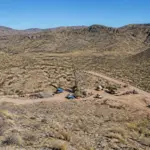
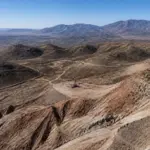
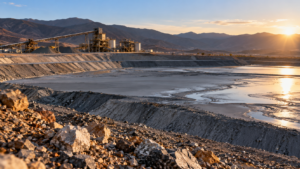
The Pela Ema rare earths operation is located in Minaçu, in Brazil’s Goiás state.

USA Rare Earth has secured a package of U.S. government-backed financing and offtake commitments to support its planned $2.8 billion acquisition of Brazil’s Serra Verde rare earths operation, according to company disclosures and Reuters reporting.
The transaction would give USA Rare Earth control of the Pela Ema mine and processing plant in Goiás, one of the few commercial-scale sources outside Asia producing the magnetic rare earth elements neodymium, praseodymium, dysprosium and terbium.
The U.S. International Development Finance Corp. has committed $565 million in financing for Serra Verde, while the Department of War has agreed to invest $750 million in a special-purpose vehicle that will purchase the project’s production under a 15-year offtake arrangement.
The commitments are intended to strengthen a supply chain serving permanent magnet manufacturing, defense equipment, electric vehicles, wind turbines and other industrial applications.
More Read

Acquisition combines cash and shares
USA Rare Earth’s agreement values Serra Verde at approximately $2.8 billion. The consideration includes $300 million in cash and 126.849 million newly issued USA Rare Earth shares, according to the company’s announcement.

The acquisition is expected to close in the third quarter, subject to customary closing conditions and regulatory approvals.
The transaction would expand USA Rare Earth’s existing strategy of linking upstream mining and processing with downstream magnet manufacturing in the United States. The company has also disclosed up to $1.6 billion in potential equity and debt support from the U.S. Department of Commerce under nonbinding letters of intent announced earlier this year.
More Read

That support is separate from the DFC financing and Department of War investment tied to Serra Verde’s production.

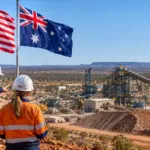
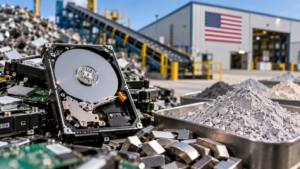
Processing equipment at a rare earths operation modeled on the Pela Ema project.
DFC financing targets mine expansion
The $565 million DFC package is intended to fund optimization and expansion work at the Pela Ema mine and processing plant through the operation’s ramp-up to positive cash flow.
Serra Verde entered commercial production in 2024. The company says the operation is expected to produce 6,400 tonnes of rare earth oxides annually by the end of 2027, with a planned mine life of 25 years.
The Pela Ema deposit is an ionic-clay rare earths project. Unlike many hard-rock rare earth deposits, ionic-clay operations can use relatively shallow mining and leaching processes to recover the contained elements.
Serra Verde says the deposit does not require the production of conventional wet tailings. The project also draws grid electricity with a significant renewable component, according to information published by the company.
The DFC financing is significant because it links U.S. development finance directly to an operating rare earths asset rather than a greenfield project still awaiting construction. The funding is expected to support production growth, plant optimization and associated infrastructure.
The financing also reflects Washington’s effort to diversify critical mineral supply away from concentrated Asian processing and refining networks.
Department of War backs long-term offtake
The Department of War’s $750 million investment will capitalize a special-purpose vehicle established to purchase 100% of Serra Verde’s Phase 1 production of the four magnetic rare earth elements.
The commitment was increased from an originally contemplated $500 million, according to reporting on the transaction. The SPV is being capitalized with an overall target of $1.55 billion.
The structure is designed to provide Serra Verde with a long-term buyer while giving U.S. government-backed entities access to material required for strategic manufacturing.
In addition to the Department of War investment, a Tier 1 institutional bank has issued a commitment letter for a senior secured borrowing-base revolving credit facility of up to $500 million. The facility is expected to provide working capital for rare earth purchases.
The U.S. government has also entered into a forward purchase contract for at least $300 million of rare earth products over five years.
Serra Verde support package
| Component | Amount | Purpose |
|---|---|---|
| DFC financing package | $565 million | Mine and processing plant optimization and expansion |
| Department of War SPV investment | $750 million | Capitalization of the long-term offtake vehicle |
| Bank revolving credit facility | Up to $500 million | Working capital for rare earth purchases |
| U.S. government forward purchase | At least $300 million | Purchase of rare earth products over five years |
| Department of Commerce support | Up to $1.6 billion | Potential equity and debt support under nonbinding commitments |
The individual amounts serve different purposes and should not be treated as a single direct subsidy to USA Rare Earth. The DFC financing is tied to the Serra Verde operation, while the Department of War investment and bank facility support the offtake SPV.
Brazil becomes a larger part of U.S. supply strategy
Serra Verde’s Pela Ema operation is located in Minaçu, central Brazil, in an established mining region with road, power and port connections.
The company describes the deposit as one of the largest known ionic-clay rare earth deposits. Its rare earth elements occur in weathered saprolites formed from the underlying Serra Dourada granite.
Serra Verde’s project history records more than 11,000 exploration and drilling holes covering approximately 57,600 meters. Commercial production began after commissioning work that continued through 2023.
The mine’s product mix is particularly important. Neodymium and praseodymium are central to high-strength permanent magnets, while dysprosium and terbium can improve magnet performance at high temperatures. Those characteristics make the four elements relevant to defense systems, aerospace equipment, industrial motors and electric-drive technologies.

Shallow mining and processing infrastructure at a rare earths operation in central Brazil.
The acquisition would therefore give USA Rare Earth access to a producing asset with exposure to both light and heavy magnetic rare earths. It would also add a non-Chinese source of supply to a U.S.-backed procurement structure.
That does not remove the technical and commercial risks associated with the project. USA Rare Earth will still need to manage the integration of Serra Verde, deliver the planned production ramp-up and maintain recovery rates and product quality through expansion.
The transaction is also exposed to permitting, operational, commodity-price and foreign-exchange risks in Brazil. The project’s long-term economics will depend on the performance of the processing plant as well as the ability of the SPV to place material into downstream supply chains.
Mine-to-magnet strategy gains a producing asset
USA Rare Earth has been developing an integrated supply model that spans mining, separation and magnet production. The Serra Verde acquisition would add an operating rare earths mine to that strategy and provide a source of feedstock for future downstream capacity.
The company’s planned U.S. magnet manufacturing activities are intended to address a supply-chain gap between mined material and finished permanent magnets. That gap has become a central focus of U.S. industrial policy as manufacturers seek alternatives to China-centered supply networks.
For Brazil, the transaction would bring additional U.S. government-backed capital into a strategic mining project and potentially support the expansion of rare earths production. For U.S. manufacturers and defense suppliers, the offtake structure offers a longer-term route to material from an operating mine outside Asia.
The immediate test will be execution. Closing the acquisition, completing the planned expansion and delivering the contracted volumes will determine whether the financing structure translates into a durable supply source.
For mining investors and policymakers, the deal provides a notable example of how government capital, commercial lending and long-term offtake agreements are being combined to finance critical mineral assets.
Related coverage
- Rare earths supply chain: Energy Fuels adds mine-to-magnet capacity
- Critical minerals supply chain: 2026 drivers, risks and scenarios
- Autonomous mining technology: Six metrics for deployment readiness
Sources: USA Rare Earth announcement, Reuters, Serra Verde operations, Serra Verde project history, U.S. Department of War release.