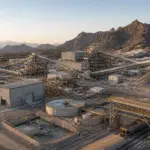
Modern enrichment infrastructure illustrates the processing bottleneck between uranium mining and reactor fuel.

By Penny Langford
The United States is moving to end its dependence on Russian enriched uranium, but the replacement capacity needed to close the gap will not arrive at the same pace as the policy deadline.
Under the Prohibiting Russian Uranium Imports Act, imports of Russian low-enriched uranium (LEU) are scheduled to end on Jan. 1, 2028, subject to limited waivers. The deadline has given utilities, fuel suppliers and governments a fixed target for restructuring a supply chain that has relied on Russian enrichment services for decades.
The challenge is that mining more uranium is only one part of the solution. Reactor fuel also requires conversion, enrichment, fabrication and qualified transportation. The United States has uranium resources and producers, but its commercial enrichment base remains too small to replace Russian supply immediately.

That creates a strategic risk for utilities and a potential opportunity for miners and fuel-cycle companies: provided new processing capacity is commissioned on schedule.

Why enrichment, not mining, is the immediate bottleneck
Uranium is mined and milled into yellowcake before being converted into uranium hexafluoride and enriched. Enrichment increases the concentration of uranium-235 so that the material can be used in most commercial reactors.
The process is measured in separative work units, or SWU. A utility does not simply purchase a quantity of uranium ore; it must secure enough natural uranium, conversion services, enrichment capacity and fuel fabrication slots to support its reactor reload schedule.

The United States currently has roughly 4 million to 5 million SWU of domestic enrichment capacity, primarily at Urenco USA’s facility in New Mexico, according to industry assessments cited in recent reporting. U.S. reactor demand is substantially higher, with estimates ranging from approximately 15.6 million to 20 million SWU annually, depending on the fleet and methodology used.
That means current domestic capacity covers only a portion of national requirements. Russia has historically supplied an estimated 20% to 30% of enriched uranium used in the United States and Europe, while accounting for about 44% of global enrichment capacity, according to figures cited by the U.S. Department of Energy and industry analysts.
A recent CBC News investigation reported that the United States imported about 400 tonnes of Russian LEU in 2025, valued at roughly $1 billion. The shipments included material delivered to fuel suppliers serving U.S. reactors.
The figures explain why the waiver period matters. It is not simply a legal transition. It is a bridge between a large existing supply source and a replacement system that remains under construction.
The waiver provides time, but not certainty
The U.S. uranium import ban took effect in August 2024, but the legislation allows the Department of Energy to issue waivers when no viable alternative source is available or when imports are considered in the national interest.
Those waivers are scheduled to end by January 2028. The arrangement gives utilities additional time to qualify alternative suppliers, adjust procurement portfolios and secure fuel inventories. It also gives enrichment companies a limited window to bring capacity online.
The timing, however, creates a potential mismatch:
- Russian supply is expected to fall sharply as the waiver deadline approaches.
- Existing U.S. enrichment capacity is insufficient to replace the full volume.
- New domestic facilities require licensing, construction, commissioning and customer qualification.
- Allied enrichment capacity will also be competing to serve utilities in Europe, North America and other markets.
An assessment published by ResearchAndMarkets argues that rebuilding the U.S. nuclear fuel cycle will require coordinated investment across mining, conversion, enrichment, fuel fabrication and advanced fuel production. The report also highlights the importance of long-term contracts because enrichment projects need predictable demand before companies can commit large amounts of capital.
Timeline: from Russian dependence to a broader supplier base
| Period | Development | Supply-chain significance |
|---|---|---|
| 2024 | U.S. ban on Russian LEU imports takes effect, with waiver authority | Policy shifts from dependence management toward supply diversification |
| 2025–2027 | Waivers allow qualifying Russian LEU imports to continue | Utilities use remaining time to secure non-Russian supply and manage inventories |
| Jan. 1, 2028 | Scheduled end of Russian LEU waivers | Potential disruption if allied and domestic capacity cannot cover the shortfall |
| Late 2020s | Urenco, Orano and other allied suppliers expand or redirect capacity | Imports from trusted partners are likely to bridge part of the gap |
| Around 2029 and beyond | Centrus and other U.S. projects are expected to add production | Domestic enrichment begins to expand, although commercial scale remains gradual |
| Early 2030s | DOE-supported projects from Centrus, Orano Federal Services and other developers may reach larger output | New capacity could reduce reliance on foreign enrichment if projects remain on schedule |
| Mid-2030s | Further expansion at Urenco USA and other facilities may become available | U.S. supply resilience improves, but the market remains dependent on execution |
The table reflects announced or assessed timelines rather than guaranteed production dates. Enrichment projects face the same risks common to major mining and industrial developments: permitting delays, cost inflation, equipment supply constraints, financing requirements and workforce shortages.
Urenco ramp-up helps, but does not close the gap alone
Urenco USA’s Eunice, New Mexico, facility is currently the largest commercial enrichment operation in North America. Its existing capacity is estimated at approximately 4.3 million to 4.8 million SWU per year.
Urenco has announced plans to expand the facility by roughly 2.1 million SWU annually between 2032 and 2036. If completed, the expansion would materially strengthen North American supply, but much of that capacity is scheduled for after the 2028 waiver deadline.
Urenco’s European facilities are also important to the transition. Additional output from enrichment plants in the United Kingdom, Germany and the Netherlands could help supply U.S. utilities through allied imports, even though that material would not be produced domestically.
This distinction matters for policymakers. A supply chain can become less exposed to Russia without becoming fully domestic. In the short term, the United States is likely to rely on a combination of domestic production and allied capacity rather than a single national source.

Large-scale enrichment requires long lead times, specialized equipment and strict operating controls.
Centrus and Orano point to the later phase of the build-out
Centrus Energy is producing high-assay low-enriched uranium, or HALEU, at a demonstration facility in Ohio under a U.S. Department of Energy contract. HALEU is intended for several advanced reactor designs, but it is not a direct substitute for the bulk LEU used by the existing commercial fleet.
Centrus has also outlined plans for additional enrichment capacity in Ohio, with commercial-scale output expected later than the 2028 cutoff. The company’s expansion is therefore strategically important, but it is unlikely to eliminate the near-term transition risk on its own.
Orano is pursuing a parallel path. The French company has established enrichment operations in Europe and is associated with U.S. plans to rebuild domestic fuel-cycle capability. Orano-linked European production may help supply U.S. utilities before its U.S. projects reach large-scale output.
The U.S. Department of Energy’s domestic LEU program is designed to support both conventional LEU and HALEU capacity. DOE has also announced a broader funding package intended to restore U.S. enrichment and fuel-cycle infrastructure.
The policy objective is clear, but the commercial test will be whether projects progress from awards and demonstrations to sustained production.
Implications for utilities
For nuclear utilities, the main risk is not necessarily an immediate fuel shortage at every reactor. Utilities plan reloads years in advance and may hold inventories or have existing contracts that extend beyond the waiver period.
The more immediate issue is procurement flexibility.
Utilities may need to:
- Secure longer-term enrichment contracts with Urenco, Orano and other non-Russian suppliers.
- Diversify conversion, enrichment and fabrication providers rather than relying on a single integrated route.
- Review inventory levels and reload schedules as the 2028 deadline approaches.
- Account for higher enrichment and fuel costs if demand for allied capacity rises.
- Track HALEU availability separately from conventional LEU because advanced reactor projects face a different bottleneck.
A tighter market could also increase the value of fuel-cycle certainty. Utilities may accept higher contracted costs in exchange for reliable delivery, qualified fuel designs and clearer exposure to geopolitical restrictions.
Implications for policymakers
Policymakers face a sequencing problem. Ending Russian imports reduces geopolitical exposure, but the transition cannot be completed through sanctions alone.
The most important policy measures are likely to include:
- Stable funding for enrichment and conversion projects.
- Faster but credible regulatory review.
- Support for workforce development and specialized manufacturing.
- Strategic inventories of uranium and enriched material.
- Coordination with European, Canadian and other allied suppliers.
- Clear rules for emergency waivers and national-interest exceptions.
- Support for HALEU without diverting all available resources from conventional LEU.
The supply chain also requires coordination across borders. Canada is a major uranium producer, but its CANDU reactor fleet uses natural uranium and does not require enrichment in the same way as most U.S. reactors. Future Canadian small modular reactors could require enriched fuel, creating an additional regional demand source, as CBC reported in its analysis of North American nuclear fuel supply.
Implications for uranium miners
For miners, the enrichment gap reinforces a central point: additional uranium production does not automatically translate into reactor-ready fuel.
Mining companies may benefit from stronger utility contracting and government efforts to build a more secure fuel cycle. But the value of new uranium output will depend on access to conversion, enrichment and fabrication services.
Producers and developers should therefore monitor:
- Long-term uranium contracting activity.
- Conversion and enrichment capacity available to non-Russian customers.
- Government-backed offtake and inventory programs.
- The commissioning schedules of Urenco, Centrus and Orano projects.
- Demand from advanced reactors requiring HALEU.
- Whether fuel suppliers are willing to sign contracts with new miners before downstream capacity is secured.

Uranium mining is only the first stage in a reactor fuel supply chain that also requires conversion, enrichment and fabrication.
Strategic risk remains through the early 2030s
The United States is attempting to replace a decades-old dependence on Russian enrichment within a few years. Urenco’s existing and planned operations, allied European capacity, Centrus’s Ohio projects and Orano’s expansion plans should improve resilience over time.
The difficult period is the transition.
By January 2028, Russian LEU waivers are scheduled to end, while much of the replacement capacity is expected to arrive in stages through the late 2020s and early 2030s. That makes allied imports, advance contracting and careful inventory planning essential.
For uranium miners, the policy shift creates a stronger strategic case for new production, but it does not remove downstream constraints. For utilities, the priority is securing qualified fuel rather than simply buying more uranium. For policymakers, the test is whether public support produces operating enrichment capacity before the waiver bridge ends.
The uranium supply chain is becoming more diversified, but it is not yet fully resilient. Until new enrichment capacity reaches commercial scale, the gap remains a strategic risk.
Social snippets
LinkedIn:
The U.S. is moving to end Russian enriched uranium imports, but replacement capacity is arriving in stages. Urenco’s expansion, Centrus and Orano projects, allied imports and utility contracting will determine whether the 2028 waiver deadline creates disruption: or a managed transition.
X:
The U.S. uranium supply chain faces a timing problem: Russian LEU waivers are scheduled to end Jan. 1, 2028, while much of the replacement enrichment capacity is expected later. Urenco, Centrus, Orano, utilities and policymakers all have a role in closing the gap.