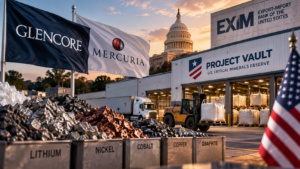
BEIJING — The U.S.-China trade war 2025 entered a more dangerous phase this week as Beijing imposed export controls on a group of critical rare earth elements, raising alarms in Washington and across global supply chains reliant on Chinese minerals.

The Chinese Ministry of Commerce announced Friday it would restrict shipments of seven medium and heavy rare earths—used in everything from missile guidance systems to electric vehicles—effective immediately. The move, widely seen as retaliation for U.S. President Donald Trump’s latest tariff hike on Chinese imports, has intensified fears that China could weaponize its dominance in the rare earth market.
China’s Strategic Use of Rare Earth Controls
China processes nearly 90% of the world’s refined rare earth elements and remains the dominant supplier to the U.S. Between 2019 and 2022, roughly 75% of rare earth imports into the United States came directly from China, according to data from the U.S. Geological Survey.
The export controls announced this week apply to critical materials such as dysprosium, terbium, samarium, gadolinium, lutetium, scandium, and yttrium. Exporters must now obtain government licenses for overseas shipments, effectively tightening the tap on global supply without implementing a full ban.
“The cannons have been loaded, but no one knows where they’re aimed,” said Ryan Castilloux, founder of consultancy Adamas Intelligence. “Restrictions on high-performance magnets could cripple defense and green tech industries in the West.”
Related News
- Platinum Shares Slide After Trump Tariffs—But Bulls See Buying Opportunity
- Australia’s Largest Nickel Sulphide Deposit Emerges in Western Australia
- Golden Valley Mine Commits $600,000 to Solar Energy and Processing Plant Upgrades Amid Gold Price Surge
Rare Earths: The Pressure Point in the U.S.-China Trade War 2025
As tensions mount in the U.S.-China trade war 2025, rare earth elements have emerged as a strategic flashpoint. These metals are essential for technologies ranging from F-35 fighter jets to wind turbines and electric vehicle motors.
More Read

David Merriman, an analyst at Project Blue, noted the scarcity of alternative suppliers: “There is only one major heavy rare earth operation outside of China, Myanmar, and Laos—and it still sends its output to China for processing.”

This bottleneck leaves the West acutely vulnerable. Even countries such as Brazil, which houses the Serra Verde mine, rely on China to handle the complex and environmentally sensitive refining process.
U.S. Vulnerabilities Exposed
Washington has long recognized its dependence on China for critical minerals. The Department of Defense has invested in developing rare earth capacity domestically, but results have been slow. Environmental regulations, permitting challenges, and high costs continue to hinder progress.
Meanwhile, China has steadily tightened its grip. The new export measures follow previous bans on metals like gallium and germanium, essential for semiconductors and telecommunications. In recent months, China exported zero antimony to the European Union, citing “national security” concerns.
“This is no longer just a trade dispute,” said a U.S. defense official familiar with the matter. “It’s a geopolitical standoff playing out through supply chains—and we are not prepared.”
Global Ramifications of China’s Retaliation
Though China’s latest measures don’t target the U.S. exclusively, experts say the global scope of the restrictions is a warning to allies of Washington. The move could prompt European and Asian governments to re-evaluate their exposure to Chinese mineral policy.
“The more China pulls this trigger—even in response to the U.S.—the more other countries will ask: what if we’re next?” said Jacob Gunter, an analyst at the Mercator Institute for China Studies.
Industry analysts expect this development to accelerate diversification efforts. Western nations have been courting mining and refining partnerships in Australia, Canada, and Africa. However, these projects remain years from full production and require substantial investment.
A Trade War Fought with Minerals
The U.S.-China trade war 2025 has evolved beyond tariffs and tech bans. Rare earth minerals—long treated as a technical and niche issue—are now a front-line weapon in a broader economic conflict.
China’s ability to disrupt these critical supply chains underscores how geopolitical power can be exercised through strategic resource control. For the United States and its allies, this latest escalation is a wake-up call.
Unless diversification and domestic production accelerate, Western industries risk deeper entanglement in a conflict where the stakes are no longer just economic—but strategic.