By Charles Pitts

The global copper market is entering a period of significant structural transition, prompting major financial institutions to aggressively lift their price projections for 2026. After years of range-bound trading, a “scarcity premium” is beginning to emerge, driven by a convergence of stagnant mine supply and a surge in demand from high-growth sectors like artificial intelligence (AI) and the energy transition.
Recent research notes from Goldman Sachs, JPMorgan, and Macquarie suggest that the red metal is no longer just a proxy for global industrial health, but a critical bottleneck for the digital and green economy. With consensus averages now clustering around the $13,000 per tonne mark, the industry is bracing for a sustained high-price environment that could redefine the economics of copper mining projects worldwide.
Forecast Summary: The Path to $13,000 and Beyond
Analysts have broadly abandoned the “surplus” narrative that dominated 2024 and 2025 outlooks. Instead, the focus has shifted to localized tightness in refined copper and the inability of mine production to keep pace with accelerating demand.
| Institution | 2026 Copper Price Forecast (USD/tonne) | Outlook Sentiment |
|---|---|---|
| Goldman Sachs | $13,735 (Year-End) | Extremely Bullish |
| Macquarie | $13,165 | Bullish |
| BMI (Fitch Solutions) | $12,700 | Moderately Bullish |
| JPMorgan | $12,600 (Average) | Bullish |
Goldman Sachs has been the most aggressive in its revisions, raising its 2026 average to $13,349/t. The bank cites “tighter-than-expected” global markets outside of the United States and strong US imports as factors that are rapidly absorbing available inventories. While some analysts still model a technical surplus in refined copper for late 2025, the market is increasingly pricing in the inevitable structural deficit that looms in the latter half of the decade.
More Read

Demand Drivers: The AI and Electrification Nexus
The narrative for copper demand has expanded beyond traditional construction and appliance manufacturing. Two primary pillars are now supporting the $13,000 forecast: the rapid expansion of AI data centers and the massive build-out of electrical grids.

1. AI Infrastructure and Data Centers
High-density computing requires an immense amount of electrical capacity. This translates directly to copper consumption through high-capacity cabling, transformers, and the substations needed to power massive data center hubs. Goldman Sachs has highlighted AI and defense as “strategic sectors” that are creating a new price floor for copper. As data centers migrate to more power-intensive AI chips, the copper intensity of these facilities is expected to rise exponentially.
2. Power Grids and the Energy Transition
The global push for decarbonization requires a total overhaul of existing power infrastructure. Transmission lines, renewable energy integration, and the electrification of transport (EVs) are all copper-heavy endeavors. Analysts point to the fact that while electric vehicle sales growth may fluctuate, the fundamental need for grid expansion remains a non-negotiable requirement for net-zero goals, ensuring a steady stream of demand that is less sensitive to short-term economic cycles.
More Read
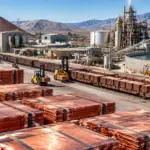

Industrial copper cathodes and high-purity refined wiring ready for industrial application.
Supply Side Risks: Chile, DRC, and Ore Grade Decay
While demand is surging, the supply side of the equation is struggling under the weight of operational disruptions and a lack of new “mega-project” investment.
Chile’s Operational Challenges
Chile, the world’s largest producer, is facing a “perfect storm” of issues. Declining ore grades at legacy mines like those operated by Codelco mean that more rock must be processed to yield the same amount of metal, driving up operational costs. Furthermore, supply chain risks: specifically potential shortages of sulfuric acid used in leaching: could threaten up to 200,000 tonnes of production in 2026.
Disruptions in the DRC and Indonesia
The Democratic Republic of the Congo (DRC) has become a vital source of new supply, yet logistical bottlenecks and geopolitical instability remain persistent risks. In Indonesia, disruptions at the world’s second-largest copper mine, Grasberg, have already forced multiple force majeure declarations in recent years. JPMorgan analysts have noted that underutilization at major sites like Grasberg and production downgrades at Chilean projects like Quebrada Blanca are materially tightening the refined copper balance.

Strategic Implications for Investors and Operators
For mining professionals and investors, the move toward $13,000/t signals a shift in project valuations. Projects that were previously marginal at $8,000 or $9,000 copper are now being reassessed with renewed urgency. However, the lead time for bringing a new greenfield mine online remains 10 to 15 years, meaning that the supply response to these higher prices will not be immediate.
The industry is also seeing an increased focus on geometallurgy and advanced ore processing to maximize output from existing assets. Efficiency gains and autonomous fleet management are becoming essential tools for operators looking to capitalize on high prices while managing the rising costs of deep-level or low-grade extraction.
2026 Outlook: Base, Bull, and Bear Cases
To navigate the volatility, it is essential to consider the different scenarios that could play out over the next 18 months:
- Bull Case ($14,000+): Persistent supply disruptions in Chile and the DRC combine with an AI-driven data center “super-cycle.” If global inventories fall to critical levels (less than 3 days of consumption), a sharp price spike into the $14,000–$15,000 range is possible.
- Base Case ($12,500–$13,500): Structural demand from the energy transition offsets moderate macro-economic headwinds. Mine supply grows marginally but fails to close the gap with refined copper consumption.
- Bear Case ($10,000–$11,000): A severe global recession or a significant slowdown in Chinese industrial activity dampens demand. In this scenario, the market remains in a technical surplus, and prices correct toward historical support levels, though the “green demand floor” likely prevents a collapse below $9,000.

Real-time monitoring and data visualization are critical for optimizing production as market tightness increases.
Conclusion
The consensus among top-tier analysts is clear: the copper market is moving into uncharted territory. The transition from a surplus-driven correction narrative to one of structural scarcity reflects the indispensable role of copper in the 21st-century economy. Whether it is powering the next generation of AI or modernizing global electrical grids, copper remains the essential conductor of progress. For decision-makers in the mining sector, the 2026 forecast isn’t just about a price target; it’s a signal to prepare for a new era of resource constraints and operational complexity.