The critical minerals landscape just got more concentrated. And more expensive. And considerably more geopolitically fraught.

Your finance team is probably modeling copper deficits and lithium price curves. That's table stakes. What they're missing is the strategic calculus that's reshaping capital allocation across the sector in 2026. The Critical Minerals Institute just refined its watchlist from 55 minerals down to 24. That's not a simplification: it's a prioritization signal that every mining CFO should be parsing line by line.
Supply concentration is now the primary valuation risk metric. Not commodity popularity. Not ESG scores. Geographic dependency.
1. The Watchlist Contracted to 24: That's the Signal
The CMI synthesized 12 global critical minerals lists spanning the United States, Europe, NATO, Canada, Australia, Japan, South Korea, India, and New Zealand. The result: 24 strategic minerals that represent actual supply-chain vulnerability, not wishful thinking about what governments want to secure.
This isn't a comprehensive materials list. It's a threat assessment.
More Read

Finance teams treating this as a broad commodity basket are misreading the assignment. These 24 minerals represent the highest-probability supply disruption scenarios over the next 36 months. Model accordingly.


2. Five Minerals (Plus One) Dominate Strategic Exposure
The top tier is clear: Cobalt, Copper, Gallium, Rare Earth Elements, and Uranium. Tungsten sits just outside as the leading candidate for elevation to the top five, according to CMI director Alastair Neill.

These six minerals represent the bulk of sovereign supply-chain anxiety across NATO and Five Eyes countries. Everything else on the watchlist matters. But these six are where the Pentagon, Brussels, and Ottawa are actually deploying capital and regulatory frameworks.
Investment thesis development in 2026 starts here. Diversification beyond these core six requires explicit justification in capital allocation committees.
3. China's Production Dominance Defines the Risk Premium
Supply concentration is the valuation driver, not demand growth forecasts. The numbers are brutal:
- 98% of gallium production originates from China
- Over 80% of tungsten comes from Chinese facilities
- 48-50% of antimony is Chinese-controlled
- Rare earths concentration remains structurally Chinese despite downstream diversification efforts
This isn't a trade policy footnote. It's the central geopolitical pricing mechanism for critical minerals assets in 2026.
Finance teams still modeling these commodities as fungible global markets are underpricing sovereign risk. The geographic premium on non-Chinese production is structural, not cyclical.
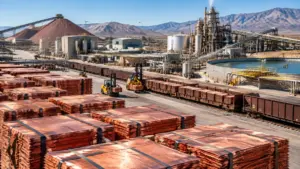
4. Copper Supply Is Already Tightening
Neill's assessment is unambiguous: copper is "essential" for planetary electrification, but "older mines are getting lower grade" while new mine timelines stretch beyond reasonable project finance horizons.

The supply-demand squeeze isn't theoretical. It's happening now. Copper supply deficit projections show an 800-kiloton gap materializing faster than permitting timelines can address.
The uncomfortable reality: you can't disrupt geology. AI data centers need copper. Electric vehicles need copper. Grid modernization needs copper. And the average time from discovery to first production is 16+ years.
Those two clocks don't sync.
5. Tungsten Dependency Just Became a Defense Priority
The last U.S. tungsten mine closed over a decade ago. China, Vietnam, and Russia now dominate production of tungsten carbide: widely used in industrial drilling, defense applications, and manufacturing.
End users are reassessing supply-chain dependency not because tungsten became more useful, but because the geopolitical risk calculus shifted. When your primary suppliers are Beijing, Hanoi, and Moscow, you're not buying a commodity. You're buying exposure.
Domestic tungsten projects in North America are suddenly attracting Pentagon attention and development capital. The technical barriers remain significant. But the strategic premium is undeniable.
6. Uranium Demand Gets Long-Term Structural Support
Small modular reactors (SMRs) are moving from conceptual designs to deployment pipelines in Canada and China. This isn't about traditional nuclear power cycles or uranium spot pricing.
SMRs represent distributed electricity generation to meet AI and data center loads that grid infrastructure can't accommodate on realistic timelines. That's a structural, multi-decade demand driver independent of Uranium prices or traditional nuclear build-out schedules.
Finance teams modeling uranium as a cyclical commodity tied to traditional reactor construction are missing the load-growth story. Data center electricity requirements are rewriting base-load assumptions across the power sector.
7. Pentagon Stockpiling Is Shifting Capital Flows
Defense applications for critical minerals: particularly antimony in military ammunition: are elevating strategic minerals from supply-chain concern to national security mandate.
The Pentagon's acceleration of critical minerals stockpiling isn't subtle. It's targeting domestic assets with "inelastic production profiles" like indium and antimony. Military procurement timelines and pricing mechanisms operate on different economics than commercial markets.
Projects with Pentagon offtake or strategic stockpile agreements are trading at premiums that reflect sovereign buyer certainty, not commodity price forecasts.

8. FORGE Framework Signals Trade Policy Infrastructure
The U.S. launched the Forum on Resource Geostrategic Engagement (FORGE) with 54 country participants. South Korea chairs through June 2026. Bilateral frameworks with Mexico, Japan, and the EU are already operational.
These aren't ceremonial partnerships. FORGE is developing trade policies, border-adjusted price floors, and supply-chain resilience standards that will shape critical minerals flows and financing structures.
Finance teams ignoring multilateral policy frameworks are underestimating how quickly sovereign buyers can reshape market structures. When 54 countries coordinate on strategic materials, commercial spot markets become secondary pricing mechanisms.
9. Silver Remains a Single-List Outlier
The U.S. Geological Survey uniquely designated silver as critical in 2025. No other country's critical minerals list includes it.
CMI views silver as unlikely to gain watchlist inclusion without multi-country consensus. That limits the sovereign supply-risk premium that's driving valuations elsewhere in the critical minerals space.
Silver has industrial applications and monetary value. But it doesn't carry the geopolitical pricing mechanism that's elevating cobalt, gallium, and tungsten assets. Model the distinction.
10. Domestic North American Production Is Accelerating
Companies like GoldHaven Resources confirmed significant indium discoveries: 334 ppm in surface assays: alongside tungsten mineralization and bonanza silver grades in British Columbia. Americas Gold and Silver identified high-grade antimony-silver-copper veins in Idaho with 100+ meters of vertical extent.
This isn't exploration noise. It's policy-driven sovereign supply-chain repositioning creating investment flows into domestic critical minerals assets that wouldn't pencil under pure commodity economics.
The strategic premium on North American production is real. Finance teams need to distinguish between projects that compete on global cost curves versus projects that access sovereign premium pricing through defense, strategic stockpile, or allied-nation offtake agreements.

What Finance Teams Should Monitor Now
Track three leading indicators in 2026:
Geopolitical supply concentration metrics. When China controls 98% of gallium production, that's not a market. It's a sovereign chokepoint. Price your exposure accordingly.
Pentagon stockpiling announcements. Defense procurement timelines operate on certainty premiums, not commodity price forecasts. Follow the defense capital.
Bilateral government frameworks. FORGE and similar multilateral structures are building trade policy infrastructure that will reshape critical minerals flows faster than commercial markets anticipate.
The critical minerals investment thesis in 2026 isn't about picking commodities. It's about identifying which assets access sovereign risk premiums through geographic positioning, defense applications, or allied-nation supply-chain frameworks.
Commercial commodity markets are secondary pricing mechanisms now. The primary pricing mechanism is geopolitical dependency.
Finance teams modeling critical minerals as traditional commodity plays are underpricing the strategic premium: and overestimating their ability to access it without explicit sovereign partnerships.
Welcome to the new reality. Supply concentration is the valuation driver. And there are only 24 minerals that matter enough to make the watchlist.