Why Energy Fuels’ Dysprosium Oxide Production Matters
For the first time in modern history, an American company has produced a kilogram of dysprosium oxide at 99.9% purity on U.S. soil. Energy Fuels dysprosium oxide output was announced this week at the company’s White Mesa Mill in Utah — a milestone that marks the re-emergence of heavy rare earth separation technology in the United States after decades of absence.

Unlike laboratory samples, this is a pre-commercial quantity produced using a demonstration-scale solvent extraction system designed and engineered in-house. That distinction matters. The U.S. once lost its rare earth processing know-how; Energy Fuels has now shown that capability can be rebuilt domestically with American process engineering.
Why Energy Fuels’ Dysprosium Production Stands Apart
In the past two years, several U.S. companies have announced “first dysprosium” achievements. Most amounted to laboratory-scale output using legacy ion-exchange methods that cannot scale economically.
Energy Fuels’ solvent-extraction system builds on proven designs from its light rare earth separation work — positioning it as one of the only U.S. operators with demonstrated separation experience at scale.
By contrast, MP Materials has announced ambitions for heavy rare earth production but has yet to disclose any verified quantities, purities, or process details for dysprosium or terbium. Until those details emerge, Energy Fuels dysprosium oxide production remains the first and only U.S. effort to publicly confirm high-purity output with both material and method on record.
More Read

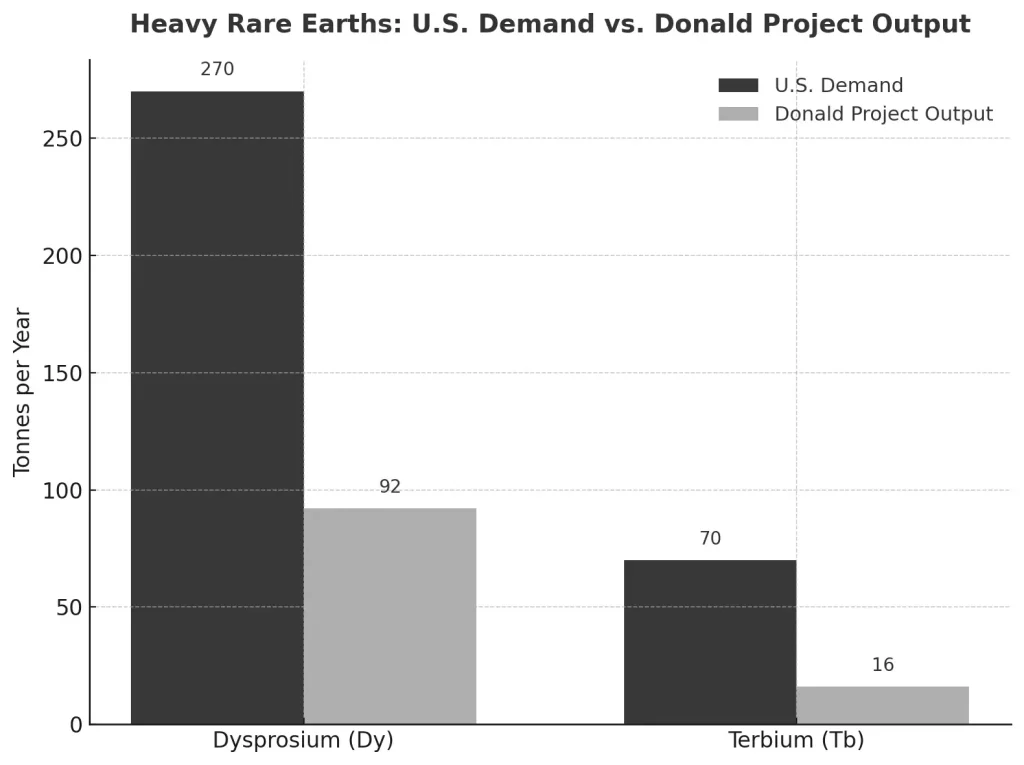
Annual U.S. demand for dysprosium and terbium far exceeds current domestic output. If developed, the Donald project rare earths deposit in Australia could cover roughly one-third of America’s dysprosium needs and nearly one-quarter of terbium demand.

The Structural Challenge: Heavy Rare Earth Feedstock
The achievement is significant, but it also exposes the real bottleneck: America lacks heavy rare earth ore.
- Mountain Pass (MP Materials): Rich in light REEs like neodymium-praseodymium, but with negligible Dy/Tb.
- U.S. mining today: Produces virtually no dysprosium or terbium in meaningful volumes.
Without secure feedstock, even advanced solvent-extraction facilities risk standing idle. This is why Energy Fuels’ future hinges not only on White Mesa but also on its stake in the Donald mineral sands project in Victoria, Australia.
More Read

Donald’s xenotime fraction is unusually rich in heavy REEs, with concentrations of ~2.15% dysprosium and 0.37% terbium (TREO basis) — among the highest known globally. Energy Fuels has secured rights to all monazite and xenotime concentrate from the deposit.
At planned Phase 1 output (~7,100 tonnes of concentrate annually), Donald could yield:
- ~92 tonnes of dysprosium oxide
- ~16 tonnes of terbium oxide
These volumes would cover roughly one-third of U.S. dysprosium demand and nearly one-quarter of terbium demand — a scale unmatched by any other announced domestic effort.
The Competitive Landscape
Energy Fuels is not alone in advancing heavy rare earth separation. Lynas Rare Earths recently produced its first dysprosium and terbium oxides at its Malaysia plant and is building a U.S. heavy rare earth separation facility in Texas with Department of Defense support.
However, Lynas will continue to rely on Australian feedstock. Energy Fuels, by controlling both U.S. processing capacity and access to heavy-enriched concentrate from Donald, could deliver a vertically integrated supply chain — something no other U.S. entity has secured.
By contrast, MP Materials has ambitions for heavy rare earth production but has yet to disclose verified output, while Lynas Rare Earths is advancing a U.S. facility with Department of Defense support. If timelines hold, White Mesa could emerge as the largest American producer of separated dysprosium and terbium oxides by 2027.
Why It Matters
Dysprosium and terbium are indispensable in high-temperature permanent magnets used in:
- Electric vehicle motors
- Offshore wind turbines
- Precision defense systems
Today, over 90% of the world’s supply originates from China. The Energy Fuels dysprosium oxide milestone represents more than a technical proof-point; it signals the potential rebirth of a U.S. heavy rare earth industry.
Today, over 90% of the world’s supply originates from China, according to the U.S. Geological Survey and Department of Energy reports.
By marrying in-house solvent extraction expertise at the White Mesa Mill rare earth separation plant with access to Donald’s heavy-enriched concentrate, Energy Fuels could provide the missing pieces of America’s magnet materials supply chain — technology and feedstock.
Bottom Line
One kilogram of dysprosium oxide does not change markets overnight. But it proves that the capability gap in the U.S. heavy rare earths supply chain is finally being closed. If Energy Fuels delivers feedstock from Donald and scales White Mesa, the U.S. could move from symbolic production to strategic independence in the rare earths that matter most.
Frequently Asked Questions About Energy Fuels Dysprosium Oxide
1. What is dysprosium oxide and why is it important?
2. What did Energy Fuels achieve with dysprosium oxide?
3. Why does this milestone matter for the United States?
4. Where will the U.S. get the raw materials to make dysprosium oxide?
5. How much dysprosium and terbium could the Donald project provide?
6. How does Energy Fuels compare with other companies like MP Materials and Lynas?
Lynas Rare Earths has already produced dysprosium and terbium in Malaysia and is building a heavy rare earth separation plant in Texas with U.S. DoD support.
Energy Fuels stands out by combining U.S. processing capacity with a secured source of heavy-enriched feedstock (Donald project).