By Charles Pitts

The mining landscape in West Africa is undergoing a structural transformation as Ghana, the continent’s leading gold producer, enforces a rigorous localization mandate. By December 2026, the Ghanaian Minerals Commission has ordered major international miners: most notably Newmont, AngloGold Ashanti, and Zijin Mining: to transition their core mining operations to local contractors.
This directive represents a decisive shift from the traditional export-led model that has defined the sector for over a century. Instead of functioning as extraction-and-export hubs, these multi-national operations are now being integrated into a domestic-centric economic framework that prioritizes local ownership, in-country refining, and domestic supply chain resilience.
The December 2026 Ultimatum: Localize or Face Sanctions
For decades, the “Big Three” in Ghana: Newmont (Ahafo North and South), AngloGold Ashanti (Iduapriem), and Zijin Mining (through its local unit): have largely managed their own operations with internal staff and global service providers. However, under revised local ownership rules introduced in early 2025, the Minerals Commission has mandated a strict ownership structure for mining services.
Surface mining operations must now be 100% Ghanaian-owned, while underground mining requires at least 50% local ownership. While many other large-scale operators in the region have already transitioned to contract mining models, Newmont, AngloGold, and Zijin remained outliers. The government’s recent rejection of Newmont’s request for an extension to 2027 underscores the firm stance taken by Ghanaian authorities.
More Read


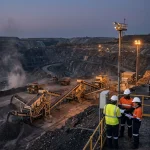
Large-scale open-pit mining operations are now moving toward 100% local contractor management.

Failure to comply with the December 2026 deadline carries heavy risks. The Minerals Commission has signaled that initial violations will result in significant financial penalties, with persistent non-compliance potentially leading to mine shutdowns. This policy is specifically designed to build the capacity of domestic mining service giants such as Rocksure International and Engineers & Planners, ensuring that the high-value technical work of mining stays within the country.
Downstream Sovereignty: The Push for Domestic Refining
Parallel to the localization of mining services is Ghana’s aggressive push for domestic gold refining. The commissioning of the Royal Ghana Gold Refinery in late 2024 and the recent January 2026 agreement with the Gold Coast Refinery have established a domestic ecosystem capable of processing a significant portion of the nation’s output.
More Read

To feed these refineries, the Ghanaian government has begun invoking state pre-emption rights. Under this framework, the state can purchase a minimum of 20% of gold produced by large-scale mining companies. This gold is channeled into domestic refineries to produce 24-carat bars with 99.99% purity, aiming for London Bullion Market Association (LBMA) certification.
By refining gold in Accra rather than shipping raw doré to Switzerland or South Africa, Ghana aims to:
- Retain refining fees: Keeping millions of dollars in processing revenue within the domestic economy.
- Create industrial jobs: Transitioning the workforce from raw extraction to high-tech metallurgy.
- Support the “Gold for Oil” program: Using refined gold as a strategic reserve to stabilize the national currency and secure energy imports.
| Mandate Category | Ownership Requirement | Key Stakeholders |
|---|---|---|
| Surface Mining Services | 100% Ghanaian Owned | Newmont, Rocksure, E&P |
| Underground Mining | ≥50% Ghanaian Owned | AngloGold, Zijin |
| State Gold Acquisition | 20% of Total Output | Bank of Ghana, GoldBod |
| Refining Target | 99.99% (LBMA Standard) | Royal Ghana Gold Refinery |
Operational Impacts and Financial Adjustments
The transition to a localized model is not without its hurdles. For companies like Newmont and AngloGold, shifting from owner-operator models to contract mining involves significant logistical and financial restructuring. Operational costs may see a short-term spike as companies re-negotiate service contracts and invest in the technical training of local partners.
However, the long-term outlook suggests a more stable operating environment. By deeply embedding their operations into the local economy, these companies may mitigate some of the geopolitical risks and community tensions that often plague “enclave” mining projects. The integration of local firms into the supply chain also reduces dependence on international logistics, which proved volatile during recent global supply chain disruptions.

Localizing management and control operations is a key pillar of Ghana’s new mineral policy.
Industry analysts at Skillings Mining Review note that this trend is not isolated to gold. The mandate for local value addition is spreading to critical minerals and other commodities across West Africa. As seen in recent reports on high-grade satellite mine payoffs, the efficiency of the mine-to-market pipeline is increasingly dependent on local infrastructure and political alignment.
Building a West African Regional Hub
Ghana’s strategy extends beyond its own borders. By developing world-class refining capacity and a robust domestic service sector, Accra is positioning itself as the central mining hub for the entire West African sub-region.
The partnership between the Gold Coast Refinery and South Africa’s Rand Refinery provides a technical bridge that could eventually see gold from neighboring Burkina Faso, Mali, and Côte d’Ivoire flowing into Ghana for processing. This “regional hub” ambition is a strategic move for West African mining sovereignty, reducing the continent’s historical reliance on European and North American refineries.

Underground mining technology must now be shared with local partners to meet the 50% ownership threshold.
The Outlook for 2026 and Beyond
As the December 2026 deadline approaches, the global mining community is watching Ghana closely. The success of Newmont, AngloGold, and Zijin in navigating these new mandates will serve as a blueprint for other resource-rich nations in the Global South seeking to reclaim a larger share of their mineral wealth.
For investors and mining professionals, the message is clear: the era of the isolated extraction camp is ending. The future of mining in Ghana: and increasingly across the globe: is one of deep integration, local partnership, and downstream value addition.
For more in-depth analysis on commodity markets and operational developments, visit the Skillings Mining Intelligence newsroom.