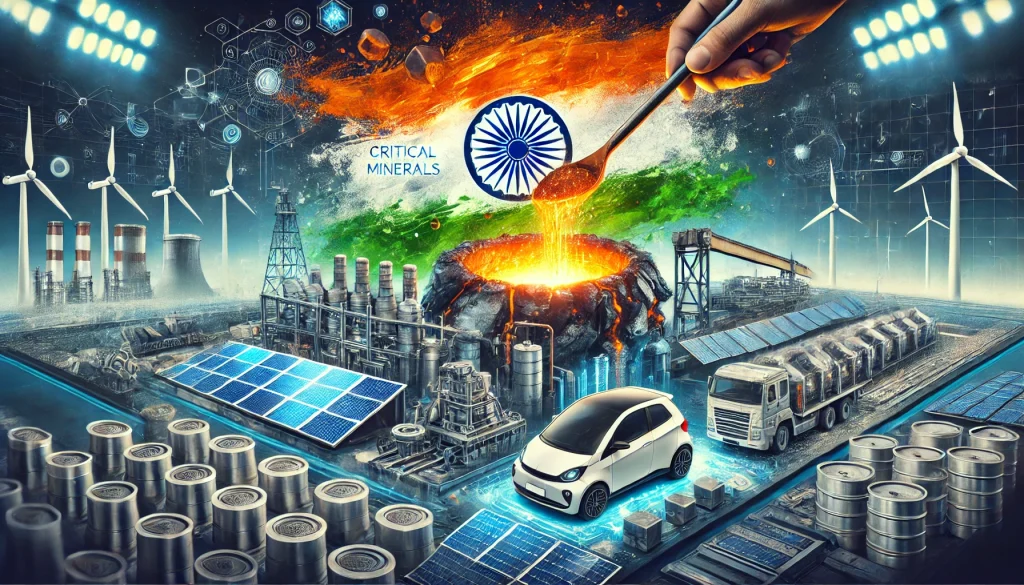
In a significant step to strengthen its critical minerals sector, the Indian government has eliminated customs duty on critical minerals, including waste and scrap of key materials such as antimony, cobalt, tungsten, and copper. This policy shift, announced by Finance Minister Nirmala Sitharaman during the annual Union Budget presentation, aims to secure essential raw materials for domestic industries, promote recycling, and enhance India’s global competitiveness.

The decision is part of India’s broader strategy to achieve self-sufficiency in critical minerals, which are vital for emerging sectors such as electric vehicles (EVs), renewable energy, and advanced manufacturing. By removing import duties, the government seeks to bolster domestic recycling efforts and strengthen India’s industrial base.
Related News
- The Global Nickel Supply Chain: Securing Resources for the EV Boom
- Rare Earth Elements in Greenland: Geopolitics, Arctic Dominance, and Economic Ambitions
- Lithium-Ion Battery Recycling: A Game-Changer in Economic and Technological Stakes
- Nickel Prices Hit Four-Year Low Amid Economic and Supply Challenges
Expanding the Scope: Lithium-Ion Batteries, Lead, and Zinc
In addition to eliminating customs duty on critical minerals, the government has also removed import tariffs on lithium-ion battery waste, cobalt powder, lead, and zinc scrap. This move is expected to provide a cost-effective feedstock to India’s critical mineral recycling industry, enabling domestic companies to compete globally.
By lowering input costs for manufacturers, the government aims to attract investments in secondary production and processing capacities. Industry experts believe that duty-free imports of these materials will significantly reduce reliance on expensive primary minerals, enhance efficiency in India’s recycling sector, and foster a circular economy.
Industry Leaders Welcome the Reforms
The removal of customs duty on critical minerals has been widely welcomed by industry stakeholders, particularly those involved in metal processing and battery recycling. Arun Misra, CEO of Hindustan Zinc Ltd, emphasized that this policy change will be instrumental in India’s transition to a low-carbon economy. He noted that metals are fundamental to modern technologies, and lower input costs will make Indian companies more competitive in international markets.
More Read

The policy shift is also expected to benefit industries engaged in the production of electric vehicles, solar panels, and wind energy components. By reducing costs for essential raw materials, the reform will encourage domestic production, decrease reliance on imports, and strengthen India’s manufacturing ecosystem.

Encouraging Investments in Recycling and Downstream Industries
The elimination of customs duty on critical minerals is expected to drive investments in the secondary metal industry and critical mineral recycling. With lower costs for sourcing recycled raw materials, companies may be more inclined to establish new recycling facilities, leveraging India’s growing industrial demand for these resources.
Additionally, the government is working on a new policy framework to recover critical minerals from mining by-products, further boosting domestic supply. This initiative aims to expand the availability of essential materials, promote sustainable mining practices, and support the country’s growing industrial base.

Aligning with India’s Critical Minerals Strategy
This reform aligns with India’s broader objective of securing access to critical minerals, essential for the country’s economic growth and technological advancement. Recently, the government approved a ₹163 billion investment to develop the critical minerals sector, underscoring its long-term commitment to ensuring a stable supply of these vital resources.
By eliminating customs duty on critical minerals, India is creating a level playing field for domestic recyclers and secondary producers, enabling them to compete with global players. The reforms are expected to boost exports of secondary and downstream products, further integrating India into global supply chains.
Strengthening India’s Competitive Edge
The removal of customs duty on critical minerals marks a pivotal moment in India’s industrial strategy. By lowering the cost of recycled raw materials, the government is not only fostering a more competitive domestic industry but also supporting broader goals of economic growth, sustainability, and energy transition.
As India positions itself as a leader in renewable energy, electric mobility, and advanced manufacturing, these reforms will play a crucial role in securing the country’s long-term industrial and environmental objectives. With a strong focus on recycling, sustainability, and domestic value addition, India is taking decisive steps toward becoming a global hub for critical minerals and clean energy technologies.