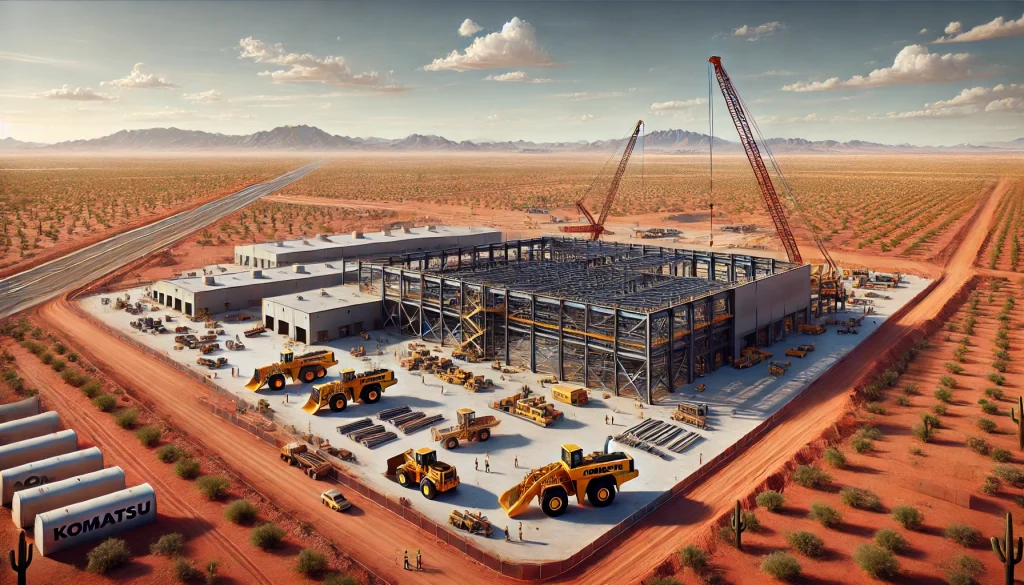
MESA, ARIZ. — Komatsu Ltd., a global leader in mining equipment manufacturing, broke ground this week on a new $80 million, state-of-the-art sales and service facility in Mesa, Arizona. The move signals a decisive bet on the long-term strength of copper demand and Arizona’s fast-growing role in the global critical minerals supply chain.

The 215,000-square-foot facility, scheduled for completion by mid-2026, will triple the company’s existing operational footprint in the region. Strategically located near Phoenix-Mesa Gateway Airport, the project aims to strengthen Komatsu’s position as a key supplier to mining operations across the Southwestern U.S.
“As the copper industry continues to grow, Arizona is at the heart of that momentum,” said Tom Suess, Vice President of Komatsu North America Mining Stores. “Expanding our presence in the Mesa area positions us to support our customers and partners in a region that’s leading the way in critical mineral production.”
Related News
- Australia’s Largest Nickel Sulphide Deposit Emerges in Western Australia
- Golden Valley Mine Commits $600,000 to Solar Energy and Processing Plant Upgrades Amid Gold Price Surge
- Altona Rare Earths Finds High-Grade Gallium as Prices Surge
- Mining Regulatory Clarity Act 2025 Aims to Secure U.S. Mineral Supply Chains and National Security
Arizona’s Role in the Copper Boom
Arizona, already the number one exporting state for mineral ores in the U.S., has emerged as a focal point in the global energy transition. Copper—used in everything from electric vehicles to renewable energy infrastructure—is in high demand, and the state’s production capacity is central to meeting that need.
“We are excited to celebrate the groundbreaking of Komatsu’s new facility in Mesa,” said Sandra Watson, President and CEO of the Arizona Commerce Authority. “Arizona’s mining ecosystem continues to attract investment and innovation.”
Local leaders echoed that sentiment, with Mesa Mayor Mark Freeman touting the city’s investments in infrastructure and business-friendly climate as key drivers in attracting top-tier companies like Komatsu.
Economic Footprint and Job Creation
In addition to reinforcing Komatsu’s service capabilities, the facility is expected to generate tangible economic benefits for the East Valley and beyond. Construction alone will create a wave of short-term jobs. Over the longer term, Komatsu anticipates the addition of up to 100 permanent positions, ranging from technical roles to administrative and logistics support.
More Read

The Mesa facility will house a full suite of capabilities including equipment sales, parts distribution, maintenance services, and machine rebuild operations—catering to a customer base increasingly focused on uptime, supply chain reliability, and ESG compliance.

Strategic Positioning Amidst Global Competition
Komatsu’s investment comes at a time when mining equipment manufacturers are racing to localize services, reduce lead times, and deepen partnerships with major producers. With peers like Caterpillar and Epiroc also scaling up North American footprints, the race to embed operations near critical mineral hubs has become increasingly competitive.
“Proximity to customers isn’t just about convenience anymore—it’s about resilience,” said Victor Brandt, an independent mining supply chain consultant. “If you’re not where the minerals are, you’re falling behind.”
Komatsu’s Mesa expansion also reflects a longer-term pivot: the industry’s reorientation toward supporting electrification, automation, and decarbonization in mining operations. As copper-intensive projects like Resolution Copper and Ivanhoe Electric’s Santa Cruz project advance, equipment providers will need to adapt quickly to next-generation requirements.
More Read
Looking Ahead
With this new facility, Komatsu is positioning itself not just as a supplier—but as a strategic partner in the transformation of American mining. The move underscores how manufacturers are not only reacting to today’s commodity cycles, but preparing for a multi-decade transition toward low-carbon energy systems.
Mesa, long viewed as a logistics outpost, is now being redefined as a cornerstone of the critical minerals economy.