The relentless surge in global demand for electric vehicles (EVs) and portable electronics has catapulted lithium-ion battery recycling into the center of industrial innovation and environmental discourse. As these batteries power a sustainable energy future, their eventual disposal poses critical challenges. The imperative to recycle lithium-ion batteries is no longer optional; it is an economic and technological necessity.

Related News
- Nickel Prices Hit Four-Year Low Amid Economic and Supply Challenges
- Revitalizing the U.S. Uranium Mining Industry: A Strategic Imperative
- Antimony: Alaska’s Emerging Role in America’s Strategic Mineral Supply
- Canada’s Nuclear Future: Can the Nation Become a Uranium Superpower?
- Uganda Calls On Global Miners to Invest in Critical Minerals
The Economic Imperative: Addressing Metal Shortages and Geopolitical Risks
Critical metals like lithium, cobalt, and nickel are the lifeblood of lithium-ion batteries (LIBs), yet their finite availability and geographic concentration pose significant risks. By 2050, the world could face a shortfall of 46.7 million tons of lithium, according to industry forecasts. The economic repercussions of such scarcity would ripple through industries reliant on these metals.
Lithium-ion battery recycling offers a solution by reclaiming valuable materials from spent batteries. It addresses the geopolitical risks of supply chain disruptions, as major reserves of these metals are concentrated in politically volatile regions. As Vipra Joshi et al. note, recycling can transform LIB waste into a “treasure,” reducing dependency on raw material imports and bolstering economic resilience.
Additionally, the economic potential of a circular economy model is immense. The global LIB recycling market is projected to grow to $23.72 billion by 2030. This surge is driven by the dual advantages of cost reduction in battery manufacturing and mitigation of environmental risks.
Technological Innovations in LIB Recycling Technologies
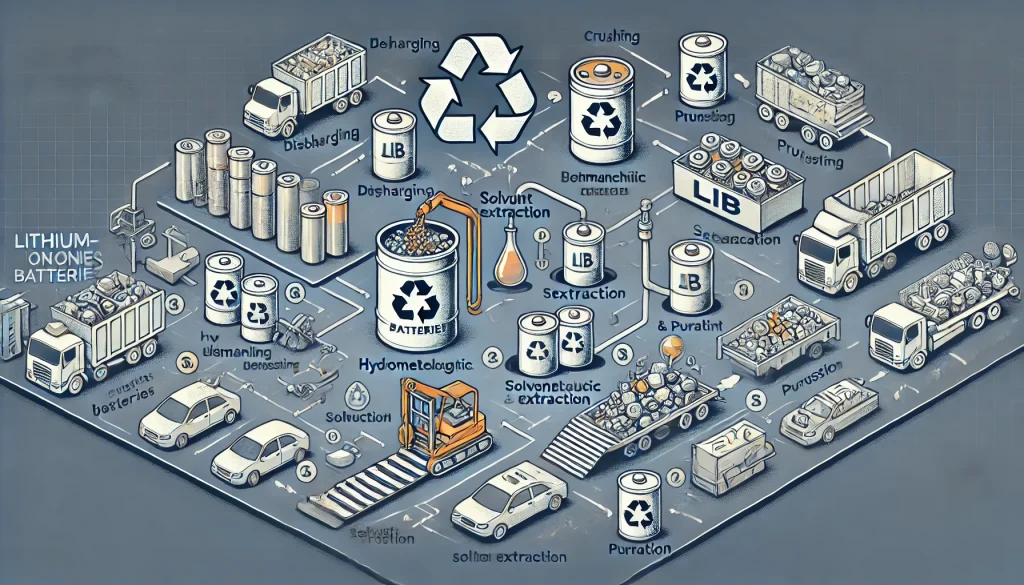
Recycling technologies have evolved to meet the challenge of extracting metals from LIBs efficiently and sustainably. Among these, hydrometallurgy has emerged as a frontrunner, offering high recovery rates with reduced energy consumption compared to pyrometallurgy. By employing acid leaching processes, hydrometallurgy can recover over 99% of lithium and cobalt, making it a cornerstone of LIB recycling technologies.
More Read

Solvent Extraction and Precipitation
Solvent extraction is another innovation that selectively isolates metals from leach solutions. Advanced reagents like Cyanex 272 and Acorga M5640 enable the efficient separation of cobalt, nickel, and manganese. However, challenges persist, including high costs and the complexity of separating these metals in concentrated solutions.

Precipitation techniques further enhance recovery by optimizing pH conditions to selectively precipitate metals like lithium and cobalt. For instance, the use of potassium permanganate to extract manganese as MnO2 exemplifies the precision achievable with modern methods.
Challenges Ahead: Bridging Cost and Environmental Gaps
Despite these advancements, economic and environmental hurdles remain. Recycling processes often demand significant energy and chemical inputs, which can offset their environmental benefits. Moreover, the high costs of developing scalable and efficient LIB recycling technologies deter widespread adoption.

Researchers are exploring eco-friendly alternatives, such as using organic acids for leaching and incorporating biological methods involving microbes. While promising, these innovations are in nascent stages and require further development to compete with established methods.
The Future of Closed-Loop Systems in Lithium-Ion Battery Recycling
The ultimate goal of lithium-ion battery recycling lies in achieving a closed-loop system, where materials from spent batteries are continuously repurposed for new production. This approach not only conserves resources but also aligns with global sustainability goals by minimizing waste and emissions. Companies like Tesla and Redwood Materials are investing heavily in such systems, signaling a transformative shift in the industry.
A Race Against Time
The confluence of economic necessity and environmental responsibility underscores the critical role of lithium-ion battery recycling. As demand for LIBs soars, the urgency to refine and implement innovative LIB recycling technologies intensifies. Industry leaders and policymakers must collaborate to overcome the economic and technical barriers to a circular economy.
Recycling is not just an environmental obligation; it is a strategic imperative for sustaining the industries that rely on these batteries. The question is no longer whether to recycle but how quickly and effectively it can be scaled. As the world accelerates toward an electrified future, lithium-ion battery recycling stands as a cornerstone of both economic security and environmental stewardship.