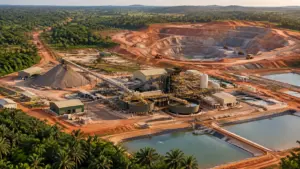
Newmont is writing a very expensive check to prove a point. On February 25, 2026, Argentine Economy Minister Luis Caputo confirmed what the industry had been whispering about for months: Newmont is committing $800 million to the Cerro Negro Expansion 1 (CNE1) project. This isn’t just a maintenance budget. It is a full-scale tactical “double down” on a jurisdiction that, until recently, many Tier-1 miners treated with extreme caution.

The capital will fund the restart and aggressive expansion of the Cerro Negro complex in Santa Cruz Province. For Newmont, the goal is clear: extend the operational life of this asset well beyond 2035 and squeeze every ounce of efficiency out of a mine that has already proven its grade.
But let’s be honest about the timing. This move comes as Argentina undergoes a radical economic restructuring under the Milei administration. Capital is starting to feel brave again. Newmont, flush with a record $7.3 billion in free cash flow from 2025, is the first major to signal that the water is fine.
The $800 Million Calculus
The $800 million figure is substantial, but in the context of Newmont’s 2025 balance sheet, it’s a calculated deployment of liquidity. That $7.3 billion in free cash flow wasn’t a fluke; it was the result of a disciplined pivot toward high-margin Tier-1 assets. By self-funding CNE1, Newmont is bypassing the high-interest debt markets that are currently hammering mining finance teams across the sector.
The strategic calculus here isn’t subtle:
More Read

- Infrastructure Longevity: The investment targets the development of the San Marcos and Emilia deposits.
- Technological Dominance: A significant portion of the capital is earmarked for automation and remote operations.
- Safety and Throughput: Improving operational safety isn’t just about ESG; it’s about reducing the downtime that crippled production in previous cycles.


Why Cerro Negro Matters Now
Cerro Negro isn’t just another pit. It’s a complex of three underground mines: Eureka, Mariana Central, and Mariana Norte: that together form the backbone of Newmont’s South American gold production. The addition of the Emilia deposit, which reached commercial production in late 2022, was the pilot for what we are seeing now.
The CNE1 expansion is designed to synchronize these disparate deposits into a single, high-throughput machine. That’s a needle that’s almost impossible to thread without massive upfront capital. Newmont is betting that by spending $800 million today, they can drive down the All-In Sustaining Cost (AISC) over the next decade.
More Read

In the current market, where central bank gold reserves reached record highs in Q1 2026, owning a low-cost, high-volume producer in a favorable jurisdiction is the ultimate hedge.
The Automation Play: Lessons from the Surface
One of the most telling aspects of the CNE1 announcement is the focus on automated load-haul-dump (LHD) vehicles. These aren’t the experimental prototypes of five years ago. These are units controlled remotely from surface offices, removing personnel from the most hazardous areas of the underground operation.
We’ve seen the industry struggle with the learning curve of these systems before. Our analysis of autonomous haulage lessons from the first 1,000 hours of operation shows that the real gains aren’t just in safety: they’re in the consistency of the duty cycle. Machines don’t take lunch breaks, and they don’t vary their speed based on fatigue. At Cerro Negro, where the underground geometry is complex, automation is the only way to hit the production targets Newmont has promised its shareholders.

The Argentine Political Risk: Real or Overblown?
You can’t talk about $800 million in Argentina without talking about the “Argentina Risk.” For decades, the country has been a graveyard for foreign direct investment, plagued by currency controls and shifting tax regimes.
However, the presence of Economy Minister Luis Caputo at the announcement signals a shift. The Milei government is desperate for Tier-1 mining investment to stabilize the macroeconomy. By positioning Cerro Negro as a flagship for regional development and employment, Newmont is effectively buying political insurance.
The company was recognized as Argentina’s “Mining Company of the Year” in 2022. That’s not just a trophy on a wall; it’s a social license to operate that they have carefully cultivated. In a world where ESG reporting is fundamentally changing how companies access capital, Newmont’s ability to maintain local support while expanding is their most valuable intangible asset.
Operational Timeline and Key Milestones
The expansion isn’t a “flip the switch” event. It’s a multi-year slog. Here is the projected timeline for CNE1 based on current technical reports:
| Milestone | Expected Date | Impact |
|---|---|---|
| Initial Capital Deployment | Q2 2026 | Procurement of automated fleet and long-lead items. |
| San Marcos Development | Late 2026 | Accessing high-grade zones to bolster mill feed. |
| Full Integrated Production | 2027 | Completion of expansion infrastructure. |
| Life of Mine Extension | 2035+ | Finalization of long-term reserve modeling. |
The San Marcos deposit is the key. While Eureka and Mariana have been the workhorses, San Marcos represents the future of the complex’s grade profile. If Newmont hits a snag in the development of San Marcos, the $800 million investment starts to look a lot more expensive.

The Gold vs. Copper Dilemma
There is a broader narrative at play here. While Newmont is doubling down on gold in Argentina, the rest of the industry is obsessed with the 2026 copper deficit. Major players like BHP and Glencore are shunning M&A mania to focus on their copper pipelines.
Newmont’s decision to pour nearly a billion dollars into a gold-primary asset might seem contrarian. But look at the numbers. As the copper supply crisis forces a technology-first approach, gold remains the ultimate liquidity provider. Newmont is using its gold strength to fund its transition into a more diversified major. They aren’t ignoring the copper trend; they are using Cerro Negro to bankroll it.
Risks: The Uncomfortable Truths
No $800 million investment is without “nasty” variables. For Cerro Negro, the risks are three-fold:
- Inflationary Pressures: Argentina’s internal inflation can eat a CAPEX budget for breakfast. If local costs for labor and services spike beyond Newmont’s projections, that $800 million could easily swell to $1 billion.
- Geological Complexity: Underground mining is a battle against the unknown. Any deviation in the vein structures at San Marcos could throttle the expected production rates.
- Regional Competition: With more majors looking at Argentina, competition for skilled technical labor is going to get brutal. Newmont will have to pay a premium to keep the engineers who understand the automated systems they are installing.

The Verdict
Newmont’s $800 million expansion of Cerro Negro is a definitive end to the era of “wait and see” in Argentina. The company is leveraging its record 2025 cash flow to build a high-tech fortress in Santa Cruz.
By focusing on automation and the expansion of the San Marcos and Emilia deposits, Newmont is doing more than just extending the life of a mine. They are setting the blueprint for how Tier-1 miners must operate in 2026: with deep pockets, advanced tech, and a very close relationship with the host government.
This isn’t a gamble; it’s a statement of intent. The mining industry is watching. If Newmont succeeds in de-risking Cerro Negro while maintaining its AISC margins, expect a flood of capital to follow them into the Argentine highlands. But if the “Argentina Risk” bites back, it will be a very expensive lesson in the limits of corporate discipline.
The clock is already ticking on the 2027 full production target. For Newmont, and for Argentina, the stakes couldn’t be higher.