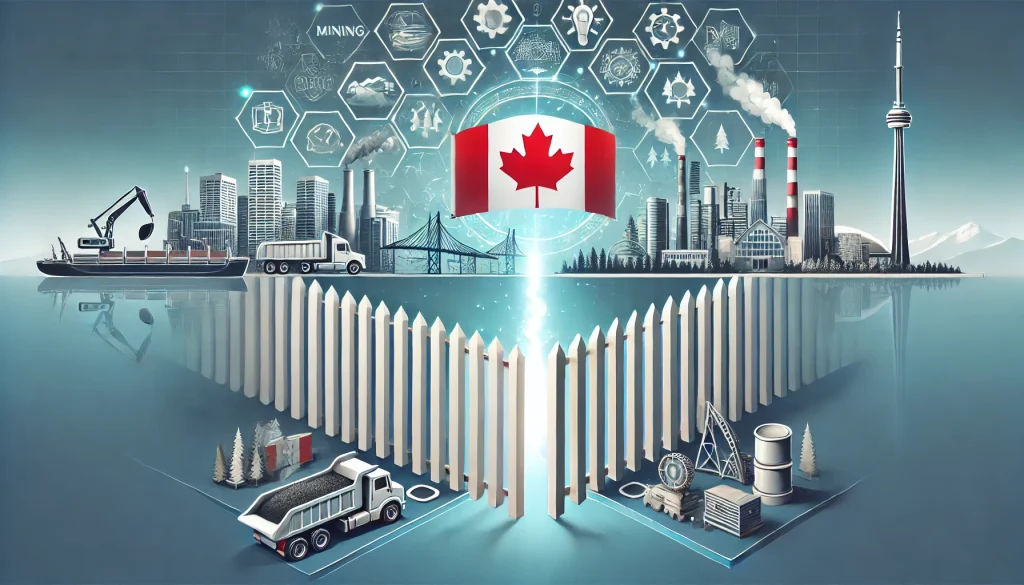
Ottawa’s Trade Barrier Reforms: Progress, But More Work Needed
The federal government is making strides in reducing internal trade barriers, announcing the removal of nearly half of its remaining exemptions under the Canadian Free Trade Agreement (CFTA). While this move signals progress, industry leaders—particularly in mining, forestry, and energy—argue that deeper reforms are essential to unlocking Canada’s full economic potential.

Ottawa’s Efforts to Remove Trade Barriers
The Canadian Free Trade Agreement, introduced in 2017, aimed to streamline trade by eliminating regulatory inconsistencies across provinces and territories. However, lingering exemptions continue to limit its impact.
On Friday, Internal Trade Minister Anita Anand announced that the federal government would cut its list of exemptions from 36 to 19, following last year’s reduction of 17 exemptions. The latest changes primarily affect procurement restrictions but leave key areas like national security and international trade obligations untouched.
“We are all hands on deck to promote freer trade here at home,” Anand stated. “The removal of these federal exceptions is another step toward eliminating barriers to internal trade, reducing costs for Canadian businesses, increasing productivity, and adding billions to the economy.”
Despite these federal efforts, significant barriers remain at the provincial level, particularly in resource-heavy industries like mining, forestry, agriculture, and energy.
More Read

Related News
- How Remote Sensing is Transforming Sustainable Mining
- EU Warns of Counterstrike as U.S. Tariffs Push Steel Prices Higher
- Atlas Copco’s Electric Compressors Power Portugal’s Marble Industry
- Ukraine and the U.S. Partner in the Critical Minerals Sector
How Internal Trade Barriers Impact Canada’s Resource Sectors
Canada’s resource sectors are among the hardest hit by interprovincial trade restrictions. Mining companies operating across multiple provinces must navigate inconsistent permitting, transportation, and environmental regulations. The energy sector faces similar challenges, with differing standards for pipelines, electricity transmission, and natural gas distribution.

A report from the Macdonald-Laurier Institute estimates that internal trade restrictions shrink Canada’s GDP by 3.2% to 7.3%. The Canadian Federation of Independent Business (CFIB) has projected that eliminating these barriers could generate up to $200 billion annually.
“We need a system where a miner in Ontario can access the same regulatory framework as a miner in Alberta—without unnecessary red tape,” said Randall Zalazar, director of government relations at the Canadian Chamber of Commerce. “The lack of harmonization in environmental and safety regulations between provinces creates delays, increases costs, and discourages investment.”
More Read

For example, mining firms transporting minerals across provincial borders must comply with varying licensing rules and royalty structures. Likewise, provinces impose distinct standards on mining equipment, complicating procurement and supply chain operations.
Provinces Show Interest in Reform—But With Caveats
Some provincial leaders have expressed interest in liberalizing trade, albeit with conditions. Nova Scotia Premier Tim Houston announced plans on Thursday to introduce legislation removing certain trade barriers—provided other provinces follow suit.
However, entrenched regional interests continue to pose challenges. For instance, Nova Scotia’s liquor monopoly maintains tight control over alcohol distribution, while other provinces have similar restrictions in the energy and forestry sectors.
While many provinces recognize the economic benefits of free trade, they remain hesitant to relinquish control over industries that generate substantial revenue. “We need a coordinated effort,” Zalazar added. “Provinces must embrace mutual recognition and standardization if we are serious about boosting the economy.”
Why Reducing Trade Barriers Is Crucial Amid U.S. Trade Uncertainty
Canada’s urgency to address internal trade inefficiencies has intensified in light of external trade risks. U.S. President Donald Trump has proposed a 25% tariff on Canadian goods and a 10% tariff on Canadian energy, with a decision expected by March 4.
With 18% of Canada’s GDP dependent on internal trade, maximizing domestic market efficiency is more critical than ever. While Ottawa’s latest reforms are a step in the right direction, industry leaders stress that meaningful change requires provincial cooperation and a comprehensive regulatory overhaul.
For mining, energy, and other resource-heavy sectors, the stakes are high. Without significant reform, internal trade barriers will continue to hinder growth, investment, and competitiveness in an economy already grappling with global uncertainties.