By Penny Laneford

WASHINGTON : The U.S. Department of Defense has finalized a $137 million contract with Lynas Rare Earths Ltd. to secure a multi-year supply of light rare earth elements, specifically Neodymium-Praseodymium (NdPr). The deal, announced Monday, March 16, establishes a four-year procurement window with a guaranteed floor price of $110 per kilogram: a strategic move designed to insulate the U.S. defense industrial base from the volatile pricing and supply-chain dominance of China.
This isn’t just another government purchase order. It is an expensive, high-stakes admission: the United States cannot build a modern military without Australian minerals, and it can no longer afford to let the open market dictate the availability of those minerals.
The $110 Floor: Paying for Sovereignty
Let’s look at the brutal numbers. The Pentagon is committing $137 million over four years. But the kicker is the floor price of $110 per kilogram for NdPr.
To the uninitiated, a floor price might look like a subsidy. To the Pentagon, it’s an insurance policy. By guaranteeing Lynas a price of $110/kg, the U.S. is ensuring that even if China attempts to “flood the zone” and crash global rare earth prices: a tactic they’ve used with devastating efficiency in the past: Lynas remains economically viable and the supply remains domestic (or at least, allied).
More Read

NdPr is the bedrock of high-strength permanent magnets. You find it in the motors of F-35 fighter jets, the guidance systems of precision missiles, and the Virginia-class submarines. Without it, the U.S. military is essentially grounded. The strategic calculus here isn’t subtle: pay a premium now or lose the ability to manufacture later.


The Texas Pivot: A Reality Check on Infrastructure
Perhaps the most telling aspect of this deal is what it isn’t.

Originally, there was significant noise about Lynas establishing a massive refining footprint in Texas. Those plans have hit a wall of construction uncertainties and escalating costs. Instead of waiting for a refinery that might not be ready until the end of the decade, the Pentagon has pivoted to a direct supply agreement.
This shift highlights a growing panic in Washington. We’ve seen similar movements in other sectors, such as the USA Rare Earth consolidation of Round Top, where the focus has sharpened on immediate control over the resource rather than speculative infrastructure timelines.
The reality? You can’t disrupt geology, and you certainly can’t fast-track complex chemical refineries in a high-inflation environment. The Pentagon realized that waiting for a Texas facility was a luxury they didn’t have. They needed the molecules now.
Breaking the Stranglehold
China currently controls nearly 90% of global rare earth refining. For years, the West has talked about “de-risking.” This deal is the first real sign of “de-coupling” in the defense sector.
By locking in Lynas: the world’s largest rare earth producer outside of China: the U.S. is creating a closed-loop system. Lynas mines the material at Mt Weld in Western Australia and processes it through its established facilities. This bypasses the Chinese supply chain entirely.
But here’s where it gets really uncomfortable: $137 million is a drop in the bucket compared to the billions China has invested in its rare earth “magneteering” over the last thirty years.
It’s a start. But is it enough?

Market Implications: The New Uranium?
We are seeing a trend where the Department of Defense acts more like a venture capital firm or a commodity hedge fund than a government agency. This mirrors the AI-energy nexus we’ve analyzed previously, where Big Tech is effectively setting a price floor for nuclear energy to ensure their data centers stay powered.
The Pentagon is doing the same for NdPr. They are creating a “defense floor” for rare earths.
For junior miners and other players in the space, this deal sends a clear signal: the U.S. government is willing to pay above-market rates for supply security. We’ve seen Canada issue similar warnings: that stockpiles are useless without processing infrastructure. The Lynas deal is the American answer to that problem. If you can’t build the processing fast enough, you buy the output of the guy who already has it.

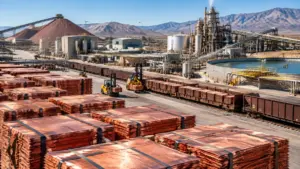
A conceptual visualization of the rare earth supply chain moving from Australian pits to U.S. defense applications, bypassing traditional trade routes.
The Technical Bottleneck
Why NdPr specifically? Neodymium and Praseodymium are the “light” rare earths that provide the magnetic strength required for miniaturized high-performance motors. While the world obsesses over the “green transition” and EVs: something we’ve covered regarding Per Geijer’s rare earth find: the military focus is on high-heat resistance and reliability.
The problem has always been the “wet mill.” Chemical separation of rare earths is a nasty, complex, and energy-intensive process. Lynas has the scars to prove they can do it, having fought through regulatory hurdles in Malaysia for years. The Pentagon isn’t just buying NdPr; they are buying the expertise of a company that has survived the rare earth wars.
What Happens Next?
This deal covers four years. That’s a blip in mining timelines.
The clock is already ticking. By 2030, the demand for NdPr for non-defense applications (like wind turbines and EVs) is expected to double. If the Pentagon is taking $137 million worth of supply off the market now, it tightens the vice for everyone else.
And here’s what makes this particularly nasty for other industries: they don’t have the “national security” budget to pay $110/kg when the market might be sitting at $80. The military is crowding out the commercial sector.
We should expect more of these direct-to-government deals. Whether it’s lithium rebounds in 2026 or uranium targets in Saskatchewan, the government is no longer a passive observer of the commodities market. It is an active, aggressive participant.

The Strategic Summary
The strategic calculus here isn’t subtle. The U.S. has recognized that its “just-in-time” supply chain for critical minerals was a “just-in-case” disaster waiting to happen.
- Price Certainty: The $110/kg floor protects the producer from Chinese price manipulation.
- Volume Security: 4 years of guaranteed supply for the defense industrial base.
- Infrastructure Realism: Abandoning (for now) the immediate hope of a Texas refinery in favor of securing existing allied supply.
Welcome to the new reality. Mining is no longer just about digging holes in the ground; it’s the front line of the 21st-century’s coldest war. The Pentagon just fired its latest shot.
Key Data Points: Lynas-Pentagon Deal
| Metric | Detail |
|---|---|
| Total Contract Value | $137 Million USD |
| Duration | 4 Years |
| Primary Commodity | Neodymium-Praseodymium (NdPr) |
| Guaranteed Floor Price | $110 per Kilogram |
| Strategic Goal | Supply chain diversification away from China |
| Current Status | Active; shift from previous Texas refinery focus |
For more in-depth analysis on the minerals shaping the global defense landscape, visit our Policy & Regulation section.