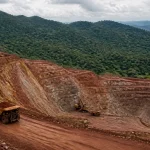
Finsch mine in South Africa’s Northern Cape, where production has been suspended since June.

By Charles Pitts
Petra Diamonds will sell the assets of its Finsch diamond mine in South Africa after creditors approved a business rescue plan that concludes there is no viable path to restarting production.
The decision effectively ends Petra’s operation of the mine, which has been under business rescue since May and suspended production since June. A skeleton workforce will remain on site to secure and reclaim assets ahead of their sale, with proceeds directed first toward creditors according to the ranking of their claims.
The plan was presented to creditors by Finsch’s business rescue practitioners and approved with the required voting thresholds. The practitioners said restarting the mine was not commercially viable under current market conditions, according to Petra’s investor disclosures.
More Read

The outcome represents one of the clearest consequences yet of the prolonged downturn in the natural diamond market. Finsch’s production is heavily weighted toward smaller diamonds, a segment that has experienced sharp price pressure as consumer demand weakened and laboratory-grown stones expanded their share of the market.

Petra has also pointed to the sustained strength of the South African rand, which increased the mine’s cost base in dollar terms and further reduced operating margins.
No viable restart identified
Finsch was placed into business rescue after Petra and its advisers determined that continuing to operate the mine would require funding that could not be justified by expected revenue.
More Read

Business rescue practitioners Daniel Theodorus van Jaarsveld and Luke Bernard Saffy took custodianship of the operation after their appointment. Production was suspended in the week of June 10 while they assessed the mine’s financial position and developed a plan for creditors.
The approved plan is not a turnaround proposal. Instead, it provides for the sale of Finsch’s assets in an effort to maximise recoveries for creditors.
Limited activity will continue at the mine, but it will focus on asset reclamation, preservation and preparation for sale rather than ore extraction. The secured creditor is providing post-commencement funding to support those activities. That funding, together with the secured creditor’s existing claims, will rank ahead of other claims in distributions from the asset-sale proceeds.
A skeleton staff structure will be maintained for the reclamation work. Petra said remaining employment matters would be addressed under Section 189 of South Africa’s Labour Relations Act, which governs consultations and potential retrenchments in cases of proposed operational restructuring.

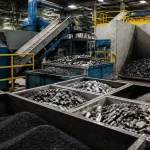
Processing and recovery equipment at a diamond mining operation in South Africa.
Smaller stones under sustained pressure
Finsch has historically been an important source of volume for Petra, producing roughly 2 million to 3 million carats a year. But much of its output consists of smaller diamonds, leaving the mine particularly exposed to the weakest part of the market.
Petra said more than 90% of Finsch’s production is made up of stones below two carats. Prices in that segment have been damaged by weaker consumer demand, inventory pressure through the cutting and polishing pipeline and the growing availability of laboratory-grown diamonds.
The impact was visible in Petra’s tender results. In April and May, Finsch diamonds averaged about $47 per carat, down from approximately $56 per carat in the third quarter, according to figures reported by Miningmx.
That decline matters because a mine’s economics depend not only on the number of carats recovered, but also on the value and distribution of those stones. A high-volume operation can remain under pressure if the average price per carat falls below the level needed to cover labour, energy, maintenance, underground development and other fixed costs.
Petra’s Cullinan mine, which produces a higher-value mix than Finsch, has been directing mining toward areas known to contain more valuable stones. That approach may help protect margins at Cullinan, but it does not resolve Finsch’s structural exposure to smaller diamonds.
Strong rand adds to cost pressure
The market downturn was compounded by currency movements.
Petra generates revenue largely in U.S. dollars, while a significant portion of its South African operating costs is incurred in rand. A stronger rand therefore reduces the local-currency benefit of dollar-denominated diamond sales and raises costs when measured against revenue.
Petra Chief Executive Vivek Gadodia previously described the combination of weak diamond prices and the stronger rand as making Finsch financially untenable. The company has also said it does not expect a material near-term recovery in the value of smaller diamonds.
That assessment narrowed the scope for a production restart. Keeping the mine operating would have required Petra to fund ongoing costs while waiting for a market recovery that management could not reliably forecast.
| Key Finsch business-rescue indicators | Position |
|---|---|
| Production status | Suspended since June |
| Principal product exposure | More than 90% below two carats |
| Recent average tender price | About $47 per carat |
| Earlier comparison | About $56 per carat |
| Approved solution | Asset sale |
| On-site activity | Asset reclamation and preservation |
| Priority for sale proceeds | Secured creditor and other claims by legal ranking |
Source: Petra Diamonds disclosures and Miningmx reporting.
Creditors take priority in asset sale
The creditor-approved plan is designed to preserve whatever value remains in Finsch’s physical assets and recover it through an orderly sale process.
The assets may include mining and processing equipment, infrastructure and other operational property. The value recovered will depend on the condition of the equipment, the cost of removal, available buyers and whether potential purchasers see an opportunity to repurpose the infrastructure.
The business rescue process gives creditors a formal structure for deciding how the operation should proceed. In this case, the conclusion was that selling the assets offered a better prospect of recovery than continuing to fund a loss-making mine.
The secured creditor’s priority reflects both its existing security position and the post-commencement funding provided to keep limited site activity in place. Unsecured creditors and other stakeholders will receive distributions only after higher-ranking claims have been addressed, subject to the applicable legal framework and the proceeds ultimately generated.
For employees and contractors, the decision means that the mine’s future will be centred on closure and reclamation rather than a return to normal production. The consultation process under Section 189 will determine the treatment of affected employees as the staffing requirement declines.

Limited site activity will focus on securing and reclaiming Finsch’s assets.
Wider impact on Petra Diamonds
The Finsch decision comes as Petra manages pressure across its balance sheet and reviews the future of its remaining operations.
Petra reported net debt of about $322 million at the end of its financial year, up from approximately $298 million in the third quarter, according to Miningmx. The company has also secured additional working-capital support, including a R300 million facility, while a lender agreed to defer about $6 million in cash interest payments that had been due in July.
The company has suspended its production guidance for the 2026–2030 period while it incorporates the outcome of the Finsch rescue process and develops a revised plan for its wider business.
That revision is likely to place greater emphasis on cash preservation, mine-level margins and the ability of individual operations to withstand diamond-price volatility. Finsch’s closure removes production volume from the group, but it also eliminates the need to fund an operation whose product mix and cost base no longer support continued mining under current conditions.
The decision also leaves Petra more concentrated around Cullinan, where the company is seeking to prioritise higher-value areas. That may improve the quality of future revenue, but it also increases the importance of operational performance at the remaining mine.

Finsch’s shaft and support infrastructure will form part of the asset-reclamation and sale process.
A test for the diamond market
Finsch’s fate highlights the difficulty of operating mines that depend on a recovery in smaller-stone prices.
Diamond producers have faced a combination of weak retail demand, excess inventory, financing pressure among cutters and polishers, and competition from laboratory-grown alternatives. Those pressures have been uneven across the market, with larger and higher-quality natural stones generally showing greater resilience than commercial-sized goods.
The broader industry has often assumed that diamond downturns would be relatively short. Petra’s decision suggests that producers cannot rely on a quick rebound when the underlying product mix is concentrated in the most pressured segment.
For South Africa’s mining sector, the asset sale will also raise questions about the future ownership and use of Finsch’s infrastructure. A buyer could seek to acquire selected equipment, reopen parts of the operation under a different cost structure or use the site for another mining purpose. But the approved rescue plan itself does not identify a viable restart of Finsch mining.
For now, the mine’s next phase is defined by reclamation, creditor recovery and workforce consultations. The production story has ended; the value-recovery process has begun.
Related: Mining M&A activity is reshaping the resources sector and Skillings Mining Intelligence, covering daily developments across mining markets, operations and finance.