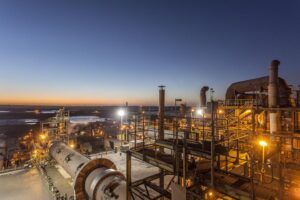
Weardale Lithium has received approval from Durham County Council to develop the UK’s largest lithium extraction facility, marking a significant milestone in the country’s push for domestic battery mineral production. The unanimous decision paves the way for the construction of a state-of-the-art plant in Eastgate, County Durham, transforming a long-dormant industrial site into a key player in the global lithium supply chain.

A Strategic Move for UK Lithium Production
The planned facility will extract battery-grade lithium carbonate from geothermal groundwaters using direct lithium extraction (DLE), an advanced method with a lower carbon and water footprint than traditional mining. Weardale Lithium aims to scale the project to a commercial capacity of at least 10,000 tonnes per year, positioning itself as a major contributor to the UK’s electrification and energy security goals.
The site, previously home to a cement works demolished over two decades ago, offers existing infrastructure and connectivity advantages, enabling a sustainable redevelopment that minimizes environmental and logistical challenges.
A First for the UK: End-to-End Lithium Production On-Site
The Weardale demonstration plant is the UK’s first permitted lithium brine extraction facility designed to produce battery-grade lithium carbonate entirely on-site. By integrating continuous-flow trials, the plant will optimize well performance and DLE efficiency while producing lithium samples tailored for battery manufacturers.
“This project is a game-changer for UK lithium production,” said a Weardale Lithium spokesperson. “Not only does it help secure a domestic supply of a critical mineral, but it also employs an environmentally responsible method.”
More Read

The project holds national significance, as the UK currently relies entirely on imported lithium, primarily from Australia, Chile, and China. A domestic source of battery-grade lithium carbonate could enhance supply chain resilience for the UK’s expanding electric vehicle (EV) and renewable energy sectors.

Economic and Environmental Impact
The facility represents a multi-million-pound investment in the local and regional economy. During the demonstration phase, the project is expected to create 20 to 50 jobs, with full-scale commercial operations projected to generate approximately 125 highly skilled positions. Weardale Lithium estimates the facility will contribute around £1 billion in gross value added (GVA) to the North East region.
Beyond its economic benefits, the project is designed with sustainability in mind. The DLE process, combined with geothermal energy sources where feasible, significantly reduces water and energy consumption compared to traditional lithium extraction methods. Additionally, using pipelines to transport brine to the plant minimizes road traffic and land disruption, further reducing the site’s carbon footprint.
A Step Toward UK Battery Independence
With the UK government prioritizing domestic battery production to support its EV and net-zero targets, Weardale Lithium’s facility aligns with national policy efforts to establish a homegrown supply of critical minerals. The UK’s automotive sector, particularly companies investing in gigafactories, could benefit from a local, sustainable lithium source, reducing dependence on volatile international markets.
The planning approval follows three years of multi-disciplinary research into optimal DLE technologies and geological assessments of the North Pennine Orefield’s geothermal brines. As the UK accelerates efforts to secure its battery supply chain, Weardale Lithium’s project could serve as a model for sustainable lithium production nationwide.
“This facility is a crucial step toward strengthening the UK’s battery materials industry,” said a mining analyst familiar with the project. “If successful, it could pave the way for further lithium extraction projects across the UK, reducing reliance on imports and supporting domestic manufacturing.”
With construction now underway, all eyes will be on Weardale Lithium as it strives to demonstrate that sustainable lithium extraction can be both commercially viable and environmentally responsible.