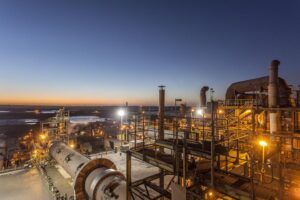
Here’s the uncomfortable truth about rare earth projects outside China: most of them stop at the mining part.

And that’s where the story falls apart for investors. Because digging ore out of the ground is table stakes. The real bottleneck: the part that determines whether a project actually matters: is what happens next. Separation. Refining. Processing the ore into the oxides and metals that manufacturers can actually use.
China controls 91% of that capacity globally. Not mining. Processing.
So when you read headlines about new rare earth discoveries in Australia or Texas or Greenland, the first question should be: where’s the refinery? Because without one, you’re looking at a mine that ships concentrate to China, which defeats the entire geopolitical purpose of building supply chains outside China in the first place.
Let’s talk about who actually has the full pathway: and who’s still missing the most important piece.
More Read

The Processing Gap Nobody Wants to Discuss
Mining rare earth ore is relatively straightforward. It’s dirty, capital-intensive, and faces permitting challenges, but it’s not technically exotic. Companies have been doing it for decades.

Separation and refining? That’s a different game. It requires specialized chemical facilities, technical expertise that’s concentrated in China, and economics that are brutal. Chinese rare earth oxides cost five to six times less than Western-produced equivalents. That’s not a rounding error. That’s a structural cost disadvantage that makes competing nearly impossible without subsidies or captive offtake agreements.

This is why most non-Chinese rare earth projects are mining projects pretending to be supply chain solutions. They’ll produce concentrate. Ship it to China for processing. And call it diversification.
Which is fine if you’re selling a mining story. It’s not fine if you’re solving a strategic supply problem.
Who Actually Has Processing: The Short List
There are exactly three types of rare earth projects outside China that have credible processing pathways: operational facilities with separation capacity, advanced projects with committed refining infrastructure, and recycling initiatives that bypass mining entirely.
Lynas Rare Earths is the only large-scale non-Chinese producer with operational separation capacity. They mine in Australia at Mount Weld, ship concentrate to Malaysia for processing at their Lynas Advanced Materials Plant, and recently added a heavy rare earths processing facility in Western Australia. They’re also building a U.S. processing plant in Texas with Department of Defense funding. That’s a complete pathway: mine, separate, refine, deliver to customer.
MP Materials in California is the other name that matters. Mountain Pass produces rare earth concentrate and has been ramping domestic processing capacity. They’re not at full vertical integration yet, but they’re building it: Stage II processing came online recently, and they’re working toward magnet manufacturing. Critically, they’re not shipping concentrate overseas for separation.
Iluka Resources in Australia has the Eneabba project, which isn’t just another mining story. They’re building an integrated rare earths refinery at Eneabba designed to process monazite into separated oxides. Construction is underway. Completion is targeted for 2026-2027. If they execute, that’s another non-Chinese refining node.
Beyond these, the landscape gets thin fast.
The U.S.-Saudi joint venture on a rare earths refinery represents committed capital toward separation capacity, but it’s early stage. Details on feedstock sourcing and commercial timelines remain unclear. The U.S.-Australia Critical Minerals Framework committed $1 billion to joint production projects, some of which will include processing, but most funded projects are still in development.
Who Doesn’t Have Processing: Almost Everyone Else
The majority of rare earth exploration and development projects outside China are mining-only plays. They’ll extract ore. Produce concentrate. And rely on someone else: usually China: for the refining step.
That’s not inherently bad. Concentrate production is still valuable, and some projects have legitimate plans to add downstream capacity later. But investors need to be clear-eyed about what they’re buying: exposure to mining economics, not strategic supply chain independence.

Greenland, for example, has significant rare earth resources that periodically generate headlines. Projects like Kvanefjeld hold meaningful deposits. But processing infrastructure? Not built. Not financed. Not close.
Canada has multiple rare earth deposits under exploration or development: Saskatchewan, Quebec, Northwest Territories. Some have compelling grades. None have committed separation facilities. The gap between resource announcement and processing capability can be a decade or more, assuming project economics ever pencil.
African rare earth projects face similar realities. Tanzania, Malawi, South Africa all have known deposits. Processing pathways remain hypothetical.
Even projects that talk about building refineries often underestimate the capital intensity and technical complexity. A rare earth separation facility costs hundreds of millions to billions of dollars, requires specialized permitting, and needs sustained offtake agreements to justify the spend. Most juniors can’t finance it. Most majors won’t finance it unless copper or another core commodity is driving the economics.
The Recycling Wildcard
Here’s where it gets interesting: recycling sidesteps the mining-and-processing problem entirely.
Rare earths from end-of-life electronics, magnets, and batteries can be recovered and reprocessed at smaller scale with lower capital intensity than building a greenfield mine and refinery. And because the feedstock is already refined material, you’re skipping the most expensive and technically difficult separation steps.
Redwood Materials in the U.S. is already operational, processing battery materials including rare earths. The UK’s Tyseley Energy Park is another functioning recycling center. Additional commercial-scale mineral recycling facilities across the U.S., Canada, and Europe are scheduled to come online in 2026 and 2027.
This isn’t a full solution: recycling can’t replace primary production at the scale markets need: but it’s a meaningful supplement. And critically, it’s processing capacity that doesn’t rely on shipping concentrate to China.
For investors, recycling plays offer a different risk-return profile: lower capital requirements, faster time-to-market, and insulation from geopolitical supply disruptions. The downside? Lower total production volumes and feedstock dependency on collection networks.

The Economics That Make This Hard
Why don’t more projects build refineries? Because the unit economics are punishing.
Chinese separation facilities benefit from decades of process optimization, lower labor and regulatory costs, and economies of scale that Western facilities can’t match. A new refinery in the U.S. or Australia has to compete on price with Chinese facilities that produce the same oxides at one-fifth the cost.
That’s a math problem you can’t solve with better management or smarter engineering. It requires either subsidies (government funding to close the cost gap) or captive customers willing to pay a premium for non-Chinese supply.
Both are happening: defense contractors and EV manufacturers are increasingly willing to pay more for secure supply chains: but it’s not enough to make every project viable. Most need some combination of government grants, loan guarantees, strategic offtake agreements, and patient capital.
New non-Chinese processing capacity isn’t expected to meaningfully enter the supply chain until 2027. That’s the timeline for projects under construction now. Everything else is further out.
What This Means for Investors
If you’re evaluating rare earth exposure, separate mining projects from processing projects. They’re different businesses with different risk profiles.
Mining-only projects give you commodity price exposure and resource leverage. If rare earth prices spike, concentrate producers benefit. But you’re not solving supply chain diversification, and you’re vulnerable to Chinese processing bottlenecks or export restrictions on refined products.
Integrated projects with processing give you strategic supply chain exposure. These are the names that benefit from government incentives, defense offtake contracts, and the premium customers pay for non-Chinese material. But they’re capital-intensive, face longer development timelines, and carry execution risk.
Recycling plays offer a middle path: faster deployment, lower capex, and immediate processing capability. But they’re scale-constrained and feedstock-dependent.
The cleanest investment thesis? Companies that already have operational processing capacity. Lynas. MP Materials. Iluka when Eneabba comes online. These are the projects that actually matter if you believe Western governments are serious about building rare earth supply chains outside China.
Everything else is a bet on future refining capacity that may or may not get built.
The Reality Check
Here’s the part the press releases skip: building separation capacity outside China is slow, expensive, and economically marginal without subsidies. The projects that succeed will be the ones with committed government funding and locked-in customers willing to pay a premium.
Most rare earth projects outside China are still mining stories. They’ll dig ore. Ship concentrate. And rely on Chinese refineries to turn it into usable material.
That’s not supply chain independence. That’s outsourcing with extra steps.
For investors, the distinction matters. If you’re buying a rare earth stock, know whether you’re buying a mine or a supply chain solution. Because only one of those actually solves the problem everyone’s talking about.