By Sonny Jimerson

For decades, the United States has operated on a hope and a prayer when it comes to graphite. We’ve watched as the lithium-ion battery revolution accelerated, all while remaining 100% dependent on foreign imports for the very material that makes up nearly half the mass of an EV battery.
That era of absolute vulnerability just hit a brick wall in upstate New York.
Titan Mining (NYSE-A, TSX: TII) officially announced on March 11, 2026, that it has commenced shipments of graphite concentrate from its demonstration facility in St. Lawrence County. It isn’t just a corporate milestone; it is the first meaningful domestic production of natural flake graphite in the U.S. in more than a generation.
For an industry that has grown accustomed to “announcements” that never materialize into physical product, this is the real deal. Titan isn’t just talking about a feasibility study: though they have a massive one underway: they are actually putting bags of concentrate on trucks.
More Read
The Numbers Behind the Breakthrough
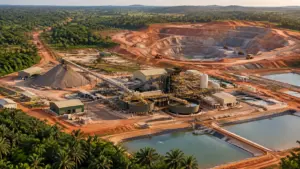
Let’s look at the hard data. The demonstration plant at Titan’s Empire mine site has produced approximately 1,600 kilograms of graphite concentrate to date. These initial batches are destined for customer qualification: the rigorous “prove it” phase where battery manufacturers verify that the material meets the exacting standards required for anode production.

The facility is currently ramping up to its nameplate capacity of 1,200 tonnes per annum (tpa). While that sounds modest compared to global demand, the strategic value is massive. This is a “proof of concept” at industrial scale.
The U.S. currently relies entirely on imports, primarily from China, to meet its graphite needs. That is not a strategic preference; it is a total dependency. In a world where resource nationalism is the new normal, having a domestic tap that actually flows is the difference between a functional supply chain and a stranded industry.
More Read

From Demonstration to Dominance: The 40,000-Tonne Goal
The demonstration plant is only the opening act. Titan Mining has simultaneously launched a fully funded Feasibility Study (FS) for a massive integrated operation at its Kilbourne Graphite Project.
The goal: 40,000 tonnes per annum of integrated mining and processing.
To put that in perspective, Titan believes this single project could eventually supply roughly 50% of the total U.S. demand for natural graphite. That is a staggering figure. It represents a pivot from “zero domestic production” to “significant self-reliance” centered in a single zip code in New York.
| Metric | Demonstration Facility | Full-Scale Kilbourne Project (Target) |
|---|---|---|
| Annual Capacity | 1,200 tonnes | 40,000 tonnes |
| Current Status | Operational / Shipping | Feasibility Study Underway |
| Location | Empire Mine, NY | Kilbourne Project, NY |
| Funding Support | Internal / Customer Offtake | $120M EXIM LOI / FS Funded |
The FS isn’t just a paper exercise. Drilling is already deep into the execution phase. As of the latest update, Titan has completed roughly 82% of its infill drilling and 51% of its exploration drilling. They aren’t guessing where the ore is; they’re mapping the foundation for a multi-decade industrial anchor.
The National Security Calculus
This isn’t just about batteries for high-end sedans. It’s about the 2026 critical minerals scoreboard. Graphite is a tier-one strategic material. Without it, the “Made in America” battery push is an expensive house of cards.
The U.S. government clearly understands the stakes. The Export-Import Bank of the United States (EXIM) has already issued a non-binding Letter of Interest (LOI) for up to $120 million in debt financing. This falls under the “Make More in America” initiative: a clear signal that Washington is tired of being held hostage by overseas supply chains.

The strategic calculus here isn’t subtle: if the U.S. wants to lead the global battery revolution, it cannot outsource the foundation of the anode. China’s recent moves to restrict graphite exports have only sharpened the focus on projects like Kilbourne. Titan Mining is positioned as the primary pressure-relief valve for a market that is currently gasping for air.
The New York Advantage
It’s easy to forget that New York has a deep, albeit sometimes quiet, industrial and mining heritage. By utilizing the existing Empire mine site for the demonstration plant, Titan has managed to bypass many of the “greenfield” headaches that typically kill mining projects before they start.
The infrastructure is there. The workforce is there. Most importantly, the political will to reshore critical industry is finally matching the economic reality.

The integrated nature of the Kilbourne project: combining the mine and the processing facility: is the “secret sauce.” Shipping raw ore is a low-margin game. Producing high-purity concentrate that can go straight into the battery supply chain is where the value lies. Titan is targeting the full vertical, ensuring that the economic benefits stay within the state and the country.
Why This Matters Now
The timing is critical. We are seeing a massive shift in how the US Senate views critical minerals. Legislation is no longer just about environmental protection; it’s about industrial survival.
Titan is currently targeting a final construction decision for the full-scale project in late 2026 or early 2027. If they stick to that timeline, we could see full commercial production beginning in 2027.
But here is the uncomfortable truth: 40,000 tonnes is a lot, but the demand curve for graphite is vertical. As the world moves toward 2030, even a project of this scale will be part of a larger scramble for supply. The fact that Titan is the only end-to-end producer currently putting material in trucks gives them a massive first-mover advantage.

Risks and Realities
No mining project is without its “gotchas.” Titan is operating in a state with some of the strictest environmental regulations in the world. While using a brownfield site (the Empire mine) helps, the full-scale Kilbourne project will require a complex dance of permitting and community engagement.
Then there’s the market risk. While the U.S. is desperate for graphite, the global price is still heavily influenced by Chinese overproduction and potential dumping strategies designed to kill off Western competition before it starts. This is why the EXIM Bank funding and potential offtake agreements with domestic automakers are so vital. They provide a floor in a market that can be notoriously volatile.
Furthermore, the technology for battery anodes isn’t static. While natural flake graphite remains the gold standard, there is constant R&D into synthetic alternatives and silicon-based anodes. However, for the next decade, natural graphite is the undisputed king of the anode market. Titan is betting on the chemistry of today and tomorrow.
The Bottom Line
Titan Mining is doing what many said couldn’t be done: they are producing graphite in the United States.
The 1,600 kilograms already shipped from New York may seem like a drop in the ocean, but in the context of national security and industrial resurgence, it’s a flood. It proves that the “drought” is over.
We’ve spent decades talking about “strategic autonomy.” Titan Mining just stopped talking and started shipping. The Kilbourne project is no longer a “maybe.” It is the most important site in the American critical minerals map right now.
The strategic takeaway: Watch the feasibility study results later this year. If the numbers hold, and the EXIM funding moves from “letter of interest” to “closed deal,” Titan Mining won’t just be a New York success story: it will be the cornerstone of the entire U.S. battery supply chain.