By Salini Krishnan

Mining’s shift from automated trials to commercial-scale autonomy has reached a new threshold. Komatsu has commissioned its 1,000th ultra-class autonomous haul truck, while Vale has brought a 19-truck Komatsu 930E fleet into operation at the Salobo copper mine in Brazil.
The milestones arrive as autonomous haulage expands across commodities, equipment classes and operating regions. EACON is moving toward round-the-clock autonomous operations at Australia’s Havana pit, SANY has shipped its first autonomous electric truck fleet to South America, and major equipment manufacturers are extending autonomy into drilling and underground production.
The result is a more competitive technology market: and a more complicated investment and operating decision for mine owners.
The 1,000-truck milestone changes the debate
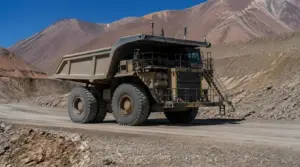
Komatsu’s FrontRunner Autonomous Haulage System has now been used to commission more than 1,000 ultra-class trucks, making Komatsu the first original equipment manufacturer to reach that level, according to the company’s April announcement.
The milestone truck is a Komatsu 930E-5AT electric-drive haul truck with a 290-metric-tonne payload, deployed at Barrick’s Nevada Gold Mines operation in the United States. Komatsu said customers using FrontRunner have collectively moved more than 11.5 billion metric tonnes of material since the system entered commercial service.

Those numbers matter because they place autonomous haulage beyond the pilot stage. A mining company evaluating the technology is no longer asking whether a truck can operate without a driver under controlled conditions. The questions are now more practical:
- Can autonomy deliver higher utilization over a full operating year?
- How does it perform alongside manned equipment?
- What happens when communications fail or a truck requires recovery?
- Does the mine have the workforce, infrastructure and maintenance systems to support it?
- Can the additional productivity reach the crusher and concentrator, or is it lost to another bottleneck?
The answer will differ by mine. But the commercial evidence base is becoming large enough for operators to compare outcomes rather than concepts.

The cost case for autonomy depends on the complete haulage cycle, not the truck alone.
Vale links autonomous haulage to copper growth
At Vale Base Metals’ Salobo copper complex in Pará, Brazil, 19 Komatsu 930E haul trucks are now operating with FrontRunner, according to International Mining.
Salobo is an important test case because the autonomy deployment is connected to a broader production strategy. Vale is targeting approximately a 7% increase in total mine movement, while the Salobo III operation is being expanded through a coarse-particle flotation project expected to add about 6 million tonnes per year of ore-processing capacity.
That creates a direct link between haulage performance and plant economics. More autonomous truck availability has value only if shovels can load consistently, crushers can accept the additional feed and the concentrator can process it. Water, stockpile, maintenance and tailings systems must also keep pace.
Salobo’s wider fleet remains mixed, including Komatsu and Caterpillar haul trucks. That means autonomous vehicles must operate within a mine environment that still contains manually driven equipment, light vehicles, service trucks and maintenance crews.
For mine planners, the deployment therefore represents more than a truck-automation project. It is a test of how autonomous equipment can be integrated into a changing copper operation with multiple machine types and production destinations.
Australia shows the retrofit route
The path to autonomy is not limited to purchasing new ultra-class equipment.
At Western Australia’s Havana pit, EACON has been deploying its ORCASTRA autonomous haulage platform on six retrofitted Komatsu HD1500 trucks. The fleet is associated with Norton Gold Fields, part of Zijin Mining, and mining contractor Thiess.
The project began with controlled autonomous cycles and day-shift production before moving into night operations. EACON has now begun a staged progression toward 24/7 autonomous haulage, including autonomous night shifts in an active open-pit gold operation.
Havana illustrates the appeal of retrofits. An operator may be able to introduce autonomy without replacing an entire truck fleet, allowing the technology to be tested on selected routes or during specific shifts. That can reduce the upfront disruption associated with a full fleet conversion.
The trade-off is integration risk. A retrofit must account for the condition and configuration of existing machines, including braking, steering, drive-by-wire controls, sensors and communications. It also has to fit within local traffic-management rules and the mine’s existing safety case.
The commercial question is whether a retrofit can deliver enough productivity and reliability to justify the cost of installation, supervision, maintenance and system upgrades.
Electric autonomy moves into South America
SANY has added another dimension to the market by shipping its first fleet of SKT110Ei pure-electric autonomous mining trucks to South America.
According to SANY and the company’s announcement carried by PR Newswire, the project includes autonomous vehicles, intelligent dispatching, lifecycle maintenance services and a liquid-cooled dual-gun fast-charging system.
The customer and mine location have not been publicly identified. The shipment is nevertheless significant because it combines two trends that are often discussed separately: electrification and autonomy.
Battery-electric trucks create potential benefits through lower direct emissions, reduced engine noise and improved energy efficiency. They also introduce new operational requirements, including charging capacity, power quality, battery management, cycle planning and emergency procedures.
SANY said it had deployed more than 300 autonomous mining trucks in China before expanding into South America. The overseas project will test whether its technology, service model and charging infrastructure can operate under the conditions of a different mining jurisdiction.
Electric autonomous fleets add charging and power-management requirements to the mine plan.
Autonomy is spreading from haulage to drilling
The next phase of autonomous mining technology 2026 is not limited to haul trucks.
Sandvik and Rio Tinto have entered a partnership to integrate Sandvik’s AutoMine platform with Rio Tinto’s Autonomous Drilling System. The initial focus is on autonomous open-pit support drilling, using Sandvik i-series surface drill rigs and Rio Tinto’s existing remote-operations infrastructure.
The partnership is designed to improve interoperability between systems and enable remote, multi-rig control from Rio Tinto’s Perth Operations Centre. Field trials are expected to follow initial testing and protocol validation.
The significance lies in the move toward mixed-OEM autonomy. Large miners do not want every automation project to create a separate control room, data structure and training requirement. Common interfaces could allow operators to manage equipment from different manufacturers through a more unified architecture.
Epiroc is pursuing a similar expansion underground. The company has extended its Deep Automation platform to cover underground production drilling and rock bolting, alongside autonomous loading and haulage.
For underground operators, the potential benefit is process integration. Automated drilling can improve hole placement and cycle consistency, while automated bolting can reduce personnel exposure near unsupported ground. The challenge is greater variability: underground headings, geological conditions, ventilation, traffic and ground-support requirements can change rapidly.

Autonomous drilling extends the technology race beyond haulage and dispatch.
The commercial scoreboard
The following tracker summarizes the most visible milestones shaping the sector.
| Company or operation | Technology | Reported milestone | Strategic significance |
|---|---|---|---|
| Komatsu | FrontRunner autonomous haulage | 1,000+ ultra-class trucks commissioned | Commercial-scale OEM autonomy |
| Vale Salobo | 19 Komatsu 930E trucks | Autonomous copper haulage live | Links fleet automation with plant expansion |
| EACON Havana | Retrofitted Komatsu HD1500 fleet | Six trucks moving toward 24/7 operations | Demonstrates staged retrofit adoption |
| SANY | SKT110Ei electric autonomous trucks | First fleet shipped to South America | Combines electrification with overseas autonomy |
| Sandvik and Rio Tinto | AutoMine and ADS integration | Joint autonomous drilling development | Tests interoperability across OEM platforms |
| Epiroc | Deep Automation | Underground drilling and bolting added | Extends autonomy into the full production cycle |
The figures are not directly comparable. Komatsu’s number refers to commissioned ultra-class trucks, while SANY’s shipment is a regional project milestone and EACON’s deployment involves a small retrofit fleet. Even so, the pattern is clear: autonomy is becoming a systems market rather than a single-product category.
Investor lens: follow the operating evidence
A Cramer-style stock call would be tempting after a milestone like Komatsu’s. But the more useful approach for investors and analysts is to follow measurable operating evidence rather than react to a headline.
The companies best positioned in this market will likely be those that can demonstrate:
- Repeatable fleet uptime, not only successful demonstrations;
- Low intervention and recovery rates;
- Interoperability across equipment and software systems;
- Strong service and maintenance support near remote mines;
- Cybersecurity and communications resilience;
- Clear workforce-transition plans;
- Documented reductions in cost per tonne, fuel use or safety exposure.
Komatsu has the scale advantage and the largest publicly disclosed OEM milestone. Sandvik and Epiroc are competing for the broader automation layer, where drilling, bolting, loading and haulage are coordinated through a common operating architecture. SANY and EACON are testing whether electric and retrofit models can lower the entry barrier for new customers and regions.
None of that is an automatic investment recommendation. The key risk is that software and automation benefits may be offset by integration costs, network failures, charging constraints, maintenance complexity or bottlenecks elsewhere in the mine.
Costs are being reshaped: not simply reduced
Autonomy can reduce direct labor exposure, improve cycle consistency and support higher equipment utilization. It can also shift costs into software licenses, communications networks, control rooms, sensor maintenance, cybersecurity and specialist training.
That means the most important metric is not whether a truck is driverless. It is whether the mine produces more saleable metal safely and reliably at a lower total cost.
Vale’s Salobo deployment provides a useful framework. The autonomous fleet is being evaluated alongside expanded processing capacity and higher material-movement targets. EACON’s Havana project tests whether retrofits can reach continuous production. SANY is testing the combination of electric haulage and autonomy in a new region. Sandvik, Rio Tinto and Epiroc are extending the model into drilling and ground support.
The 1,000-truck milestone marks the end of autonomy as a novelty. The next milestone will be harder to achieve: proving that connected autonomous systems can reshape the economics of entire mines.
For continuing mining news and technology analysis, see Skillings’ coverage of mining technology, mining operations and copper markets.
Sources
- Komatsu: First OEM to commission 1,000 ultra-class autonomous haul trucks
- International Mining: Autonomous Komatsu 930E fleet goes live at Vale’s Salobo copper mine
- SANY: First autonomous mining trucks shipped to South America
- Sandvik: Partnership with Rio Tinto on autonomous open-pit drilling
- Epiroc: Deep Automation expands to underground drilling
- Skillings: Autonomous mining technology and fleet-scale safety standards