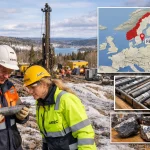
The mining industry is currently staring into a 800,000-ton abyss. Nobody wants to admit it, but the math for the 2026 copper market is fundamentally broken. We are watching a collision between the old world of physical grit and the new world of silicon hunger, and the friction is generating enough heat to melt a balance sheet.
As we dive into the March 2026 issue of the Skillings Mining Review, the narrative isn’t just about supply and demand. It’s about a survivalist divergence in strategy. On one side of the table, you have the boardroom hawks betting on mega-consolidation to bypass the “permitting purgatory” that kills greenfield projects. On the other, you have the tech optimists betting that AI exploration and digital twins can squeeze blood: or rather, metal: from a stone.
Welcome to the 2026 Copper Crunch. This isn’t a drill.
The 800,000-Ton Math Problem
The structural deficit isn’t a “potential risk” anymore; it’s the floor. We are looking at a projected 800,000-ton shortfall. For context, that’s not a rounding error. That’s a crisis.
More Read

The drivers are twofold and relentless. First, the shiny AI revolution. While everyone was busy talking about chatbots, nobody was talking about the wiring. AI data centers are expected to consume approximately 475 kilotons of copper in 2026 alone: a massive 110-kiloton jump from just a year ago. Combine that with the global push for electrification, and you have a demand profile that is vertical.


Meanwhile, the supply side is flatlining. J.P. Morgan is out here projecting prices to average $12,075 per metric ton, peaking even higher in the second quarter. Why? Because mine supply growth has slowed to a crawl: roughly 1.4% growth. That is nowhere near enough to feed the beast. If you want to know how we got here, check out our copper price forecast 2026 for the deep dive on the drivers.
More Read

The Boardroom Play: Buy Your Way Out of Trouble
The first camp of executives has reached a grim conclusion: You can’t wait for a permit. In 2026, the average time from discovery to first production for a copper mine is still hovering between seven and ten years. That’s two full market cycles. If you want copper for the 2026-2030 window, you can’t dig it. You have to buy it.
We’re seeing a wave of M&A that looks less like strategic growth and more like a land grab. This is “mega-consolidation” as a defense mechanism. By acquiring existing assets, majors are securing brownfield expansion opportunities that are already permitted, effectively jumping the line.
But as we’ve seen with the Newmont and Barrick Nevada fallout, these boardroom handshakes are often more fragile than the rock they’re trying to mine. The strategic calculus here isn’t subtle: if you don’t own the copper today, you won’t have the copper tomorrow.

The Algorithm Play: Tech vs. Geology
On the flip side, we have the “Pitfall Algorithms.” This is the camp that believes the 2026 Copper Crunch can be solved through technical optimization rather than just brute-force acquisition.
We’re not just talking about putting a sensor on a truck. We’re talking about:
- AI-Driven Exploration: Using machine learning to identify “blind” deposits that traditional geochemistry missed.
- Digital Twins: Creating real-time virtual replicas of the entire pit to optimize every single blast and haul cycle.
- Metal-Organic Frameworks (MOFs): Radical new chemistry being deployed for trace metal recovery from tailing ponds and low-grade waste.
- Autonomous Fleets: Removing the human element to run 24/7/365 with surgical precision.
The goal? Lower the cutoff grade. If the algorithms can make a 0.3% copper deposit look like a 0.6% deposit through sheer efficiency, the supply gap starts to shrink. It’s an elegant solution. But there’s a catch. You can’t “disrupt” geology. An algorithm can tell you where the copper is, but it can’t build a concentrator overnight.
The Skillings Legacy: 114 Years of Grit
At Skillings, we’ve been tracking these cycles since 1912. We’ve seen the booms, the busts, and the technological leaps that supposedly “changed everything.” The theme for our March 2026 coverage is “The Soundtrack of the Iron Range”: a nod to the rhythmic, industrial heartbeat that has sustained this industry for over a century.
There is a profound irony in the 2026 Copper Crunch. The very AI that is being touted as the “solution” to mining’s efficiency problems is the primary driver of the copper shortage. The “Soundtrack of the Iron Range” is being remixed with the hum of data center cooling fans.

This evolution is part of our 114-year legacy. We’ve always balanced the traditional grit of the miners with the cutting-edge algorithms of the engineers. In 2026, that balance is being tested like never before. The industry is being forced to choose between the boardroom (M&A) and the pit (Tech). The reality? You probably need both to survive the next 24 months.
A Global Chessboard: Geopolitics and Inventory
It’s not just about what’s in the ground; it’s about where it’s going. Inventory levels at the London Metal Exchange and Shanghai Futures Exchange are at record lows. There is no buffer.
And then there’s the geopolitical wild card. By mid-2026, we’re looking at potential U.S. tariffs on refined copper imports. If that goes through, the price divergence between regional hubs will become a canyon. While Mexico deals with its own mining security crisis, and major players like Rio Tinto double down on Quebec, the map of “safe” copper is shrinking.

For more on the macro supply risks, read our updated Copper Forecast 2026. The supply chain isn’t just stretched; it’s fraying at the edges.
What Happens Next?
2026 marks the inflection point where the mining industry realizes it can no longer “business as usual” its way out of a deficit. The 800,000-ton gap is a physical reality that boardroom maneuvers can only hide for so long.
Here is the kicker: even if every single M&A deal closes and every AI algorithm works perfectly, we are still short. The “chickens-coming-home-to-roost” moment for the decade of underinvestment in exploration is finally here.
The companies that win will be those that successfully fuse the “grit” and the “algorithms.” You need the operational excellence to get the rock out of the ground and the technical wizardry to make it profitable at lower grades.
The clock is already ticking. By the time you finish reading the March 2026 Skillings Mining Review, the market will have likely tightened another notch. There’s not enough to go around. Those who didn’t secure their supply yesterday are going to be paying for it, literally: tomorrow.

The soundtrack of the Iron Range is getting louder, but it’s no longer just the sound of iron and copper. It’s the sound of a global scramble for the most critical metal of the 21st century.
Welcome to the crunch. It’s going to be a long year.