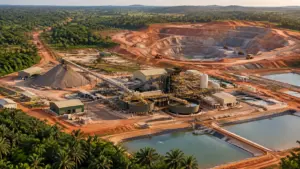
Antimony is the most important mineral you’ve probably never thought about. While everyone else is obsessed with lithium-ion batteries and copper shortages, a much more immediate and dangerous crisis is unfolding in the shadows. It’s not “sexy.” It’s a gray, brittle metalloid that looks like a cheap rock.

But if you like having a functional military, a stable power grid, or electronics that don’t spontaneously combust, you should be paying attention.
The antimony supply crunch isn’t just another market fluctuation. It’s a geopolitical chokehold. As of March 2026, we aren’t just looking at higher prices; we are looking at the potential paralysis of Western defense manufacturing. The numbers are grim, the timeline is tight, and the solutions are: to put it bluntly: years away.
The Strategic Stranglehold
Here is the uncomfortable truth nobody wants to admit: the West has spent decades outsourcing its security to its greatest rival.
China dominates the global antimony market with a level of control that makes the OPEC oil embargo of the 70s look like a minor inconvenience. They produce roughly 40% of the world’s output and control a staggering 70% to 80% of the primary supply. The United States, meanwhile, relies on China for approximately 63% of its antimony imports.
More Read



In August 2024, Beijing started tightening the screws by restricting exports. By December, they effectively slammed the door on shipments to the U.S. This wasn’t a “regulatory adjustment.” It was a declaration that the flow of critical minerals is now a weapon.
If you want to understand why this matters so much, look at what antimony actually does. It’s a primary component in flame retardants used in everything from airplanes to uniforms. It’s used in lead-acid batteries and semiconductors. Most critically, it is essential for ammunition primers, infrared sensors, and precision optics.
More Read

Without antimony, you don’t have a modern military. Period.
A Pricing Chart That Looks Like a Vertical Wall
When supply vanishes and demand stays high, the math is simple and brutal.
At the start of 2024, antimony was trading at roughly $5 per pound. By the end of the year, it hit $10. As we sit here in early 2026, the market has completely decoupled from reality. Prices have surged toward $60,000 per tonne.
That’s not a typo. That’s a 500% increase in a window where production costs for end-users were already being hammered by inflation.
For a procurement officer at a defense contractor or a battery manufacturer, these aren’t just “higher costs.” These are project-killing figures. When the price of a critical input quintuples, your margins don’t just shrink: they evaporate.
The volatility is so extreme that many analysts are predicting $25 per pound as the “floor” for the foreseeable future. We’ve moved past the “rebound” phase we see in other battery metals; this is a structural deficit that price signals alone can’t fix. You can’t just print more antimony. You have to dig it out of the ground, and that takes time.
Domestic Production: The Long Road from Zero
The United States currently has zero active antimony mining operations.
Zero.
We have plenty of it in the ground: specifically in Idaho and Alaska: but having a resource and having a mine are two very different things. The Stibnite Gold Project in Idaho, led by Perpetua Resources, is the white knight everyone is waiting for. But even if everything goes perfectly, it won’t be operational for at least another three years.

Once Stibnite is online, it’s expected to meet only about 35% of U.S. demand during its first six years. That’s a massive help, sure. But it still leaves a 65% hole that we’re currently filling with hopes and prayers.
Sunshine Silver is another bright spot, projecting that their U.S. antimony refinery could supply 40% of domestic demand by 2028 and potentially 80% by 2031. But 2031 feels like a lifetime away when the export bans are happening now.
The disconnect between the “green energy” push and the reality of mining permits is staggering. We want domestic supply, but the regulatory hurdles often take a decade to clear. Ironically, the same people demanding more high-tech weaponry and renewable energy storage are often the ones making it impossible to mine the materials needed to build them.
The $27 Million Band-Aid (and Why It’s Not Enough)
On March 4, 2026, the Department of War (the re-designated Department of Defense under the current administration) announced a $27 million investment for domestic excavation, extraction, and processing of antimony.
In the world of government spending, $27 million is a rounding error. It’s a drop in the bucket compared to the billions being funneled into semiconductor chips or EV tax credits.
However, the signaling is more important than the dollar amount. It shows that the administration has finally realized that mineral security is national security. This follows a trend of reclassifying antimony as a “strategic mineral,” a move designed to fast-track permits and unlock secondary funding.

But let’s be real: $27 million isn’t going to build a refinery. It’s going to fund feasibility studies and early-stage excavation. It’s an admission of the problem, not a solution to it. The “perfect storm” of tariffs, conflict, and supply chain fragility: the same storm JPMorgan predicted for gold: is now centered directly over the industrial metals sector.
The Broader “Rare Earth” Problem
Antimony is the canary in the coal mine. It is the first major casualty of a new era of “resource nationalism” where countries use their geological luck as a diplomatic cudgel.
We saw this coming with rare earth elements, but antimony is arguably more dangerous because its applications are so specific and its substitutes are so inferior. If you run out of neodymium for magnets, you can sometimes use different motor designs. If you run out of antimony for munitions primers, your guns don’t go “bang.”
This isn’t just a U.S. problem. Western governments across the globe are frantically re-evaluating their stockpiles. But you can’t build a stockpile if there’s nothing to buy. The market is currently in a state of “forced conservation,” where only the highest-priority defense projects are getting the material they need.

What Happens Next?
If you’re an investor or an operator in the mining space, the next 24 months will be a period of brutal Darwinism.
- Price Stagnation is Dead: Expect antimony prices to stay elevated and volatile. Any company that has a sniff of domestic antimony production is going to be valued like a tech startup.
- M&A Activity will Spike: Larger mining firms will start looking to gobble up junior explorers with antimony-heavy portfolios. They aren’t buying the cash flow; they’re buying the “strategic insurance.”
- Recycling Becomes Mandatory: We will see a massive push for antimony recovery from lead-acid batteries and electronic waste. It won’t be enough to solve the crisis, but it will be a lucrative niche.
- The Regulatory Pivot: The pressure to bypass environmental “red tape” in the name of national security will reach a fever pitch. We’re going to see a clash between ESG mandates and the Department of War. Guess who usually wins that fight?
The Uncomfortable Reality
Everyone is talking about the antimony supply crunch because it represents the end of an era. The era of cheap, reliable, globalized commodities is over. We are moving into a “balkanized” mining world where who you buy from is just as important as what you’re buying.
The U.S. is currently losing this game. We are three steps behind, and we’re trying to run a marathon with our shoelaces tied together by 20-year-old permitting laws.
The $27 million investment is a start. The Stibnite project is a hope. But until we actually start pulling rocks out of the ground and processing them on our own soil, we are at the mercy of a supplier that has every incentive to see us fail.
Welcome to the new reality of mining. It’s messy, it’s expensive, and there’s not enough to go around.
Social Media Snippet:
China just slammed the door on Antimony exports, and the U.S. has zero domestic mines. Prices are up 500%, and the Department of War is scrambling with a $27M “emergency” investment. Is this the end of the global supply chain as we know it? Read our deep dive on why the Antimony crunch is a national security nightmare. #MiningNews #Antimony #SupplyChain #CriticalMinerals #DefenseIndustry