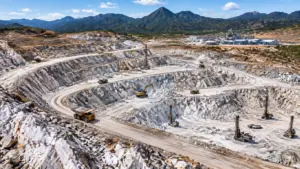
Saudi Arabia has identified an estimated 110 million tonnes of ore containing high concentrations of rare earth elements and promising concentrations of uranium at Jabal Sayid in the Madinah region.

Energy Minister Prince Abdulaziz bin Salman announced the finding during the International Atomic Energy Agency’s General Conference in Vienna on September 14. He said exploration and geological studies at Jabal Sayid had identified the estimated ore resource, with particularly high concentrations of heavy rare earth elements.
The announcement adds a new dimension to Saudi Arabia’s push to expand mining and build domestic critical-mineral supply chains. It also comes as Riyadh deepens cooperation with Washington on critical minerals and civilian nuclear energy.
The 110 million tonnes figure needs context
The 110 million tonnes refers to ore. It does not mean Saudi Arabia has discovered 110 million tonnes of rare earth elements or 110 million tonnes of uranium.
That distinction is important.
More Read

The reported ore contains concentrations of rare earth elements and uranium. The amount that could eventually be recovered will depend on further geological, metallurgical and economic work.

A large ore estimate does not automatically become a commercial reserve. Mining companies must establish the grade, mineralogy, recoverability, processing requirements and project economics before they can determine how much material can be economically extracted.
For now, the announcement points to a large mineralized system with a combination of rare earths and uranium.
More Read
Jabal Sayid has a broader rare-earth profile
The newly reported ore estimate sits alongside earlier estimates of rare-earth and uranium content associated with Jabal Sayid.
According to a Center for Strategic and International Studies analysis citing estimates supplied by Saudi Arabia’s Ministry of Industry and Mineral Resources and state miner Ma’aden, Jabal Sayid is estimated to contain about 552,000 tonnes of heavy rare earths, including dysprosium and terbium, and another 355,000 tonnes of light rare earths, including neodymium and praseodymium. CSIS also cites an estimated 31,000 tonnes of uranium at the site.
Those figures should not be confused with the newly announced 110 million tonnes of ore.
They are separate estimates of mineral content associated with the Jabal Sayid area. The classification and economic recoverability of those materials will be important as Saudi Arabia moves further into exploration and potential development.
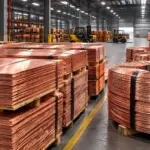
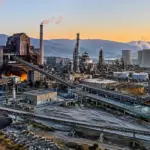
Jabal Sayid is also already an established mining area. The new rare-earth and uranium findings therefore add another mineral dimension to a site better known within the mining industry for its copper operations.
Heavy rare earths make the finding strategically important
The concentration of heavy rare earth elements is particularly significant.
Dysprosium and terbium are used in high-performance permanent magnets and other advanced applications. Their supply is more concentrated than that of many light rare earth elements.
China remains dominant across the rare-earth supply chain. USGS data show that China accounted for more than 70% of global rare-earth extraction and about 87% of processing in its latest country assessment. China also accounted for all reported dysprosium and terbium production in that assessment.
The 2026 USGS Mineral Commodity Summaries lists China’s rare-earth reserves at 44 million tonnes, against a global total of more than 85 million tonnes. It reports Chinese mine production of about 270,000 tonnes in 2025.
That dominance explains why rare-earth projects outside China attract strategic attention even before they reach production.
For Saudi Arabia, however, identifying the minerals is only the first step. The more difficult question is whether the Kingdom can extract, separate and process them competitively.
Saudi Arabia is building a wider critical-minerals strategy
Jabal Sayid fits into Saudi Arabia’s broader effort to make mining a larger part of its economy.
Under Vision 2030, the Kingdom has positioned mining as a strategic sector and has invested in geological mapping, exploration, licensing and industrial development. The 2025 Vision 2030 annual report says the estimated value of Saudi Arabia’s mineral resources has risen to more than $2.5 trillion, up about 90% from the 2016 estimate.
Rare earths give that strategy another strategic layer.
Saudi Arabia is also working to build downstream processing capacity. In November 2025, Ma’aden signed a binding term sheet with MP Materials to develop a rare-earth refining and separation facility in the Kingdom. Under the agreement, Ma’aden would hold at least 51% of the joint venture, while MP Materials and the U.S. Department of War, through a joint venture, would hold a targeted 49% equity position.
The planned facility is intended to process, refine and separate rare earth elements using Saudi and international feedstock.
That matters because a mine alone does not create a complete rare-earth supply chain. Separation and refining determine whether mineral resources can be converted into the materials required by manufacturers.
The China comparison is about processing, not just reserves
Saudi Arabia’s potential has to be viewed against China’s existing position.
China’s 44 million tonnes of reported rare-earth reserves are significant, but reserves alone do not explain its market power. China also has a dominant position in mining, separation and processing.
That distinction matters for Saudi Arabia.
A new deposit outside China does not automatically create an alternative supply source. Saudi Arabia would need to develop the mining, separation and refining capabilities required to turn its geological resources into commercial products.
The planned Ma’aden–MP Materials refinery points in that direction. So does the Kingdom’s wider effort to attract investment into mineral processing and downstream industries.
Uranium adds a second strategic dimension
The uranium component gives the Jabal Sayid finding a separate significance.
Saudi Arabia is developing a civilian nuclear program while also seeking greater cooperation with international partners on nuclear technology and uranium.
In July 2026, the United States and Saudi Arabia signed a peaceful nuclear cooperation agreement and a bilateral safeguards agreement. The U.S. Department of Energy said the agreements provide the legal foundation for a long-term civilian nuclear partnership and include commitments around nuclear safety, security and nonproliferation.
The two countries had already established a framework for cooperation on uranium exploration, mining and milling as part of their broader energy and critical-minerals relationship.
That makes the uranium associated with Jabal Sayid relevant to Saudi Arabia’s wider resource strategy.
It does not, however, mean the reported uranium can immediately be counted as commercial nuclear fuel supply. Further exploration, resource definition, technical evaluation and regulatory work would be required before any such development.
The real test will be development
The Jabal Sayid finding gives Saudi Arabia another potentially important mineral asset. But the geological numbers are only the beginning.
The next milestones will involve grade, mineralogy, recoverability, processing technology, infrastructure and project economics.
Those factors will determine whether the reported mineralization can become a commercial mining and processing operation.
Rare earths present a particular challenge because producing separated elements requires specialized processing. Uranium adds another layer of technical and regulatory requirements.
The strategic opportunity is therefore larger than the headline 110 million tonnes.
Saudi Arabia is trying to move from mineral exploration toward an integrated mining and processing industry. Jabal Sayid now sits at the intersection of that effort, the global drive to diversify rare-earth supply and the Kingdom’s plans for civilian nuclear energy.
The next important milestone will not be another large tonnage figure. It will be evidence that the reported mineralization can move from geological potential to technically viable and economically competitive production.