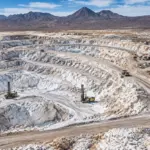
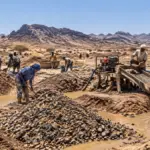
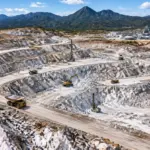
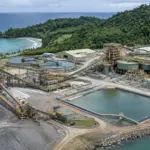
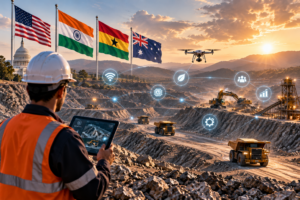
The lithium, cobalt and graphite in a battery can begin their journey on one continent, move to another for processing and reach a battery factory thousands of kilometres away. The real battery map is far more complicated than the label on your phone suggests.
Look at a map of the world’s rare-earth reserves and the picture seems straightforward.
China stands out. Brazil has enormous reserves. India also appears prominently.
But here’s the catch:
More Read
That isn’t the map of your phone’s battery.

Rare earths play an important role in modern technology and electric vehicles, particularly in permanent magnets used in some motors. However, the main supply chains behind lithium-ion batteries follow a different geography.
To understand where a battery really comes from, follow the material through four stages:
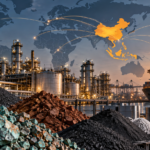
Mine → Refine → Make battery materials → Manufacture the cell
Once you follow that journey, the map becomes much more surprising.
Where do battery minerals come from?
Start with the minerals.
Most lithium-ion batteries use lithium and graphite. Other materials depend on the battery chemistry.
Nickel, manganese and cobalt feature in nickel-based cathode chemistries such as NMC. Lithium iron phosphate, or LFP, uses neither nickel nor cobalt.
That difference matters.
There isn’t one universal battery-mineral supply chain. Instead, several overlapping supply chains begin in different parts of the world.
The first map: where the minerals come from
Lithium connects the battery industry to countries such as Australia, Chile, China and Argentina.
Cobalt points overwhelmingly towards the Democratic Republic of Congo (DRC).
Nickel has become heavily concentrated in Indonesia.
Graphite has a particularly strong connection to China, both for mining and processing.
This is the geological map of the battery.
But it tells only half the story.
The biggest surprise happens after mining
Mining produces the raw material. Battery manufacturers need something much more refined.
Companies must concentrate, purify and chemically process the material before manufacturers can use it in a battery.
That’s where the geography changes.
Consider lithium.
Australia, Chile and China accounted for around 85% of global lithium mining in 2023, according to the International Energy Agency (IEA). China, however, handled almost 65% of lithium refining.
Cobalt shows an even sharper divide.
The DRC produces almost two-thirds of the world’s cobalt, yet China holds a dominant position in cobalt refining.
Nickel follows a different pattern.
Indonesia produces more than half of the world’s mined nickel. The country has also built significant refining capacity, while China remains a major player in nickel processing.
Graphite tells perhaps the clearest story.
China plays a major role in graphite mining and an even larger role in processing the material for battery applications.
The country that mines a mineral does not necessarily control the next stage of the supply chain.
That distinction changes how we should read a critical-minerals map.
A battery is a global relay race
Think of a battery as a relay race rather than a product made in one place.
A mine produces the mineral.
A processing plant concentrates and purifies it.
Chemical companies convert it into battery-grade material.
Manufacturers turn those materials into cathodes and anodes.
Battery factories then assemble the components into cells.
Finally, those cells enter phones, electric vehicles, laptops and energy-storage systems.
The journey can cross several borders before the battery reaches the consumer.
Follow the material
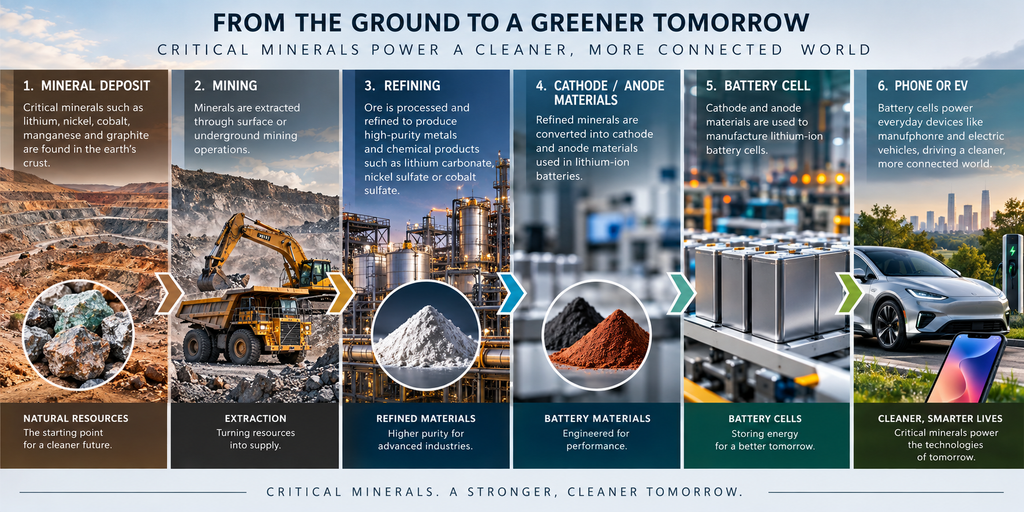
Mineral deposit – Mining – Refining –Cathode / anode materials –Battery cell –Phone or EV
This sequence explains why the phrase “made in” tells only part of a battery’s story. The country printed on a phone box may identify the final assembly location. It doesn’t reveal where the battery’s minerals originated or where companies processed them.
Cobalt shows why chemistry matters
Cobalt provides one of the clearest examples of the relationship between mining and technology.
The DRC accounts for almost two-thirds of global cobalt supply, according to the IEA. That gives the country an important position in the global battery supply chain.
Yet cobalt demand doesn’t depend only on the number of batteries produced.
Battery chemistry matters just as much.
NMC batteries use cobalt. LFP batteries do not.
LFP technology has therefore changed the demand outlook for cobalt. In 2025, LFP batteries represented more than 55% of global EV battery deployment, according to the IEA.
That trend offers an important lesson.
Technology can redraw the mineral map.
A new battery chemistry can reduce demand for one mineral while increasing demand for another.
Indonesia is rewriting the nickel map
Nickel offers another example of how mineral-rich countries can move further down the value chain.
Indonesia now accounts for more than half of global nickel mining. At the same time, the country has invested heavily in nickel processing and battery-related industries.
That strategy changes the economics of the resource.
Instead of exporting raw material, Indonesia can process more of the nickel domestically and capture a larger share of the value created further along the supply chain.
Other mineral-producing countries are watching the same opportunity.
The question is no longer simply:
Who has the mineral?
It is increasingly:
Who can process it, manufacture with it and build an industry around it?
The processing bottleneck
The battery supply chain becomes even more concentrated further downstream.
China accounted for more than 80% of global battery-cell production in 2025, according to the IEA.
The country also produced about 85% of cathode active materials and more than 90% of anode active materials for electric-car batteries.
Those numbers explain why mineral ownership alone doesn’t determine supply-chain power.
A country can possess large mineral reserves without dominating battery manufacturing.
Another country can import those minerals, refine them, manufacture battery components and capture much more value from the finished product.
China’s position across several stages gives it significant influence over the wider battery ecosystem.
That concentration also creates a vulnerability.
If disruption affects a major processing or manufacturing hub, the impact can spread through international supply chains.
Graphite is the quiet giant
Lithium gets most of the headlines.
Cobalt attracts geopolitical attention.
Nickel drives major mining investments.
Graphite receives far less public attention, yet it remains essential to conventional lithium-ion battery anodes.
China dominates important parts of the graphite supply chain, particularly processing and anode-material production. The IEA identifies graphite among the battery materials with highly concentrated supply chains.
That concentration creates another important lesson.
A battery can use minerals from several continents and still depend heavily on one country for a critical processing stage.
The processing map can therefore matter as much as the mining map — and sometimes more.
What about rare earths?
Now return to the rare-earth map that inspired this story.
Rare earths are critical minerals, but they are not the main minerals in a lithium-ion battery.
Elements such as neodymium and praseodymium play an important role in powerful permanent magnets. Manufacturers use those magnets in applications that include some electric-vehicle motors.
That creates two different questions:
What minerals go into the battery?
and
What critical minerals go into the wider electric vehicle?
Those questions have different answers.
A country can hold enormous rare-earth reserves without becoming the world’s leading source of lithium, cobalt or graphite.
The US Geological Survey tracks these mineral markets separately because their geology, production, uses and supply chains differ.
India shows why reserves don’t tell the whole story
India offers a useful example.
The country holds significant rare-earth resources, which gives it an important place on global reserve maps.
But reserves alone don’t create a dominant supply chain.
A country also needs exploration, mining capacity, processing technology, infrastructure, investment and downstream manufacturing.
That distinction applies across the critical-minerals industry.
A deposit creates potential. A mine creates production. A refinery creates processing capacity. A battery factory creates manufacturing capability.
The companies and countries that connect those stages can capture far more value.
Your phone belongs to a much bigger battery economy
Now come back to the device in your hand.
Your phone battery belongs to the same broad lithium-ion ecosystem that supports laptops, electric vehicles and energy-storage systems.
The scale of that ecosystem has changed dramatically.
The IEA estimates that total lithium-ion battery deployment across applications increased more than sixfold between 2020 and 2025. EVs and battery storage now account for around 90% of the lithium-ion battery market.
That growth has transformed batteries from a consumer-electronics story into an industrial and geopolitical story.
Countries now compete not only for mineral resources but also for refining capacity, battery materials, technology and manufacturing.
The next battery map is already changing
The current supply chain won’t remain frozen.
New mines are opening.
Existing producers are moving into refining.
Battery manufacturers are building factories closer to major markets.
Governments are also offering incentives to develop domestic supply chains and reduce dependence on concentrated sources.
Indonesia is expanding its battery-material industries. Morocco has attracted investment into battery and material production. Korea and Japan remain major players in battery components, while Europe and the United States continue to expand domestic battery manufacturing.
However, diversification takes time.
A new mine can take years to develop. A refinery needs major capital and reliable infrastructure. Battery-material production requires specialised technology and customers.
Building a complete supply chain takes even longer.
That’s why today’s map still matters, even as new players enter the industry.
So, where does your phone battery actually come from?
There isn’t one simple answer.
Its lithium may begin in Australia, Chile, China or another producing country.
Its cobalt may originate in the DRC.
Its nickel may come from Indonesia.
Its graphite may come from China or another producer.
Companies can then move those materials to processing facilities in different countries.
Battery-material manufacturers convert them into cathode and anode materials.
A cell manufacturer turns those materials into a working battery.
Another factory may finally install that cell inside a phone.
By the time you hold the finished device, its supply chain may have crossed several borders.
The country printed on the box tells you where the phone was assembled. It doesn’t tell you the full story of its battery.
The map that really matters
For years, the critical-minerals conversation focused mainly on geology:
Where are the deposits?
Today, we need to ask a broader set of questions.
Who mines the material?
Who refines it?
Who produces the battery materials?
Who manufactures the cells?
Who controls the technology and industrial capacity connecting those stages?
Those questions reveal the real structure of the global battery economy.
Mineral resources sit across continents.
Processing capacity remains much more concentrated.
Battery manufacturing is more concentrated still.
That is the surprising map behind the device in your hand.
Your phone may fit in your palm. Its battery supply chain stretches across the world.