Autonomous mining technology is moving beyond pilot fleets, but the electric-haulage story requires more precision than headline deployment numbers suggest.

EACON Mining Technology says its autonomous solution is now deployed on more than 1,500 battery-electric mining trucks, a reported milestone that would make it the largest disclosed autonomous battery-electric fleet in the sector. At the same time, major Western miners remain focused largely on trials, trolley-assisted systems and electric-drive trucks rather than full battery-electric conversion.
The difference matters for operators and investors. Autonomy can improve fleet utilisation, safety and cycle consistency. Battery-electric haulage can reduce fuel use and emissions. But combining the two at mine scale requires charging capacity, resilient communications, new maintenance capabilities and a mine plan designed around energy as well as ore.
The 1,500-truck milestone needs context
EACON’s reported deployment figure is significant, but it is a vendor-reported number rather than an independently audited global industry total.
In an earlier case study, EACON said it operated more than 450 pure battery-electric mining trucks, with more than 5 million kilometres of cumulative operation. It also reported autonomous battery-electric fleets of up to 120 trucks at individual sites.
The company’s later 2026 update describes more than 1,500 battery-electric trucks using its autonomous solution. EACON also reports more than 3,000 autonomous trucks across roughly 40 projects, spanning coal, iron ore, copper, gold and zinc operations.

Those figures should not be directly compared with the global autonomous haulage totals published by individual original equipment manufacturers. Some counts include autonomy-ready trucks, some include diesel-electric trucks and some count equipment deployed across a technology platform rather than trucks owned by one mining company.
The most defensible conclusion is that autonomous battery-electric haulage has reached meaningful commercial scale, particularly in China and in smaller- to mid-sized payload classes. It has not yet replaced conventional diesel-electric ultra-class haulage across the major global mining fleets.
Electric drive is not the same as battery-electric
The distinction is especially important at Vale’s Salobo copper complex in Brazil.
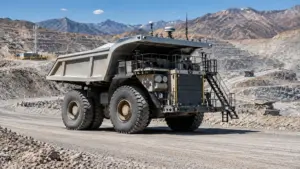
Salobo has brought 19 Komatsu 930E trucks into autonomous operation using Komatsu’s FrontRunner Autonomous Haulage System. The trucks are electric-drive haul trucks, meaning a diesel engine generates electricity for wheel motors. They are not battery-electric vehicles.
Komatsu says the 930E is a 290-metric-ton electric-drive truck and represents more than 500 autonomous trucks across customer sites. In April 2026, the company said it had commissioned its 1,000th ultra-class autonomous haul truck.
The Salobo deployment is still important for autonomous mining technology. Vale is applying driverless haulage to a major copper operation, with the fleet expected to support higher material movement as the Salobo III expansion develops. But the project demonstrates the operational maturity of autonomous electric-drive haulage, not yet battery-electric haulage at an ultra-class copper mine.
That difference affects infrastructure planning. A diesel-electric autonomous fleet requires communications coverage, dispatch software, positioning systems and safety controls. A battery-electric autonomous fleet requires all of those systems plus high-voltage distribution, charging or battery-swapping capacity, thermal management and energy scheduling.

Mining control room coordinating equipment, dispatch and production data.
Crawford shows how future fleets are being designed
Canada Nickel’s Crawford nickel project in Ontario illustrates a different stage of the technology cycle.
Canada Nickel selected Komatsu and SMS Equipment as the primary load-and-haul suppliers after a competitive process. The project’s bankable feasibility study envisages approximately 290-ton trucks, such as the Komatsu 930E or Caterpillar 794, equipped for autonomous haulage and trolley assist.
The plan is not a confirmed battery-electric fleet operating today. Instead, Crawford is being designed to accommodate a transition from diesel-electric trucks with trolley assistance toward battery-electric equipment as suitable ultra-class models become commercially available.
That sequencing could prove important. Trolley assist supplies electricity to a truck through overhead lines on selected uphill sections, reducing diesel consumption and increasing speed on grades. Crawford’s feasibility study attributes an estimated 26% reduction in unit mining operating costs and a 33% reduction in the open-pit labour component to its planned automation and trolley-assisted haulage system.
The study also estimates that 73% of uphill tonne-kilometres for the largest trucks could be completed under trolley assist.
For a future nickel operation, the benefit is not only lower emissions. Designing ramps, substations, workshops and communications networks around autonomous electric-drive equipment can reduce the cost and disruption of a later battery-electric transition.
The deployment picture
The current market is developing along several tracks rather than following one uniform path.
| Deployment or benchmark | Reported scale | Powertrain or technology | What it shows |
|---|---|---|---|
| EACON autonomous solution | More than 1,500 battery-electric trucks | Battery-electric and autonomous | Largest reported autonomous BEV deployment, based on vendor disclosure |
| EACON earlier case study | More than 450 trucks; 5 million-plus km | Pure battery-electric | Established multi-site operating experience and energy-management focus |
| Vale Salobo | 19 trucks initially | Diesel-electric Komatsu 930E with FrontRunner AHS | Autonomous haulage at a major copper complex |
| Komatsu global milestone | 1,000 ultra-class autonomous trucks commissioned | Primarily electric-drive ultra-class trucks | Commercial maturity of large-scale autonomous haulage |
| Crawford plan | Approximately 290-ton truck class | AHS-ready, trolley-assisted; future BEV pathway | Mine design incorporating electrification and autonomy from the outset |
| BHP, Rio Tinto and Caterpillar | Trial fleet | Cat 793 XE battery-electric trucks | Testing battery-electric haulage in the 240-ton class |
| Rio Tinto Oyu Tolgoi | Eight battery-swap trucks reported for trial | Battery-electric, swap-based haulage | Alternative to fixed charging for copper operations |
Figures are based on company disclosures and reported project information. Deployment definitions differ between vendors and should not be treated as a consolidated global fleet count.
The table also shows why the sector should avoid describing all electric haulage as one market. A 90-ton battery-electric truck operating with automated battery swapping has different energy, road and maintenance requirements from a 240- or 290-ton truck operating on a long open-pit cycle.
Fleet economics depend on the energy system
Battery-electric haulage can reduce fuel and energy costs, but the economic result depends on how the mine manages charging.
EACON says its energy-management platform forecasts power consumption, allocates charging capacity and sequences charge times. The company reports a 13% reduction in peak-hour electricity use, a 30% reduction in on-site charging labour and energy costs up to 70% lower than diesel models. These are company-reported figures and will vary by duty cycle, electricity prices, battery size, road gradient and local climate.
The main economic variables are:
- Utilisation: A truck that waits for a charger loses the productivity benefit of autonomy.
- Cycle profile: Long uphill hauls consume more energy and may favour trolley assist or battery swapping.
- Power tariffs: Poorly managed simultaneous charging can create expensive demand peaks.
- Battery life: Replacement timing and residual value affect total cost of ownership.
- Fleet balance: Mines may need a mixed fleet during the transition.
- Maintenance: Electric drivetrains can reduce some mechanical maintenance while increasing requirements for high-voltage systems, software and thermal management.
- Infrastructure capital: Substations, charging hubs, roads, workshops and backup systems must be included in the mine plan.
Autonomy can improve the economics of electrification by making vehicle movements more predictable. Predictable cycles make it easier to schedule charging, manage state of charge and identify exceptions before they interrupt production.
Safety and connectivity remain constraints
Removing operators from haul-truck cabs does not remove operational risk. It changes where that risk is managed.
Autonomous fleets require reliable perception systems, high-precision positioning, obstacle detection, geofencing and controlled interactions with manually operated equipment. Mixed traffic remains a practical challenge during construction, maintenance, blasting and emergency response.
Connectivity is equally important. Skillings’ analysis of mine-site networks found that autonomous systems depend on communications infrastructure capable of supporting machine control, telemetry, video and safety traffic as pits expand and haul roads move.
A network outage may not create an immediate mechanical failure, but it can trigger a controlled stop, reduce fleet availability or require manual intervention. Private LTE, 5G, Wi-Fi and mesh networks may all have a role, but the correct architecture depends on terrain, mine progression, backhaul, redundancy and cybersecurity requirements.
For operators, network design is therefore part of production planning rather than a standalone information-technology project.

Open-pit haulage requires infrastructure that can expand with the mine plan.
Base, bull and bear scenarios
The outlook for autonomous mining technology depends on whether equipment supply, grid infrastructure and mine-site integration advance at the same pace.
| Scenario | Operating assumptions | Likely outcome |
|---|---|---|
| Bear case | Charging and grid upgrades lag fleet purchases; battery degradation and downtime remain difficult to model; safety approvals slow mixed-fleet deployment | Autonomous BEV growth remains concentrated in China and selected controlled environments, while major mines retain diesel-electric fleets |
| Base case | EACON-scale deployments continue; major miners expand trials; trolley assist and battery swapping bridge the infrastructure gap | Autonomous electric haulage grows through hybrid fleets, with battery-electric trucks scaling first in repeatable routes and smaller payload classes |
| Bull case | Ultra-class BEV reliability improves quickly; charging and swapping become standard mine infrastructure; autonomy platforms interoperate across OEMs | New mines design around autonomous electric fleets from the start, while brownfield operations convert priority haul routes and expand progressively |
The base case appears most consistent with publicly reported projects. Battery-electric autonomous trucks are already operating at meaningful scale, but the largest copper, nickel, iron ore and gold mines are still validating ultra-class equipment, energy systems and integration models.
What operators should measure next
The most useful indicators for mine decision-makers are not truck counts alone. They include:
- Availability under production conditions, including charging and network downtime.
- Energy consumption per tonne-kilometre across changing grades and weather.
- Battery replacement and degradation data over several years.
- Autonomous operation in mixed traffic, not only controlled pilot zones.
- Safety performance during maintenance, blasting and recovery events.
- Grid capacity and peak-demand exposure at full fleet scale.
- Interoperability across truck, shovel, dispatch and fleet-management systems.
- Workforce transition requirements, including high-voltage maintenance and remote operations skills.
These measures will determine whether autonomous electric haulage becomes a standard operating model or remains a collection of successful but difficult-to-replicate projects.
Outlook
Autonomous mining technology is entering a more practical phase. The sector is no longer asking only whether a truck can drive without a person in the cab. It is asking whether an entire mine can coordinate machines, energy, communications and maintenance around that operating model.
The reported deployment of more than 1,500 autonomous battery-electric trucks is a meaningful signal, but it should be read alongside Salobo’s autonomous diesel-electric fleet, Crawford’s trolley-assisted future pathway and the ultra-class battery trials underway at major iron ore operations.
The near-term market will likely be mixed. Battery-electric trucks should continue gaining share where routes are predictable, charging or swapping can be standardised and grid capacity is available. Electric-drive autonomous trucks and trolley-assisted systems will remain important in large open pits where payload, range and infrastructure constraints make full battery conversion more difficult.
The strategic advantage will belong to mines that treat autonomy and electrification as one integrated production system rather than two separate equipment upgrades.
LinkedIn snippet
Autonomous electric haulage is scaling, but the market is more complex than a single truck-count milestone suggests. EACON reports more than 1,500 autonomous battery-electric trucks, while Vale’s Salobo fleet uses autonomous diesel-electric Komatsu 930E trucks and Canada Nickel’s Crawford project is planning a trolley-assisted pathway toward future battery-electric haulage. Our analysis examines fleet economics, safety, charging, connectivity and the base, bull and bear cases for autonomous mining technology.
X snippet
Autonomous electric haulage is moving from pilots to production scale. EACON reports 1,500+ autonomous battery-electric trucks, while Salobo and Crawford show different routes through electric-drive, trolley-assisted and future BEV mining. Analysis: economics, safety, charging and infrastructure constraints.
Related reading: