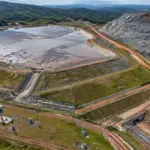
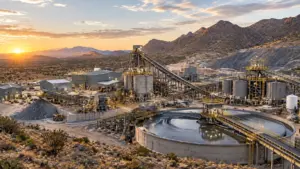
An arid mineral exploration site representing the geological setting of Saudi Arabia’s Madinah region.

By Penny Langford
Saudi Arabia has reported an estimated 110 million tonnes of uranium-bearing ore in the Madinah region, describing the material as rich in heavy rare earth elements and containing promising concentrations of uranium.
The announcement was made in the context of Saudi Arabia’s wider nuclear energy and critical minerals strategy. It links exploration at the Jabal Sayid project with plans involving state-backed miner Ma’aden and U.S.-based rare earth producer MP Materials.
The figure is significant, but it does not represent 110 million tonnes of uranium metal. The reported tonnage refers to ore, or mineralized rock, and the uranium grade, recovery rate and economic viability of the material have not yet been disclosed.
Saudi statement gives a figure of about 114 million tonnes
In a statement submitted to the International Atomic Energy Agency’s 70th General Conference in Vienna, Saudi Arabia said exploration and geological studies at the Jabal Sayid project had identified estimated resources of approximately 114 million tonnes of ore.

The material was described as containing:
- High concentrations of rare earth elements
- Particularly strong heavy rare earth element potential
- Promising concentrations of uranium
The 114-million-tonne figure is slightly higher than the approximately 110 million tonnes reported by Saudi officials and international media. Both figures refer to the same broad announcement and should be understood as rounded estimates of ore or mineralized material.
Saudi Arabia said the project ranks among the most significant rare earth resource sites currently under development globally. However, the statement did not provide grades for uranium or rare earth elements, nor did it classify the material under an internationally recognized mineral resource or reserve standard.
That distinction matters for mining companies, investors and policymakers. A large tonnage can indicate geological scale, but it does not by itself demonstrate that a deposit can be mined, processed or financed commercially.
Heavy rare earths add strategic importance
Heavy rare earth elements, including dysprosium and terbium, are used in high-performance permanent magnets and other advanced industrial applications. These materials support electric motors, wind turbines, robotics, aerospace systems and defense technologies.
They are generally considered strategically important because supply is concentrated in a limited number of countries and processing is technically complex. The availability of heavy rare earths alongside uranium could give the Madinah project a broader strategic role than a conventional uranium occurrence.
Saudi Arabia’s statement presented the deposit as part of an effort to move beyond the export of raw materials and develop domestic capabilities in mining, separation, refining and downstream manufacturing.
That approach is consistent with the Kingdom’s broader mining policy under Vision 2030. Saudi Arabia has sought to attract international partners, expand exploration and build processing capacity around critical minerals, including copper, gold, phosphate, nickel and rare earths.
Skillings has previously examined the challenge in critical minerals refining and supply chain concentration, where processing capacity remains more geographically concentrated than mining production.

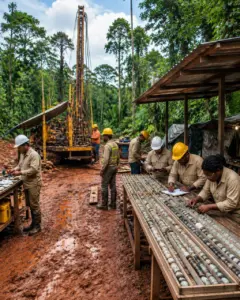
Geological drill core representing the early-stage exploration work required to define grade, continuity and recoverability.
Ma’aden and MP Materials are central to the processing plan
Saudi Arabia said the project is connected to a partnership between Ma’aden and MP Materials to develop rare earth processing and separation capabilities, as well as the production of associated uranium.
The partnership follows a broader U.S.-Saudi framework on critical minerals and supply chain security. In November 2025, Ma’aden and MP Materials announced a binding term sheet for a rare earth refining and separation facility in Saudi Arabia.
Under the agreement described by Ma’aden, the facility would be operated by Ma’aden, while MP Materials would contribute technical expertise. Ma’aden would hold at least 51% of the joint venture, with MP Materials and a U.S. government-backed vehicle holding a targeted 49% position.
The proposed facility is intended to process, refine and separate rare earth elements using Saudi and international feedstock. The partnership builds on a May 2025 memorandum of understanding between Ma’aden and MP Materials, which outlined ambitions for an integrated supply chain covering mining, separation, refining and magnet production.
The later Ma’aden announcement on the planned refining joint venture described the project as a central processing hub for rare earth elements.
Saudi Arabia’s IAEA statement went further by linking the partnership to the potential recovery and production of associated uranium. It also said the Kingdom ultimately aims to develop capabilities for uranium recovery, purification and the production of yellowcake, subject to economic feasibility and international obligations.

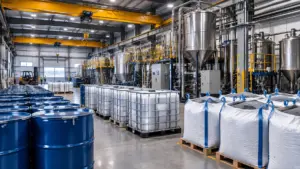
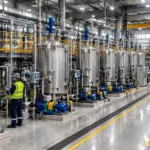
Industrial processing infrastructure representative of the separation and refining capacity Saudi Arabia aims to develop.
The uranium figure remains difficult to assess
The central uncertainty is the absence of disclosed grades.
The reported 110 million tonnes of ore could contain a relatively small uranium concentration or a materially larger one. Without assays, resource classification, metallurgical test work and recovery estimates, it is not possible to calculate how much uranium could ultimately be produced.
The same issue applies to the heavy rare earth content. The Saudi statement identifies high concentrations but does not provide:
- Uranium grade
- Total rare earth oxide grade
- Individual element distribution
- Mineralogy
- Expected recoveries
- Mining method
- Processing flowsheet
- Capital or operating cost estimates
- A development timetable
Those details will determine whether the project develops as a standalone mining operation, a multiproduct deposit or a source of byproduct material from a larger rare earth processing system.
The announcement should therefore be treated as a strategic exploration and resource-development milestone rather than a declaration of a bankable mining reserve.
A broader nuclear fuel strategy
Saudi Arabia’s statement placed the Madinah project within its National Atomic Energy Project, which includes several uranium-related tracks.
One involves recovering uranium associated with phosphoric acid from phosphate fertilizer operations in the north of the Kingdom. Saudi Arabia said pilot work conducted with French company Orano had produced promising economic indicators and that the cooperation had led to a memorandum of understanding.
A second track covers the Jabal Sayid rare earths and uranium project.
A third involves the Sedimentary Cover Survey Initiative, through which Saudi Arabia is continuing to search for conventional uranium deposits.
The Kingdom has said it wants to introduce nuclear energy into its national energy mix while developing domestic capabilities and maintaining cooperation with international institutions. In its IAEA statement, Saudi Arabia emphasized its commitment to peaceful nuclear uses, safeguards, safety and international transparency.
The uranium-bearing material in Madinah could therefore serve two potential objectives: supplying a future domestic nuclear fuel cycle and strengthening Saudi Arabia’s position in critical minerals processing.
What comes next for the Madinah project
The next milestones will be technical rather than political.
Saudi Arabia and its partners will need to define the resource through drilling and sampling, publish grades and establish how uranium and rare earth elements occur within the host rock. They will also need to demonstrate that the elements can be separated economically without creating excessive environmental or waste-management costs.
For Ma’aden and MP Materials, the key question is whether the proposed processing facility can move from a binding term sheet and feasibility work to a final investment decision, construction and commercial operation.
The project also faces the standard challenges of a complex minerals development: infrastructure, water supply, permitting, processing technology, financing, international safeguards and long-term customer agreements.
For now, the announcement signals that Saudi Arabia sees uranium and heavy rare earths as complementary parts of a broader industrial strategy. It also highlights the difference between identifying a large body of mineralized rock and proving a commercially recoverable resource.
The Madinah discovery may become an important addition to global uranium and rare earth supply. But that outcome will depend on data that have not yet been made public.

Operational monitoring is expected to become increasingly important as Saudi Arabia develops integrated critical minerals processing.
Key figures and development status
| Item | Reported information | Current limitation |
|---|---|---|
| Reported ore tonnage | About 110 million tonnes | Official IAEA statement cites approximately 114 million tonnes |
| Location | Jabal Sayid project, Madinah region | Detailed deposit boundaries have not been published |
| Uranium | Promising concentrations | Grade and recoverable uranium have not been disclosed |
| Rare earths | High concentrations, particularly heavy rare earths | Element-by-element grades and recoveries are unavailable |
| Saudi partner | Ma’aden | Development milestones remain subject to feasibility work |
| U.S. partner | MP Materials | Technical and processing role established through partnership announcements |
| Project status | Exploration, studies and partnership development | No public commercial production timetable |
Related coverage: Skillings rare earths news and analysis.