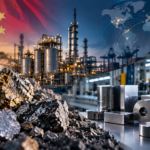
Critical Metals Corp. says it has cleared a major processing hurdle at its Tanbreez rare-earth project in Greenland, potentially strengthening plans for a large-scale refinery in Romania.

The company reported on September 16 that laboratory testing achieved more than 99% dissolution of Tanbreez eudialyte concentrate and produced 19 ultra-high-purity rare-earth and critical-metal products.
The proposed Romanian refinery has a preliminary capital cost of US$1.85 billion, with a Class 4 estimate carrying an accuracy range of ±25%. Critical Metals’ current model projects annual refinery revenue of about US$1.8 billion to US$2.2 billion.
Those figures are projections, not established project economics. Further engineering, metallurgical testing, feasibility work, permitting and financing remain before the refinery can reach a final investment decision.
The more important development is the processing route itself.
More Read

Eudialyte Creates a Difficult Processing Problem
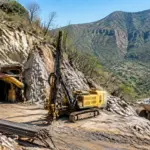
Tanbreez is a Greenland rare-earth project where the targeted mineralisation is hosted largely in eudialyte-bearing material.

Eudialyte is a complex silicate mineral containing rare earths and other critical elements. Its chemistry can make processing difficult because silica can form a gel during some acid-treatment routes. That can complicate filtration, handling and downstream recovery.
Critical Metals says its proposed flowsheet uses multistage mixed-acid reactor additions designed to prevent silica-gel formation.
More Read
The company also plans to recover silica from the process off-gas. Its modelling indicates that the approach could produce high-purity silicon dioxide while recycling acid and reducing fresh acid consumption by approximately 85%.
That is the technical heart of the announcement.
If the process performs at larger scale, the ability to recover silica and recycle acid could affect both operating costs and waste management.
But the distinction between laboratory results and commercial performance remains important.
From Concentrate to 19 High-Purity Products
The proposed Romanian refinery is being designed to process up to 100,000 tonnes of eudialyte concentrate a year.
Current modelling indicates annual production of approximately 27,943 tonnes of rare-earth and critical-metal products, including chloride salts and other high-purity products. The model also includes about 25,670 tonnes of high-purity silica powder.
Critical Metals estimates that the silica stream could contribute approximately US$600 million in annual revenue under its current pricing assumptions.
The company also estimates that silica sales and avoided acid costs could contribute approximately US$400 million to US$600 million a year in combined value.
Those numbers are modelling assumptions rather than contracted revenue.
The proposed process is designed to recover several materials that might otherwise enter the waste stream, including silica and potentially alumina, iron and copper. The company’s current modelling targets refinery tailings at approximately 1% of feed tonnage.
The Refinery’s Technology Goes Beyond Leaching
The proposed process does not stop at dissolving the eudialyte concentrate.
Critical Metals describes a multistage mixed-acid leach operating at elevated temperatures, followed by cascading recovery stages and multiple ion-exchange steps.
The company says the process is designed to separate individual elements into high-purity products, with targeted product purities of approximately 99.9% to 99.99%, subject to further testing and validation.
Another feature is vacuum freeze-drying, or lyophilisation.
Critical Metals plans to use the process for its 19 chloride salts to produce anhydrous, ultra-low-moisture powders. The company says these products could command price premiums over conventionally dried material, although those premiums remain a market assumption rather than an established commercial result.
The proposed refinery would also require significant energy infrastructure.
Current modelling estimates energy demand of up to 150 MW. The company’s design assumptions envisage about 60% to 70% of that requirement coming from gas-fired kilns and boilers, with the remaining 30% to 40% supplied through third-party or state electricity sources.
That requirement will matter for project costs, infrastructure planning and permitting.
The Value Proposition Is Downstream Processing
Critical Metals’ model illustrates why the company is pursuing a mine-to-metals strategy rather than simply exporting concentrate.
The company currently assumes a Tanbreez eudialyte concentrate transfer or sales value of about US$4,000 per tonne.
Its refinery model projects potential revenue of up to approximately US$24,000 per tonne of concentrate processed, before operating costs, capital recovery, taxes and other costs. The company’s base case uses approximately US$13,000 per tonne, based on lower historical pricing assumptions.
The difference highlights the potential economic value of downstream processing.
It also highlights the risk.
The projected value depends on product recoveries, purity, commodity prices, operating costs and the ability to sell the individual products at the assumed prices.
That means the refinery’s economics cannot be separated from the performance of the processing flowsheet.
Romania Creates a European Downstream Link
The proposed refinery is intended to connect Tanbreez concentrate from Greenland with downstream processing inside the European Union.
Under the existing term sheet, the proposed Romanian joint venture is expected to receive 50% of Tanbreez concentrate production. Critical Metals currently controls 92.5% of Tanbreez, following Greenland government approval of the transfer of the remaining 50.5% interest in April 2026.
The planned logistics chain would use shipping and rail routes to move concentrate from Greenland to the Romanian facility.
For European supply chains, the significance is therefore broader than another rare-earth mining project.
The proposed structure would place extraction in Greenland and processing in an EU and NATO member state, creating a potential Western mine-to-processing route.
Scale-Up Is the Next Test
The latest result does not eliminate the project’s development risks.
The path from laboratory testing to commercial operation still runs through pilot-scale validation, engineering, feasibility studies, permitting, financing, construction and commissioning.
Critical Metals has already been developing a proof-of-concept pilot programme for Tanbreez. Earlier metallurgical work reported a refined concentrate containing 2.96% total rare-earth oxides, about 40% above the company’s historical 2016 result. The company said the work would support further pilot-plant feed preparation and flowsheet development.
That work provides a bridge between laboratory chemistry and larger-scale process design.
The proposed Romanian refinery, however, is intended to handle 100,000 tonnes of concentrate annually. The key question is whether the reported dissolution, recovery, purity, acid-recycling and waste assumptions can be maintained at that scale.
A Processing Breakthrough Still Has to Become a Project
Critical Metals’ latest results address a specific technical obstacle in eudialyte processing.
If the proposed flowsheet can maintain its reported performance through pilot testing and subsequent scale-up, it could support a more integrated route from Tanbreez concentrate to high-purity rare-earth and critical-metal products in Europe.
That outcome has not yet been demonstrated.
The next decisive milestone is therefore not another headline laboratory result.
It is evidence that the process can maintain recovery, product purity, acid efficiency and waste-performance assumptions at commercial scale, while supporting the financing and infrastructure required for a US$1.85 billion refinery.
For Tanbreez, the processing breakthrough may have opened the next stage of development.
The real test is whether the chemistry can survive the journey from the laboratory to a 100,000-tonne-per-year industrial operation.