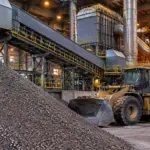
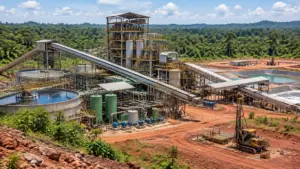
High-grade iron ore stockpiles and ship-loading infrastructure at an export terminal.

By Charles Pitts
Simandou is approaching its first full-year test as a producing iron ore basin, with most market estimates placing 2026 shipments between 16 million and 22 million tonnes. Those tonnes are arriving into an iron ore market that has recently held near US$99–US$100 per tonne, a level supported by mining costs, freight and depletion at mature operations but challenged by new supply and uneven Chinese steel demand.
The immediate question is not whether Simandou will change the market. It will. The question is how quickly its volumes arrive, which products they displace, and whether the additional supply is large enough to push the benchmark below the US$100 level that Fitch and UBS have used as a reference for 2026.
Wood Mackenzie’s base case is closer to 16 million tonnes, while more optimistic market estimates point to 20 million tonnes or more if the post-wet-season ramp performs smoothly. The range matters because each additional cargo affects more than seaborne supply. Simandou will also reshape high-grade premiums, long-haul freight demand and China’s access to a major source outside Australia and Brazil.
More Read

Simandou ramp reference points
| Market factor | 2026 reference point | Why it matters |
|---|---|---|
| Estimated Simandou shipments | 16–22 Mt | Determines the scale of the first full-year supply increase |
| Recent iron ore price level | About US$99–US$100/t | Shows the level new supply must test |
| Product grade | About 65% Fe or better | Competes in the high-grade segment and supports lower emissions intensity |
| Core infrastructure | Trans-Guinean railway and Morebaya port | The mine, rail and port must work as one export chain |
| Principal competing regions | Pilbara, Brazil and other Atlantic suppliers | Determines blending, freight and marginal supply economics |
| Longer-term basin capacity | About 120 Mtpa | The strategic impact is larger than the initial 2026 volume |
The project’s infrastructure remains central to the forecast. Ore must travel from southeastern Guinea along the Trans-Guinean railway before reaching the Morebaya export terminal. Any weakness in rail availability, port loading, vessel scheduling or wet-season operations can push annual shipments toward the bottom of the range.

That is why analysts distinguish between a calendar-year shipment forecast and an annualised run rate. A project can demonstrate strong monthly exports late in the year while still delivering only a mid-teens total for the full year.
Grade premium meets the decarbonisation constraint


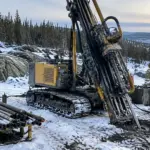
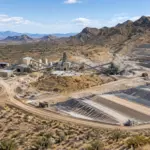
High-grade iron-bearing formations and mine benches in Guinea.
Simandou’s most important commercial feature is not simply the number of tonnes. It is the approximately 65% Fe product grade, combined with a low-impurity profile that can appeal to steelmakers seeking to reduce raw-material emissions.
Higher-grade ore generally allows steelmakers to produce the same amount of hot metal with less gangue to process. In blast-furnace operations, that can reduce coke requirements and energy use. In direct reduced iron routes, high-grade feed is even more important because the process typically requires suitable pellets or concentrate with limited impurities.
That creates a tension in the premium market. The arrival of new 65% Fe supply should increase availability and place pressure on the premium paid for existing high-grade products, including some Brazilian and Australian material. Fastmarkets has argued that Simandou is likely to put a ceiling on the highest-grade premium, while noting that chemical composition and product consistency will continue to differentiate cargoes.
The premium therefore may narrow without disappearing.
For Chinese mills, the issue is becoming more operational. Pressure to reduce emissions intensity is increasing the value of ore that can support lower coke rates or more efficient blending. At the same time, steel margins and property-sector weakness limit how much mills can pay for premium feedstock.
The result is a more selective market. Simandou can compete directly with premium products, but its price impact will depend on whether Chinese mills are profitable enough to absorb high-grade material and whether the ore’s chemistry fits existing sintering, pelletising or direct-reduction systems.
Fastmarkets’ analysis of Simandou and Wood Mackenzie’s project commentary both point to this dual effect: more high-grade supply in the short term, but stronger structural demand for suitable feedstock as steelmakers pursue decarbonisation.
Freight determines the marginal supplier

A Capesize vessel represents the long-haul freight economics of Guinea-to-China supply.
Simandou adds tonnes to the seaborne market, but it also adds distance. A Guinea-to-China voyage is materially longer than an Australia-to-China trip and broadly comparable with other Atlantic-to-Asia routes. That changes the freight balance even when the initial shipment volume remains modest.
Australia’s Pilbara producers benefit from proximity to China. Shorter voyages allow vessels to complete more rotations each year, reducing freight per tonne and limiting the tonne-mile contribution of each cargo. This helps keep Australian ore competitive when benchmark prices soften.
Brazilian suppliers face a longer route but can use Valemax and other very large ore carriers to reduce the per-tonne cost of moving cargo to China. Those ships offer economies of scale that help offset distance, particularly where port infrastructure can accommodate them.
Simandou’s early exports are expected to use a mix of Capesize, Newcastlemax and very large ore carriers. The route therefore has the potential to support Capesize demand even before volumes reach the basin’s long-term capacity. Analysts cited by S&P Global have highlighted the increase in Atlantic-to-Asia tonne-miles as a defining feature of the project.
This distinction matters for pricing. A mine with low operating costs may still be less competitive on a delivered basis if freight rises sharply. Conversely, a high-grade cargo can absorb more freight because it may reduce coke consumption or improve furnace productivity.
The marginal supplier into China will therefore be determined by the delivered cost of usable steelmaking units: not by mine-gate cost alone.
The strategic shift beyond Australia and Brazil
Simandou’s first shipments are too small to displace the Pilbara or Brazil from their dominant positions. But the project changes the strategic map.
China has long depended on Australia and Brazil for the bulk of its iron ore imports. A new large-scale source from West Africa gives steelmakers another supply corridor and creates additional flexibility in procurement, blending and contract negotiations.
That leverage will build gradually. In 2026, Simandou’s shipments are likely to be absorbed partly by overall market growth, inventory changes and depletion-related declines elsewhere. Some analysts argue the market has overestimated the project’s near-term effect because mature Australian and Brazilian mines are losing capacity, offsetting a portion of the new Guinean tonnes.
The counter-argument is that Simandou’s importance lies in the trajectory. If the basin moves from 16–22 Mt in 2026 toward its longer-term target of roughly 120 Mtpa, the effect on high-grade availability and Atlantic freight will become harder to absorb through normal depletion.
Iron ore price framework
The following framework is not a trading recommendation. It sets out the conditions that would make each market outcome more plausible.
| Scenario | Indicative 2026–2027 range | Main drivers | Market implications |
|---|---|---|---|
| Bear case | US$80–US$90/t | Simandou exceeds 20 Mt, Chinese steel demand weakens, inventories rise and major producers maintain output | High-grade premiums narrow; Pilbara and Brazilian producers face greater pressure on realised prices |
| Base case | US$90–US$105/t | Simandou delivers roughly 16–20 Mt, depletion offsets part of new supply and Chinese demand remains mixed | The US$100 level is tested but remains supported by freight, costs and constrained marginal supply |
| Bull case | US$105–US$120/t | Rail or port delays restrict Simandou, Chinese stimulus lifts steel output, or supply disruptions hit Australia or Brazil | Premium products retain strength and long-haul freight tightens |
The base case is the most balanced interpretation of current forecasts. Fitch and UBS have maintained outlooks around US$100 per tonne, while other institutions have placed average 2026 expectations in the mid-US$90s. The difference reflects a debate over whether cost support and depletion outweigh additional supply and weak Chinese demand.
The bear case requires more than Simandou alone. It would likely need a combination of higher-than-expected Guinean shipments, subdued steel production and rising port inventories. The bull case, meanwhile, depends on execution risk or a demand recovery arriving before Simandou reaches a stable export rhythm.
What to watch next
Investors, miners and steelmakers should focus on operating data rather than headline capacity figures.
- Monthly Simandou shipments: The pace after the wet season will show whether 16 Mt or 22 Mt is the more credible full-year reference.
- Chinese port inventories: Rising inventories would indicate that new cargoes are arriving faster than mills can consume them.
- Mill profitability: Weak margins would limit the ability of steelmakers to pay for high-grade material.
- High-grade premium spreads: A narrowing 65%–61% spread would indicate that Simandou is changing product availability.
- Vale and Rio Tinto guidance: Changes to production, sales and ramp schedules will show how much depletion is offsetting new Guinean supply.
- Rail and port commissioning: Delays on the Trans-Guinean railway or at Morebaya would have an immediate effect on shipment expectations.
Simandou is unlikely to deliver a single dramatic price shock in 2026. Its first full-year volumes are more likely to work through the market by changing the mix of ore, freight and supply risk.
The $100 floor will therefore be tested in several ways: by additional seaborne tonnes, by the value steelmakers assign to high-grade feed, and by the cost of moving ore across longer routes. The project’s most consequential effect may not be whether iron ore falls below US$100, but whether the market begins to price high-grade supply, freight and geopolitical diversification as separate variables rather than treating them as one benchmark.