By Penny Langford

Critical Metals Corp. is positioning a proposed refinery near Brașov, Romania, as a test of whether Europe can turn an unusual Greenland mineral into a non-Chinese source of heavy rare earths and other strategic metals.
The company’s preliminary refinery study outlines a facility designed to process up to 100,000 tonnes per year of eudialyte concentrate from its Tanbreez project in southern Greenland. The model indicates potential annual revenue of approximately US$2.2 billion, against estimated capital expenditure of about US$1.85 billion.
Those figures have attracted attention across mining news and critical minerals markets. But the project’s central question is not simply whether Tanbreez contains enough rare earths. It is whether Critical Metals can process eudialyte reliably, economically and at industrial scale.
That is a more demanding proposition than building a conventional monazite- or bastnaesite-based rare earth circuit.
The key investment question: Can a proposed Romanian refinery convert a difficult silicate feedstock into a dependable European supply of heavy rare earths without transferring geological risk into chemical and construction risk?
The project in numbers
Critical Metals has entered a term sheet for a 50:50 joint venture with Fabrica de Prelucrare a Concentratelor de Uraniu (FPCU), a Romanian state-owned entity and subsidiary of Nuclearelectrica. The proposed refinery would be located at or near the existing Feldioara industrial complex.

The company describes the project as a mine-to-metals supply chain: Tanbreez would produce the concentrate, while the Romanian facility would convert it into rare earth and critical-metal products for European industrial, defense and advanced manufacturing customers.
| Key fact | Preliminary figure or status |
|---|---|
| Proposed refinery location | Feldioara, near Brașov, Romania |
| Feedstock | Eudialyte concentrate from Tanbreez, Greenland |
| Planned concentrate throughput | Up to 100,000 tonnes per year |
| Modeled annual revenue | Approximately US$2.2 billion |
| Estimated capital cost | Approximately US$1.85 billion |
| Capital estimate classification | Class 4, with an estimated ±25% range |
| Modeled annual product output | Approximately 27,943 tonnes |
| Target product streams | 19 rare earth and critical-metal products |
| Modeled silica by-product | Approximately 25,670 tonnes per year |
| Ownership structure | Proposed 50:50 CRML-FPCU joint venture |
| Current stage | Preliminary study and further engineering |
The figures are preliminary and model-based, not a final investment decision. They remain dependent on metallurgical validation, permitting, financing, construction, product qualification and market prices.
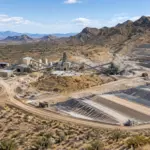
Critical Metals has also reported a patent-pending process achieving more than 99% dissolution of eudialyte concentrate in test work, producing high-purity rare earth and critical-metal chloride products. That result is important, but laboratory dissolution is only one part of a commercial flowsheet.

Eudialyte-bearing ore presents a different processing challenge from conventional rare earth minerals.
Why eudialyte is not a conventional rare earth feed
Most established rare earth processing routes are built around minerals such as monazite and bastnaesite.
Monazite is a rare earth phosphate, typically containing substantial light rare earths such as cerium, lanthanum, neodymium and praseodymium. Its main processing challenges include phosphate chemistry, thorium and uranium management, radioactive residues and environmental permitting.
Bastnaesite is a rare earth fluorocarbonate. Its treatment often involves flotation, roasting and acid leaching, with process controls required for fluorine, carbon dioxide and cerium chemistry.
Eudialyte is different. It is a complex sodium-calcium-iron-manganese-zirconium silicate that can host rare earths alongside zirconium, niobium and tantalum. Tanbreez is also notable because its mineralization includes a higher proportion of heavy rare earth elements than many conventional light-rare-earth deposits.
The advantage is a potentially broader and more valuable product basket. The disadvantage is the silicate framework.
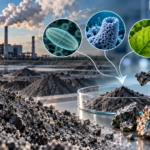
When eudialyte is attacked with acid, silicon can enter solution as silicic acid and then polymerize into colloidal or gelatinous silica. That can create a thick, difficult-to-filter slurry, trap rare earths and zirconium, foul downstream equipment and complicate solvent extraction.
In practical terms, the mineral can dissolve readily while still producing an unmanageable process stream.
That is why eudialyte has historically required specialized approaches, including dry digestion, controlled acid addition, roasting, process additives and modified reactor designs. The proposed Romanian flowsheet is reported to use multistage mixed-acid reactors intended to prevent silica gel formation and recover the silica as a commercial-grade product.
The company says that silica recovery could reduce fresh acid consumption by roughly 85% while creating an additional product stream. Its study models approximately US$600 million in annual revenue from silica, although that estimate depends on product quality, customer qualification and realized prices.
The metallurgical risk sits between the mine and the market
Critical Metals has reported successful replication of earlier metallurgical work and has incorporated high-intensity magnetic separation into its planned beneficiation circuit.
The updated concentration work is intended to lift the eudialyte concentrate grade from roughly 2.2%–2.5% total rare earth elements to more than 3%, while improving recovery and reducing gangue.
A proof-of-concept pilot plant has been acquired with a design capacity of approximately 300–500 kilograms per hour of run-of-mine kakortokite ore. The stated purpose is to produce concentrate for offtake partners and generate scale-up data before commercial plant engineering.
That intermediate step matters. The proposed refinery would be designed to handle 100,000 tonnes of concentrate annually, while the pilot plant operates at a much smaller scale. The risk is not only whether the chemistry works, but whether filtration, acid handling, heat management, residue stability and equipment materials perform continuously under industrial conditions.
A commercial plant would need to demonstrate:
- Stable concentrate quality from variable ore zones.
- Consistent control of silica during leaching.
- High recovery across multiple rare earth and critical-metal streams.
- Reliable filtration and solid-liquid separation.
- Safe handling of mixed acids and corrosive chloride solutions.
- Commercial outlets for silica, zirconium, niobium and tantalum products.
- Acceptable waste, water and residue management.
These are also central questions for mining ESG compliance 2026. A project that reduces dependence on Chinese refining still needs to demonstrate responsible water use, acid management, waste containment, emissions control and transparent permitting.

The proposed refinery would rely on tightly controlled hydrometallurgical processing rather than conventional mineral concentration alone.
Why Europe is interested
Europe’s rare earth vulnerability is concentrated in the midstream. The region can import ore and concentrates from multiple jurisdictions, but it has limited capacity to separate, refine and convert those materials into magnet-grade products.
The European Parliament has identified refining and separation capacity as a major constraint on the bloc’s critical raw materials strategy. The International Energy Agency has also warned that new non-Chinese capacity will not be sufficient to eliminate supply concentration in the medium term.
The bottleneck is most acute for heavy rare earths such as dysprosium and terbium, which are used to improve the performance of permanent magnets at high temperatures. These materials are important in electric motors, wind turbines, aerospace systems and defense applications.
China continues to dominate rare earth separation, refining and permanent magnet production. The EU Institute for Security Studies has described China as controlling virtually all heavy rare earth refining and the overwhelming majority of permanent magnet manufacturing.
A successful Tanbreez-to-Romania route would not replace Chinese supply overnight. It would, however, create an allied supply option that is integrated across two Western-aligned jurisdictions: mining in Greenland and refining in an EU and NATO member state.
That distinction is strategically important. In a disrupted critical minerals supply chain 2026 scenario, access to concentrate may not be enough. Buyers will also need confidence that separation, purification and downstream conversion can continue without export-license delays or geopolitical restrictions.
The investor take: a Cramer-style scorecard without the stock call
A Cramer-esque reading of the project starts with the headline number: US$2.2 billion in modeled annual revenue against US$1.85 billion in estimated capital cost. On the surface, that is a powerful combination.
The second positive is strategic scarcity. A European refinery capable of producing heavy rare earths and multiple critical-metal products would be addressing a recognized supply-chain gap, not chasing an oversupplied commodity.
The third positive is optionality. The proposed product slate includes rare earth chlorides, tantalum and niobium compounds, zirconium-bearing products and high-purity silica. Multiple revenue streams could reduce dependence on a single oxide or magnet-metal price.
But the scorecard has three material deductions:
- Technology risk: The economic model depends on scaling a process designed around eudialyte’s silica problem.
- Capital risk: A Class 4 capital estimate with a ±25% range can move significantly as engineering advances.
- Market risk: Modeled revenue from 19 products requires qualified buyers, realistic prices and reliable product specifications.
The strongest version of the project is a functioning European refinery with validated feedstock, contracted customers and stable by-product markets. The weakest version is a large, acid-intensive plant whose economics depend on laboratory recoveries and optimistic prices.
For investors, the milestones to watch are therefore more important than the headline valuation: pilot-plant performance, updated feasibility work, refinery permitting, financing terms, concentrate grade, recovery by element and binding offtake agreements.
What a successful route would change
If Critical Metals can move from test work to continuous commercial operation, Tanbreez would offer Europe something it currently lacks: a non-Chinese route for heavy rare earths combined with niobium, tantalum and zirconium recovery.
That would not remove China from the global supply chain. It could, however, give European manufacturers an alternative source of separated products and reduce exposure to a single processing jurisdiction.
The commercial significance would extend beyond rare earth prices. It would affect magnet security, defense procurement, industrial policy and the credibility of European critical minerals strategy.
For now, the Romanian refinery remains a preliminary study supported by encouraging metallurgical claims rather than a financed operating asset. The next test is straightforward but demanding: whether the eudialyte problem can be solved not only in a laboratory vessel, but across a refinery designed to run every day.
Social snippet
LinkedIn/X: Critical Metals Corp. is proposing a US$2.2B-per-year rare earth refinery in Romania to process eudialyte from Greenland’s Tanbreez project. The opportunity: a non-Chinese heavy rare earth route for Europe. The risk: scaling a silica-prone feedstock into a reliable commercial flowsheet. #CriticalMinerals #RareEarths #MiningNews
Sources and further reading
- Critical Metals Corp. metallurgical test-work update
- Critical Metals Corp. Romanian refinery joint-venture term sheet
- Tanbreez technical report
- IEA Global Critical Minerals Outlook
- Skillings analysis of Europe’s critical raw materials strategy
- Skillings analysis of the critical minerals supply chain