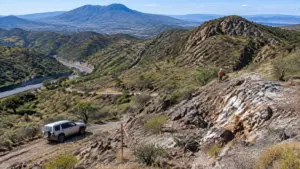
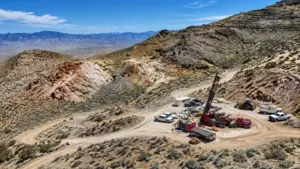
Driverless haul trucks operating in sequence on an open-pit mine bench.

By Sonny Rollins
An estimated 5,684 autonomous haul trucks were operating or autonomy-ready in surface mines globally by mid-2026, according to GlobalData. The figure marks a shift in autonomous mining technology from controlled pilot programs toward fleet-scale production deployment.
The number includes both actively autonomous and autonomy-ready machines, so it should not be treated as a single audited fleet total. Vendor disclosures also overlap by geography, truck class and counting method. Even so, the direction is clear: autonomy is becoming an operating model for large-scale material movement rather than a technology demonstration.
EACON reports more than 3,100 active autonomous trucks across 38 sites, including more than 1,500 battery-electric mining trucks using its autonomous solution. CiDi says its MetaMine autonomous haulage system has shipped more than 1,900 trucks across nearly 40 mines. Komatsu has become the first original equipment manufacturer to commission 1,000 ultra-class autonomous haul trucks.
The investment case is shifting with the fleet scale. Operators are no longer asking only whether a truck can drive without an operator. They are asking how autonomy changes the cost per tonne when the mine plan, energy system, workforce model and road network are redesigned around it.

Autonomous haulage: 2026 fleet and economics reference points
The figures below are indicative and sourced from GlobalData, vendor disclosures, OEM announcements, peer-reviewed research, Whittle Consulting and Skillings reporting. Definitions are not uniform and the vendor figures should not be added together.
| Indicator | Reported reference point | Why it matters |
|---|---|---|
| Global surface-mine autonomous or autonomy-ready trucks | Approximately 5,684 | Indicates fleet-scale adoption, although the estimate includes different equipment categories |
| EACON active autonomous fleet | More than 3,100 trucks across 38 sites | Shows large multi-site commercial deployment |
| EACON battery-electric autonomous units | More than 1,500 trucks | Demonstrates convergence between autonomy and electrification |
| CiDi MetaMine cumulative shipments | More than 1,900 trucks across nearly 40 mines | Highlights the growth of autonomous fleets across multiple truck classes |
| Komatsu ultra-class AHS trucks commissioned | 1,000 | Marks commercial maturity in the largest haulage category |
| Reported productivity or utilisation improvement | Up to approximately 30% | Reflects reduced shift-change losses, smoother cycles and higher equipment availability |
| Reported operating cost reduction | Approximately 13%–15% | Captures labour, fuel, maintenance and productivity effects in selected studies |
| Whittle Consulting additional truck driving hours | Approximately 700–1,000 per truck per year | Shows the value of continuous operation and fewer operator-related delays |
| Whittle Consulting modeled NPV uplift | Approximately 39% with mine-plan re-optimisation | Illustrates the difference between redesigning a mine and bolting autonomy onto an existing plan |
| Industry haulage savings target | About US$0.50 per tonne | A commonly cited benchmark for the potential impact on haulage cost |
A GlobalData-linked industry assessment places autonomous and autonomy-ready equipment at more than 4% of key mining machinery. That remains a minority share, but it is large enough to create a meaningful operating record across copper, iron ore, gold, coal and critical-minerals mines.
The most important caveat is that vendor figures measure different things. EACON reports active trucks, CiDi reports cumulative shipments and Komatsu’s milestone focuses on ultra-class trucks commissioned under its FrontRunner system. These are useful reference points, not a consolidated global census.
The mine plan, not the truck, determines the return
The strongest economic benefits of autonomous mining technology appear when the entire mine plan is rebuilt around the new operating assumptions.
A conventional mine plan often assumes fixed shift patterns, operator breaks, conservative truck availability, manual traffic controls and haul roads designed for human-driven cycles. Replacing the driver without changing those assumptions leaves much of the value untouched.
The Whittle Consulting autonomous haulage study illustrates the difference. Its modelling found that autonomous trucks could provide roughly 700 to 1,000 additional usable driving hours per year. That increase can reduce the number of trucks required for a target production rate or allow the same fleet to move more material.
The direct operational benefit is only the first layer. When pit limits, pushbacks, ramp geometry, dump locations, fleet sizing and production schedules are re-optimised, the modeled NPV uplift reached about 39% compared with the original plan.
This is why published payback claims need to be read carefully. A project that layers autonomous haulage onto a conventional design may capture labour and utilisation savings but miss the larger value created by:
- Lower haulage costs changing cut-off grades and pit limits.
- Higher truck availability altering fleet requirements.
- More consistent cycles supporting different crusher and stockpile schedules.
- Revised ramp and bench designs reducing waste movement.
- Continuous operation changing maintenance and shift planning.
- Improved safety assumptions reducing disruption and exposure.
Skillings’ own reporting on autonomous haulage ROI frames the industry target at about US$0.50 per tonne of haulage savings, with total haulage cost reductions commonly discussed in the 15%–20% range. Those gains are principally linked to labour, fuel, maintenance and higher utilisation.
The practical conclusion is straightforward: autonomy should be evaluated during prefeasibility and life-of-mine planning, not treated only as a late-stage fleet upgrade.

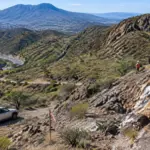
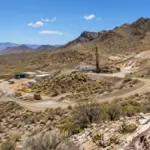
Mine geometry and haul-road design influence how much value autonomy can capture.
Electric autonomy adds a new constraint
Battery-electric and autonomous haulage are increasingly being deployed as one system. EACON’s reported fleet of more than 1,500 battery-electric autonomous trucks is the clearest evidence that electrification is moving beyond isolated demonstrations.
The combination changes the cost curve through diesel elimination, lower maintenance requirements and, in some underground applications, reduced ventilation demand. Predictable autonomous cycles can also make charging schedules easier to manage because the fleet-management system can account for route length, gradient, payload, battery state and charger availability.
But electrification creates a new production constraint: power.
A mine may have enough installed capacity for a pilot fleet but not for hundreds of trucks charging during the same demand window. Transformer availability, substation construction, grid interconnection and backup generation can become critical-path items. Long lead times for electrical equipment may delay an otherwise ready fleet.

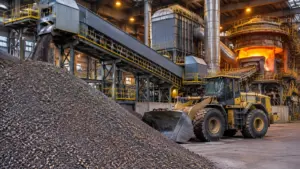
Charging infrastructure becomes part of the production system as electric fleets scale.
The operating metrics also change. Operators will need to monitor:
- Energy consumption per tonne-kilometre.
- Charger utilisation and queue time.
- Peak demand and electricity tariffs.
- Battery degradation and replacement timing.
- Production lost during charging or power interruptions.
- The role of trolley assist or battery swapping on steep routes.
Autonomy can make energy use more predictable, but it cannot remove the physical constraints of long uphill hauls, extreme temperatures, poor road conditions or inadequate grid capacity.
Labour, safety and data are adoption drivers
Labour shortages in Australia, Chile, Canada and South Africa are strengthening the case for autonomous mining technology. The issue is not simply reducing headcount. It is maintaining production when mines cannot reliably recruit and retain enough haul-truck operators for remote or high-risk sites.
Autonomy also changes where skills are required. Mines need remote supervisors, control-room specialists, high-voltage technicians, network engineers, software support and personnel trained to manage mixed fleets.
Safety remains another important driver. Removing people from haul-truck cabs reduces exposure to fatigue, traffic interactions and mobile-equipment incidents. It does not eliminate risk. Autonomous fleets still require robust exclusion zones, obstacle detection, communications, emergency procedures and safe interactions with manually operated equipment.
The resulting operational data may become just as important as the equipment itself. Continuous records of cycle time, intervention frequency, near misses, energy use and maintenance performance can support lenders, insurers and regulators that increasingly require auditable operational evidence.
Scenario framework through the next operating cycle
| Scenario | Fleet penetration and cost assumptions | Likely outcome |
|---|---|---|
| Bear case | Power upgrades lag, battery replacement costs remain difficult to model and safety approvals slow mixed-fleet deployment | Adoption remains concentrated in selected Chinese fleets and controlled routes; cost-per-tonne savings stay below industry targets |
| Base case | Large operators expand phased deployments, while trolley assist, charging and battery swapping bridge infrastructure constraints | Autonomous and electric trucks grow through mixed fleets; mature sites approach the 13%–15% operating-cost reduction range |
| Bull case | Ultra-class battery reliability improves, mine plans are redesigned early and power infrastructure is built ahead of fleet conversion | New mines are designed around integrated autonomous-electric systems, with the strongest sites moving toward or beyond the US$0.50-per-tonne haulage savings target |
The base case is the most defensible. Major operators are likely to expand from repeatable routes and controlled zones rather than convert entire fleets at once. The second wave of adopters may include mid-tier producers that can design new operations around autonomy, rather than only the largest miners retrofitting complex brownfield sites.
What to watch
The next indicators will be more useful than headline truck counts:
- Site-level utilisation data, including charger, network and maintenance downtime.
- Mine-plan re-optimisation case studies showing changes to pit limits, ramps and fleet size.
- Charging and substation build-out, particularly transformer lead times and grid reliability.
- Autonomous operation in mixed traffic, maintenance and blasting environments.
- Battery degradation and replacement data over multiple years.
- Interoperability across trucks, shovels, dispatch systems and charging platforms.
- Deployment by mid-tier operators, not only major diversified miners.
- Whether reported savings translate into total mine cost per tonne, rather than haulage cost alone.
Autonomous mining technology has crossed an important threshold. The fleet is large enough to support operational benchmarking, and the integration of battery-electric equipment is accelerating the discussion beyond labour savings.
The central lesson is that the truck is only one part of the cost curve. The largest gains will accrue to operators that redesign the pit, schedule, energy system and workforce around autonomous production instead of adding autonomy to a conventional mine plan.
LinkedIn snippet
More than 5,684 autonomous or autonomy-ready haul trucks were estimated to be deployed in surface mines by mid-2026, while EACON reports more than 1,500 battery-electric autonomous units. The next question is not whether autonomous mining technology works, but how much of its value reaches cost per tonne. Our analysis examines mine-plan redesign, power infrastructure, labour, safety and the base, bull and bear cases for fleet expansion.
X snippet
Autonomous haulage has moved from pilots to fleet scale. GlobalData estimates ~5,684 autonomous or autonomy-ready surface-mine trucks, while EACON reports 1,500+ battery-electric autonomous units. The biggest returns may depend less on the truck than on redesigning the mine plan, roads and power system.