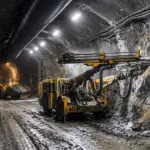
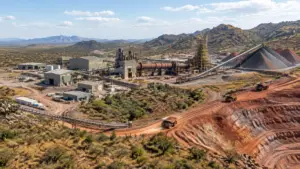
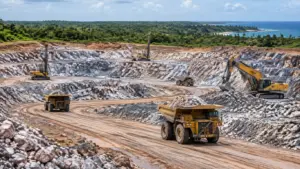
An underground power system in a hard-rock mining operation.

By Penny Langford
Hemlo Mining shares fell sharply after a temporary underground power outage curtailed work at the company’s namesake gold mine in northern Ontario, raising questions about the timing of a planned production ramp-up and the reliability of critical mine infrastructure.
The outage occurred on Sept. 4 at an electrical substation serving part of the Alimak production area on the 9,765 level. No one was injured, and Hemlo Mining said underground personnel were safely brought to surface. Mining and processing in other areas of the operation have continued.
The disruption is nevertheless material because the affected zone was part of the plan to increase underground throughput toward 4,800 tonnes per day by year-end. Analysts cited by The Northern Miner said throughput could instead trend closer to 3,800 tonnes per day while access to certain stopes remains constrained.
Hemlo Mining’s shares dropped 8.9% to C$7.55 in Toronto trading, valuing the company at roughly C$2.2 billion. The stock had traded between C$3.63 and C$8.47 over the previous year.

Temporary bypass restores some power
Hemlo Mining said a temporary electrical bypass has restored power to the affected area at reduced capacity. The arrangement allows some mining activity to continue, but development and exploration remain limited until full power is restored.
The company has completed an assessment of the damaged infrastructure and is working on repair and expedited replacement plans. It also said it is evaluating backup power options, accelerated equipment procurement and the possible relocation of electrical infrastructure from other parts of the mine.

A replacement substation had already been ordered through Hemlo’s critical-spares program before the outage. The unit, estimated to cost about US$250,000, is expected to arrive in December.
Until then, the operation is relying on mine sequencing and existing flexibility to limit the impact. Hemlo Mining President and CEO Jason Kosec said teams were evaluating opportunities to move development and mining into other areas.
The company’s asset contains more than 300 kilometres of existing mine development and several active mining zones. That network provides alternatives for production and explains why the processing plant and unaffected mining areas have continued operating.
However, flexibility does not eliminate the near-term problem. If alternative areas cannot deliver the required tonnes or grades, the mine may process less ore or draw from lower-grade material while the affected production area remains constrained.
| Operational measure | Previous plan or status | Current risk |
|---|---|---|
| Planned underground throughput | 4,800 tonnes per day by year-end | Ramp-up could be delayed |
| Potential near-term throughput | : | Analysts estimate closer to 3,800 tonnes per day |
| Estimated second-half gold output | Prior plan | Scotia Capital expects about 59,600 ounces, 20% lower |
| Replacement substation | Ordered before the incident | Delivery expected in December |
| Processing plant | Continued operating | Unaffected directly by the outage |
| Development and exploration in affected area | Ongoing before outage | Limited until full power is restored |
Sources: The Northern Miner and Hemlo Mining.
Guidance risk is larger than the repair bill
The direct replacement cost is modest relative to Hemlo Mining’s market value. The larger financial issue is lost or deferred production during a transition year for the mine.
Scotia Capital analyst Ovais Habib estimated that Hemlo could produce about 59,600 ounces of gold in the second half, a reduction of approximately 20% from the previous expectation. Habib said the ounces were likely delayed rather than permanently lost, but the timing remains important for revenue, costs and investor confidence.
National Bank Financial analyst Don DeMarco described the incident as accentuating Hemlo’s transition year. He said the affected Alimak production area was an important part of the expansion plan and that access to certain stopes had been delayed.
TD Securities analyst Steven Green also warned that the outage could affect near-term grades and slow the planned production increase.
Hemlo Mining has not published a revised formal production target in the outage announcement. That leaves investors watching for several potential consequences:
- A delay in reaching the 4,800-tonne-per-day target.
- Lower second-half gold sales than previously expected.
- Higher unit costs if fixed operating expenses are spread across fewer ounces.
- Additional capital spending on temporary power, repairs and redundancy.
- A possible shift in the timing of exploration and development work.
Those risks matter because Hemlo is still establishing itself as a standalone producer. The company acquired the operation from Barrick Mining in late 2025 and has been investing in mobile equipment and mine planning to increase output. It also intends to reopen the open pit, which was closed in 2020, to provide additional feed for a mill currently operating at about 40% of capacity.
Hemlo produced approximately 121,000 attributable ounces of gold last year, while the company reported stronger full-year production of 143,458 ounces in a February operating update. The current ramp-up is therefore central to the investment case, not a marginal improvement to an already stable production base.

Underground access and production infrastructure are highly dependent on continuous power.
Why underground power is a recurring risk in northern Ontario
The Hemlo outage also highlights a broader reliability issue for remote northern operations: electricity is often available, but the infrastructure that delivers it can contain important single points of failure.
Large mines may be connected to reliable provincial grids, yet individual operations can depend on long transmission lines, single substations or localized underground feeders. A failure at one of those nodes does not necessarily shut down an entire mine, but it can isolate a production zone, hoisting system, ventilation circuit or development heading.
The distinction is important. Emergency generators and backup systems are generally designed to maintain safety-critical functions such as ventilation, communications, dewatering and controlled access. They are not always sized to maintain full production.
Underground mining is particularly sensitive because electricity supports several systems at once:
- Ventilation and air-quality monitoring.
- Hoisting, pumping and dewatering.
- Drilling, mucking and material handling.
- Ground-control monitoring and communications.
- Charging systems for electric mobile equipment.
- Development infrastructure and underground workshops.
As mines adopt more electric equipment, power reliability becomes more important rather than less. A localized outage can affect not only production equipment but also charging capacity and the ventilation needed to operate in active headings.
A recent analysis of disruption at Alamos Gold’s Young-Davidson mine in Ontario described a regional power-line outage as one factor that compounded other operational constraints. The example does not indicate that Hemlo faces the same technical problem, but it illustrates how regional outages and mine-level infrastructure failures can interact.
The wider region is also planning for greater electricity demand. A Northwestern Ontario Municipal Association energy task force report warned that existing and proposed transmission capacity may not be sufficient for projected mining growth. Ontario has separately identified transmission expansion as important to improving reliability and supporting new mineral development.
For existing mines, that creates two distinct risks. The first is a local failure, such as Hemlo’s substation outage. The second is a regional constraint if several new mines compete for limited transmission capacity or if a major line is damaged by severe weather, wildfire or equipment failure.
Investor read-across: execution risk comes first
The market reaction shows that investors were not treating the outage as a routine maintenance issue. Hemlo’s valuation reflects expectations for growth, and the blackout has challenged the timing of that growth.
The positive case remains intact in several respects. The mill and other mining areas are operating, the affected zone remains accessible, and management has identified alternative mine areas that could support production. The company also has a substantial existing development network and a replacement substation already in the procurement process.
The risks are concentrated around execution. Investors need evidence that the bypass can support safe and consistent production, that alternative stopes can deliver comparable grades, and that full power can be restored without further delays.
Key indicators to monitor include:
- Full-power restoration: Whether the replacement or repaired substation arrives and is commissioned on schedule.
- Throughput: Whether mine rates move toward 4,800 tonnes per day or remain near the lower 3,800-tonne estimate.
- Grades and recoveries: Whether resequencing changes the quality of ore delivered to the mill.
- 2026 guidance: Whether the company formally revises gold production or cost expectations.
- Capital requirements: Whether temporary mitigation expands beyond the announced replacement equipment.
- Reliability investment: Whether Hemlo adds permanent redundancy to underground power systems.
A television-style stock verdict would be tempting after an 8.9% decline, particularly with gold prices still supporting producer margins. But the more useful conclusion is narrower: this is an execution-risk event, not a change to the long-term gold price outlook.
The outage does not by itself undermine Hemlo’s resource base, processing infrastructure or broader mine-life strategy. It does, however, make the company prove that its planned ramp-up can proceed despite a critical infrastructure failure.
For now, the stock’s next direction is likely to depend less on the size of the replacement substation than on the credibility of the recovery timeline, the quality of alternative ore and the company’s ability to protect production while rebuilding power capacity.

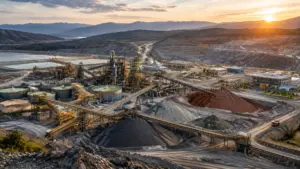
Hemlo’s remote setting increases the importance of resilient site infrastructure and critical spares.
What comes next
Hemlo Mining said it will continue using alternative mine sequencing while crews advance repair and replacement plans. The company’s December delivery target for the replacement substation provides a reference point, but the market will likely look for earlier evidence that temporary measures are working.
The key question is whether the outage results in a short delay to planned ounces or exposes a deeper weakness in the mine’s power architecture. A successful bypass, steady throughput and timely equipment installation would support the company’s view that the impact is localized and manageable.
A prolonged restriction, weaker grades or further equipment failures would increase the risk that the production ramp-up shifts into next year and that costs rise during the transition.
Until those questions are answered, Hemlo remains a gold growth story with a newly visible infrastructure risk.

Control-room monitoring is central to managing power, ventilation and production continuity underground.
This article is for information purposes only and does not constitute investment advice or a recommendation to buy or sell any security, commodity or financial instrument.