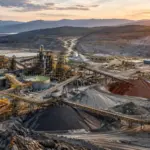
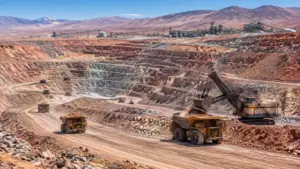
Conceptual editorial image of an open-pit gold project in Chile’s Atacama region.

Tesoro Gold’s maiden 1.28 million-ounce Ore Reserve at the Ternera deposit gives the El Zorro project a more defined development case, but it does not remove the technical and financing work still required before construction.
The reserve totals 42.8 million tonnes at 0.93 grams per tonne gold, with the material contained within a single planned open pit. Tesoro says the reserve supports a production life of more than 13 years at a planned processing rate of 3.0 million tonnes per year.
For project valuation, the significance extends beyond the headline ounces. The reserve converts a portion of Ternera’s higher-confidence Mineral Resource into mineable inventory, establishes a production schedule for the definitive feasibility study (DFS), and provides a basis for testing capital, operating and permitting assumptions.
The conversion is also a useful measure of geological confidence. According to reporting by Small Caps, the 1.28Moz reserve represents about 87% of the 1.47Moz contained in the Measured and Indicated portion of Tesoro’s August 2026 Mineral Resource Estimate. No Inferred material is included in the reserve.

What the maiden reserve changes
A Mineral Resource describes material with reasonable prospects for eventual economic extraction. An Ore Reserve goes further. It applies modifying factors such as mining methods, pit design, metallurgy, processing, infrastructure, costs, recovery, royalties, taxes and permitting assumptions.

That distinction changes how analysts evaluate a project.
Before the reserve, Ternera’s value was primarily linked to its resource scale, exploration potential and earlier study outcomes. The maiden reserve now provides a defined inventory against which Tesoro can model mine production, capital requirements and cash flow.

The reserve is divided between:
| Reserve category | Tonnes | Gold grade | Contained gold |
|---|---|---|---|
| Proved | 2.8 Mt | 1.05 g/t | 93 koz |
| Probable | 40.1 Mt | 0.92 g/t | 1.19 Moz |
| Total | 42.8 Mt | 0.93 g/t | 1.28 Moz |
Source: Tesoro Gold disclosures as reported by Small Caps. Figures may not add precisely because of rounding.
The relatively small Proved component is important. Most of the reserve is Probable, which is common for a development-stage open-pit project but leaves room for further drilling, grade-control work and operating reconciliation to influence confidence as the project advances.
Why the 87% conversion matters
The conversion ratio is not a measure of project profitability by itself. It is an indication of how much of the Measured and Indicated resource survived the transition from a geological estimate to an economically mineable plan.
An 87% conversion of contained gold suggests that the initial pit design captures most of the higher-confidence inventory. It also indicates that the conversion was not dependent on adding Inferred material to support the mine schedule.
However, the reserve grade of 0.93 g/t is below the broader resource grade cited in Tesoro’s technical materials. That difference reflects the practical effects of pit optimisation, mining dilution, ore loss, cut-off assumptions and the exclusion of material that did not meet reserve criteria.
The key question for the DFS is therefore not simply whether Ternera contains 1.28Moz. It is whether the selected pit can deliver the expected grade and recovery consistently at the planned production rate.

Exploration drilling and geological definition remain important as Ternera moves toward a DFS.
Open-pit geometry is central to value
The reserve is contained entirely within a single open pit, rather than a combination of multiple pits or an underground operation. That simplifies the development concept, but it concentrates several risks in one mine design.
Tesoro said the selected pit shell was based on optimisation using a US$3,000 per ounce gold price. The shell price is an economic input, not a guaranteed long-term gold price. It influences the amount of waste that can be moved profitably and therefore the shape and depth of the reserve pit.
For investors and operators, the most important geometry-related variables include:
- Strip ratio: the volume of waste that must be removed for each tonne of ore.
- Pit slope angles: steeper slopes can reduce waste movement but increase geotechnical risk.
- Ore loss and dilution: contacts between ore and waste affect delivered head grade.
- Mining sequence: early access to higher-grade material can improve project cash flow.
- Haulage distance: changing pit depth and waste-dump locations can affect fuel, fleet size and cycle times.
- Pit-bottom access: deeper mining may require larger ramps, additional dewatering and more complex traffic management.
The reserve announcement describes conventional open-pit mining at a 3.0Mtpa processing rate. At a simple annualised level, 42.8Mt divided by 3.0Mtpa would suggest approximately 14.3 years of mill feed. The stated mine life of more than 13 years reflects the fact that real schedules include ramp-up, stockpiles, changing mining rates, plant availability and material movement that does not translate directly into processed ore.
The first 10 years are expected to average 1.16 g/t gold, above the overall reserve grade. If delivered, that front-end grade profile could support stronger early cash generation than a flat production schedule. It also makes shortfalls during ramp-up more consequential because delays can affect the period when the mine is expected to process its better-grade material.
Processing assumptions provide another valuation bridge
Tesoro has described Ternera as suitable for a conventional crushing, grinding, gravity and carbon-in-pulp (CIP) flowsheet. Its materials cite a design gold recovery of 94.5%, supported by metallurgical test work.

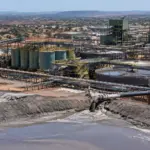
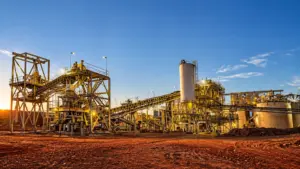
Conceptual editorial image of conventional gold processing infrastructure.
Recovery is a major bridge between geological ounces and payable ounces. Applying 94.5% recovery to 1.28Moz would imply approximately 1.21Moz recovered before accounting for refining, royalties and other commercial deductions. That is an arithmetic illustration, not a production forecast.
The DFS will need to confirm whether the selected flowsheet performs consistently across the reserve’s different rock types and mining phases. Metallurgical variability, grind size, water availability, reagent consumption and plant availability can all affect operating costs and recovered gold.
Tesoro’s earlier project materials also identified infrastructure requirements including power, water, run-of-mine pads, waste-rock storage and processing facilities. These items are not secondary to the reserve. In a remote or arid operating environment, water supply, grid connection and construction logistics can materially change the project’s capital intensity.
What the reserve means for project economics
Tesoro’s reported study metrics have changed as Ternera has moved from earlier scoping work toward a larger development concept. Its project website lists earlier scoping-study parameters including a 3.0Mtpa operation, a conventional CIP plant and a mine schedule of about 14 years, while the latest reserve announcement provides the updated reserve foundation for the DFS.
A separate report by Small Caps cited pre-feasibility-level capital of US$276.5 million, operating costs of US$1,538 per ounce and a post-tax NPV of US$994 million at a US$3,500 per ounce gold price. Those figures should be treated as study outputs rather than a final investment decision. The DFS may change capital, schedule, costs and returns as engineering advances.
The following framework separates the main valuation variables without presenting a stock recommendation:
| Scenario | Operating and market assumptions | Main valuation effect | Key evidence required |
|---|---|---|---|
| Base case | Reserve grade broadly reconciles; 3.0Mtpa ramp-up is achieved; recovery approximates 94.5%; gold price supports the current study framework | Establishes the project’s reference NPV, capital intensity and payback profile | DFS capital estimate, mine schedule, updated cost curve and permitting pathway |
| Bull case | Higher-grade zones improve early feed; resource conversion adds mineable ounces; plant availability and recovery outperform assumptions; gold remains strong | Higher early cash flow, longer mine life or improved project returns | Grade-control results, drilling conversion, metallurgical variability and infrastructure quotes |
| Bear case | Lower head grades, slower ramp-up, higher strip ratio, weaker recovery, cost inflation or permitting delays | Lower recovered ounces, higher capital needs and reduced or delayed cash flow | Geotechnical studies, water and power agreements, contractor pricing and environmental approvals |
This framework is designed to be updated when Tesoro releases the DFS. It also provides a useful template for comparing Ternera with other gold development projects: reserve confidence, recovered ounces, capital per annual ounce, operating cost, mine-life profile and permitting status.
The DFS risks that still matter
The maiden reserve is a milestone, not the end of the development process. The principal risks now shift from resource definition toward execution.
Capital and cost escalation are immediate concerns. A 3.0Mtpa plant, open-pit fleet, waste facilities, water systems, power connection and site infrastructure will require firm engineering and contractor estimates. Inflation in equipment, fuel, construction labour and consumables could reduce project returns.
Geotechnical performance is also central. The selected pit shell depends on slope assumptions. If final geotechnical work requires flatter slopes, the strip ratio and waste movement could rise.
Grade reconciliation will determine whether the reserve model performs in the field. Open-pit operations can experience dilution and ore loss that reduce mill feed grade even when the resource model is sound.
Permitting and water supply remain material in northern Chile. Small Caps reported that environmental and sectorial permit applications were progressing, with further submissions expected as the project advances. The schedule, conditions and mitigation requirements will be important inputs to the DFS and financing plan.
Funding and construction readiness will ultimately determine whether the reserve becomes production. A strong reserve can improve a project’s financeability, but lenders and partners will still focus on capex confidence, jurisdictional requirements, offtake terms, execution capability and downside resilience.

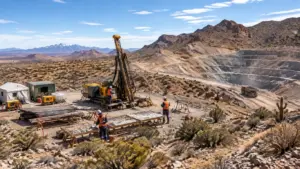
Conceptual editorial image of site infrastructure and open-pit development in an arid mining region.
Bottom line
Tesoro Gold’s 1.28Moz maiden reserve changes Ternera from a resource-led exploration and development story into a project with a defined open-pit inventory and a mine-life framework.
The strongest features are the high conversion of Measured and Indicated ounces, the exclusion of Inferred material, the single-pit configuration and the planned 3.0Mtpa throughput. The main caveat is that most of the reserve is Probable, while the economic case remains sensitive to pit geometry, grade reconciliation, capital costs, permitting and gold prices.
The next value-defining milestone is the DFS. It will show whether the reserve can support a construction-ready project under more detailed engineering, cost and permitting assumptions. Until then, the reserve should be viewed as a stronger technical foundation for valuation; not as a guarantee of project economics or future production.
For broader market context, follow Skillings’ gold mining coverage and analysis of critical-minerals supply chains.
This article is for editorial and informational purposes only. It does not constitute investment advice or a recommendation to buy or sell securities.