Honey Badger Silver’s updated preliminary economic assessment raises Prairie Creek’s after-tax net present value to about C$1.2 billion, supported by higher silver, zinc and lead prices, a revised mine plan and existing underground infrastructure.

By Penny Langford
Honey Badger Silver (TSXV: TUF) has nearly tripled the estimated value of its Prairie Creek silver-zinc-lead project in Canada’s Northwest Territories, lifting the mine’s after-tax net present value to approximately C$1.2 billion from C$419.7 million in the previous 2021 study.
The updated preliminary economic assessment, reported by The Northern Miner and released by the company, outlines a 22-year underground operation with average annual payable production of approximately 2.55 million ounces of silver, 117.2 million pounds of zinc, 94.5 million pounds of lead and 1.34 million pounds of copper.
The revaluation comes as silver prices have moved sharply higher in 2026. The company’s spot-price case uses silver at US$66.41 per ounce, compared with a long-term consensus assumption of US$50 per ounce. Zinc, lead and copper prices are also higher in the updated model than in the earlier assessment.

Prairie Creek is a past-producing mine in the Mackenzie Mountains, roughly 550 kilometres southwest of Yellowknife and near the Nahanni National Park Reserve. The site contains an existing mill, airstrip, camp facilities and approximately five kilometres of underground workings.

That brownfield infrastructure is central to the project’s investment case. Honey Badger acquired the asset for approximately C$12 million earlier this year, giving the junior mining company control of a permitted project with substantial historical capital already invested.
Updated economics point to strong metal-price leverage
The updated PEA uses three pricing cases: long-term consensus, spot pricing and a higher historical price case.

| Metric | Long-term consensus | Spot-price case | LTM high case |
|---|---|---|---|
| Silver price | US$50.00/oz | US$66.41/oz | US$121.67/oz |
| Zinc price | US$1.50/lb | US$1.84/lb | US$1.84/lb |
| Lead price | US$0.90/lb | US$0.85/lb | US$0.95/lb |
| Copper price | US$5.00/lb | US$6.68/lb | US$6.92/lb |
| After-tax NPV at 8% | C$1.165B | C$1.836B | C$3.240B |
| After-tax IRR | 29.3% | 38.2% | 54.8% |
| After-tax payback | 3.1 years | 2.4 years | 1.6 years |
The long-term consensus case is the principal basis for the approximately C$1.2-billion valuation. It forecasts C$3.17 billion of after-tax life-of-mine free cash flow, a 29.3% after-tax internal rate of return and a payback period of 3.1 years.
At spot prices, after-tax net present value rises to approximately C$1.84 billion, while the company’s higher historical-price case produces an after-tax NPV of about C$3.24 billion.
The study also shows the importance of Prairie Creek’s polymetallic production profile. Zinc, lead and copper revenue provides substantial by-product credits, reducing the effective cost of producing silver. Honey Badger reports an all-in sustaining cost of approximately negative US$22 per ounce of silver under the long-term consensus case and negative US$36 per ounce under the spot case.
Those figures should be treated as model outputs rather than operating results. The project has not yet reached commercial production, and the PEA remains preliminary.
Higher production in the early years
The mine plan anticipates underground mining at an average rate of approximately 2,400 tonnes per day. Run-of-mine material would first pass through dense-media separation before being processed at an average mill rate of about 1,500 tonnes per day.
The first seven years are expected to carry a higher-grade production profile, averaging approximately:
- 3.7 million ounces of silver per year
- 157 million pounds of zinc per year
- 118 million pounds of lead per year
- 2.2 million pounds of copper per year
- Approximately 10.7 million ounces of silver equivalent annually
Over the full 22-year mine life, average production is expected to moderate to approximately 7.9 million ounces of silver equivalent per year.
The updated mineral resource estimate contains 11.63 million tonnes of measured and indicated resources grading 115 grams per tonne silver, 8.16% zinc, 7.19% lead and 0.23% copper. Inferred resources total approximately 8.47 million tonnes, grading 130 grams per tonne silver, 11.03% zinc, 6.13% lead and 0.33% copper.
The resource increase helped extend the mine life from 20 years to 22 years. However, grades in the measured and indicated category declined from the earlier estimate, and the updated resource is based on historical rather than new drilling.

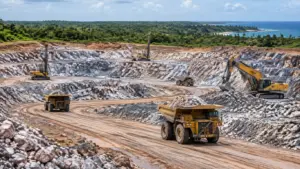
Existing underground workings are a key part of Prairie Creek’s brownfield development case.
Infrastructure reduces some risks, but access remains critical
Prairie Creek’s existing infrastructure distinguishes it from many early-stage silver and critical-minerals projects. The PEA assumes the refurbishment and use of existing underground workings, a historic mill and related site facilities.
The project’s estimated pre-commercial production capital is approximately C$667 million. The largest single component is a proposed 170-kilometre all-season road, estimated to cost approximately C$205 million.
The road would replace reliance on seasonal winter access and support year-round transportation of supplies and concentrates. Honey Badger has previously announced a potential contribution of more than C$20 million from the federal National Trade Corridors Fund, subject to applicable conditions.
The company has not committed to a formal commercial production date in the updated PEA. Executive Chair Chad Williams told The Northern Miner that initial test output could begin as early as next summer to demonstrate zinc and lead concentrate production from the existing mill. Full year-round production would require the all-season road and additional mine development.
Honey Badger is targeting a feasibility study for the second quarter of next year. That study will need to refine the mine plan, validate capital costs, confirm processing assumptions and establish a more detailed construction and commissioning schedule.

Year-round access is one of Prairie Creek’s largest remaining infrastructure requirements.
Re-rating risk and reward
The market reaction was immediate. Shares rose more than 12% to 71 cents in Toronto following the announcement, giving Honey Badger a market capitalization of roughly C$175 million, according to The Northern Miner.
That valuation remains well below the project’s updated after-tax NPV, but the gap should not be read as a simple measure of undervaluation. Prairie Creek is still a development project, and the PEA includes inferred resources that are considered too speculative to support demonstrated economic viability. No mineral reserves have been established.
The main question is whether Honey Badger can convert a strong study into a financeable construction plan without losing the leverage that has attracted investors.
| Potential scenario | What would drive it | Main risk |
|---|---|---|
| Base case | Feasibility study confirms the 22-year mine plan and long-term consensus prices | Capital costs or schedule increase |
| Bull case | Silver remains elevated, by-product prices strengthen and a staged restart generates early cash flow | Higher prices can encourage aggressive assumptions |
| Bear case | Silver retreats, road financing is delayed or mill refurbishment costs rise | Funding needs could lead to dilution or a slower restart |
The upside case is clear: Prairie Creek offers exposure to silver, zinc, lead and copper in a Canadian jurisdiction, with existing infrastructure and a production profile that could make it relevant to the North American critical-minerals supply chain.
The risk is equally clear: the C$1.2-billion value is a preliminary, price-sensitive estimate that depends on construction capital, logistics, permitting, financing and execution. The all-season road alone represents almost one-third of initial capital in the PEA.
For Honey Badger and comparable silver-zinc developers in established mining jurisdictions, the market is likely to reward projects that can demonstrate three things: a credible path to production, access to non-dilutive or project-level financing, and resilience under lower metal prices.
Prairie Creek has strengthened its case on the first point through its existing infrastructure. The next test will be whether the feasibility study can preserve the economics while narrowing the gap between a compelling model and an operating mine.

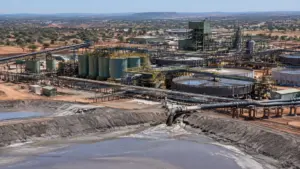
The PEA assumes dense-media separation followed by milling and production of lead and zinc concentrates.
What investors and operators will watch next
The feasibility study will be the next major milestone. Key areas to monitor include:
- Capital-cost validation: whether the C$667-million pre-production estimate holds after engineering work and contractor pricing.
- Road development: the timing, funding structure and permitting pathway for the 170-kilometre all-season corridor.
- Processing performance: confirmation that the existing mill can achieve the projected recoveries for silver, zinc, lead and copper.
- Staged production: whether initial concentrate production can begin before full road construction.
- Resource conversion: the extent to which inferred resources can be upgraded through drilling and further geological work.
- Commodity-price sensitivity: the project’s resilience if silver returns closer to the long-term consensus case or below it.
The company also says the PEA does not assign economic value to potential by-products such as germanium, antimony and tungsten, or to recently announced Canadian tax incentives. Those opportunities could provide additional upside, but they remain outside the current economic base case.
Prairie Creek has moved from a distressed brownfield asset to one of the more closely watched silver and critical-minerals development stories in Canada. The updated PEA provides a substantially larger economic framework. The feasibility study, access road and financing plan will determine whether that framework can become a mine.
Sources: The Northern Miner report and Honey Badger Silver’s PEA release. For wider context, see Skillings’ analysis of critical-minerals supply-chain constraints.