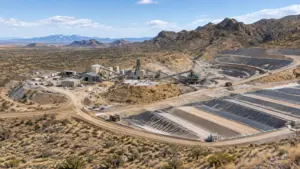
The Crawford project is designing autonomy, electrification and fleet management into its mine plan from the outset.

Canada Nickel’s planned Crawford nickel project in Ontario is putting a significant number on the development of autonomous mining technology: more than 300 machines with an estimated fleet value of about C$1.5 billion over the mine’s planned operating life.
The proposed fleet, to be supplied through Komatsu and SMS Equipment, would combine autonomous haulage, DISPATCH fleet management, trolley assist and a pathway toward battery-electric trucks. The selection is not an operating fleet yet, and the definitive supply and support agreements are targeted for completion in the first quarter of 2027. Even so, Crawford offers a useful benchmark for how large greenfield mines are being designed around automation and energy management rather than retrofitting those systems later.
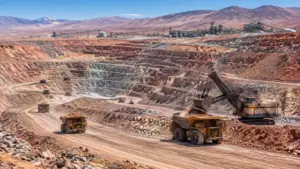
The project’s bankable feasibility study envisages approximately 290-tonne haul trucks, autonomous drilling, remote-controlled loading equipment and trolley infrastructure on key haul routes. Canada Nickel says the planned technology combination could reduce unit mining operating costs by about 26% and the open-pit labour component by about 33%. Those figures are project estimates, not guarantees, but they show why automation has become a central part of mine design.
Why the Crawford fleet matters
The most important feature of the proposal is not simply the number of machines. It is the attempt to coordinate the fleet as one operating system.
Large open-pit mines typically depend on a chain of linked activities: drilling, blasting, loading, hauling, dumping, road maintenance, refuelling and equipment servicing. A delay in one area can create queues throughout the system. Autonomous haulage can improve cycle consistency, but only if dispatch software, mine planning, communications and loading equipment work together.

Crawford’s planned fleet selection follows a competitive process involving four equipment vendors, according to reports from IM-Mining and the Canadian Mining Journal. The fleet value of C$1.5 billion should be read as a long-term procurement estimate rather than an immediate construction payment. Equipment would be purchased over the mine’s expected 40-year life as production areas and mining stages develop.
That distinction is important for investors and project financiers. The equipment number signals the scale of future capital requirements, but it does not represent the full construction cost of Crawford or a single up-front purchase order.
How autonomous haulage and DISPATCH fit together
Autonomous haulage systems use onboard sensors, positioning technology, machine controls and central supervision to move trucks without a driver in the cab. In a controlled open-pit environment, the system can manage speed, stopping, route selection and interaction with defined operating zones.
At Crawford, the planned haulage system is expected to use Komatsu’s FrontRunner autonomous haulage technology alongside DISPATCH fleet management. The two systems perform related but distinct functions:
- Autonomous haulage controls the truck’s movement within approved operating boundaries.
- DISPATCH assigns trucks to shovels, crushers, stockpiles and dump locations.
- Fleet management tracks cycle times, queueing, availability, fuel or energy use and maintenance requirements.
- Mine control manages exceptions, interventions, road closures, blasting zones and interactions with manually operated equipment.
The result is intended to be a more coordinated load-and-haul system. A truck should not simply drive autonomously; it should arrive at the right loading unit, follow the most efficient route, maintain a suitable state of charge and avoid creating congestion elsewhere in the mine.

Autonomous operations require production, safety and energy data to be managed from a common control environment.
This is increasingly relevant as mines introduce mixed fleets. A future operation may include autonomous diesel-electric trucks, trolley-assisted vehicles, battery-electric trucks, support equipment and manually operated maintenance units. DISPATCH-style systems must account for all of them while maintaining clear traffic rules and safe exclusion zones.
Skillings’ wider autonomous mining technology coverage has examined how fleet software is becoming an energy-management tool as well as a production system.
Trolley assist as the bridge to battery-electric haulage
Crawford’s plan does not assume that every ultra-class truck will be battery-electric from the first day of production. Instead, trolley assist is intended to reduce diesel use while creating electrical infrastructure that can support a later transition.
Trolley-assist trucks use overhead lines on selected sections of a haul road, typically steep ramps. The truck draws electricity through a pantograph while travelling beneath the lines. Diesel power remains available away from the trolley corridor, allowing the vehicle to operate across the wider mine.
For Crawford, the feasibility study envisages trolley infrastructure across most mining stages, with lines also serving selected stockpiles and the waste rock impoundment. The smaller East Zone starter phases are expected to have limited or no trolley coverage because of shorter ramp distances.
This approach can provide several operational benefits:
- Lower diesel consumption on high-energy uphill segments.
- Higher speed or improved cycle consistency on steep ramps.
- Reduced exposure to fuel-price volatility.
- A power-distribution network that can support future charging infrastructure.
- A staged transition that avoids waiting for battery-electric trucks to meet every ultra-class duty-cycle requirement.
The Crawford bankable feasibility study coverage from IM-Mining describes trolley assist as part of a broader mine plan involving autonomous haulage and drilling. The technology is therefore not being treated as an isolated emissions project. It is part of the mine’s production design.

Trolley assist can reduce diesel use on energy-intensive ramps while preparing a mine for future electrification.
Linkable data table: Crawford fleet benchmark
| Measure | Crawford plan or estimate | Operational significance |
|---|---|---|
| Planned fleet | More than 300 machines | Indicates a mine-wide deployment rather than a small autonomy pilot |
| Estimated fleet value | About C$1.5 billion | Represents long-term equipment procurement across the mine life |
| Primary haul-truck class | Approximately 290 tonnes | Places the project in the ultra-class open-pit segment |
| Fleet management | Komatsu DISPATCH | Coordinates truck assignments, cycles, routes and production priorities |
| Autonomous haulage | FrontRunner AHS planned | Reduces reliance on cab-based truck operation |
| Trolley assist | Planned across most mining stages | Reduces diesel use on selected uphill routes |
| Unit mining-cost estimate | About 26% reduction | Project estimate linked to automation and trolley-assisted haulage |
| Open-pit labour estimate | About 33% reduction | Reflects fewer cab-based roles and more centralised operations |
| Future powertrain | Battery-electric pathway | Depends on commercial availability, duty cycle and infrastructure |
Figures are based on public project disclosures and feasibility-study reporting. They should not be interpreted as guaranteed operating outcomes.
Capital and workforce implications
Automation and electrification may reduce operating costs, but they increase the complexity of the initial mine design.
The C$1.5 billion fleet estimate covers equipment procurement over time. Additional capital would be required for trolley lines, substations, electrical distribution, communications networks, control rooms, workshops, sensors, software and training. Battery-electric conversion would add charging equipment, high-voltage systems, thermal-management capabilities and potentially larger grid connections.
The capital question is therefore broader than the price of an autonomous truck. Operators need to compare the total cost of ownership with a conventional fleet, including:
- Truck purchase and autonomy systems.
- Trolley and charging infrastructure.
- Electricity supply and peak-demand charges.
- Battery replacement and degradation.
- Maintenance requirements.
- Labour and training.
- Network redundancy and cybersecurity.
- Downtime during commissioning and system upgrades.
The workforce impact is also more complex than a simple reduction in headcount. Fewer employees may be required to drive haul trucks, but mines will need more people with skills in fleet control, automation, electrical maintenance, data analysis, network management and high-voltage safety.
Operators will increasingly work from control rooms or maintenance centres rather than inside the pit. Technicians will need to manage sensors, drive systems, battery packs, trolley equipment and software faults. Training will also need to cover arc-flash prevention, isolation procedures, battery thermal events and recovery from autonomous-system interruptions.

Electrified autonomous fleets shift workforce demand toward controls, reliability and high-voltage maintenance.
Base, bull and bear scenarios
| Scenario | Key assumptions | Likely outcome |
|---|---|---|
| Base case | Crawford proceeds with staged autonomy and trolley assist while battery-electric ultra-class equipment continues to mature | Mixed fleets remain common, with autonomous diesel-electric and trolley-assisted trucks operating alongside future battery-electric units |
| Bull case | Ultra-class battery trucks achieve reliable range and availability; grid and charging infrastructure are delivered on schedule | New mines adopt integrated autonomous-electric designs, while trolley corridors become conversion routes for full battery-electric operation |
| Bear case | Project financing, permitting, grid upgrades or equipment availability are delayed; battery performance remains difficult in long, steep cycles | Operators limit autonomy to selected routes and defer wider electrification, retaining conventional diesel-electric fleets for flexibility |
The base case appears the most practical for the sector. Even where automation is technically proven, mine owners typically phase deployment to manage construction risk, workforce transition and mixed-fleet operations.
What Crawford signals for mining technology
Crawford’s significance extends beyond nickel. Copper, gold, iron ore and other critical-minerals projects face similar pressures: higher energy costs, labour shortages, safety requirements and the need to reduce emissions without compromising production.
The project shows how those pressures can be addressed through mine planning. Autonomous haulage is linked to DISPATCH and loading systems. Trolley assist is linked to ramp design and power distribution. Future battery-electric trucks are linked to workshop layouts, charging capacity and workforce skills.
The key performance measures will be practical rather than promotional: tonnes moved per operating hour, truck availability, queue time, energy consumed per tonne-kilometre, intervention frequency, charger utilization and maintenance downtime.
Crawford is not yet proof that a 300-machine autonomous-electric mine can deliver its planned economics. It is, however, a clear indication of where greenfield mine design is heading. The competitive advantage will increasingly come from integrating autonomous technology, energy infrastructure and workforce planning into one operating model.
LinkedIn snippet
Canada Nickel’s planned Crawford project places more than 300 machines and an estimated C$1.5 billion fleet at the centre of a mine design built around autonomous haulage, DISPATCH, trolley assist and a future battery-electric transition. Our analysis examines the capital requirements, operating assumptions and workforce changes behind the proposed fleet.
X snippet
Crawford’s planned 300-plus-machine fleet could become a benchmark for autonomous mining technology. The design combines DISPATCH, autonomous haulage, trolley assist and a future battery-electric pathway. The harder question is integration: capex, grid capacity, maintenance and workforce skills.