Gina Rinehart’s Hancock Prospecting is putting another A$8.7 million behind copper exploration in Canada, taking a proposed 13.5% stake in White Cliff Minerals and adding a Nunavut project to a rapidly widening portfolio of critical-minerals investments.

The placement, worth approximately C$8.6 million, would make Hancock the largest shareholder in the ASX-listed explorer if approved. White Cliff plans to use the funds to accelerate drilling at its Rae Copper Project, where early results have identified high-grade copper and silver mineralisation across several targets.
The deal is the latest marker in a broader shift by Australia’s richest person. Hancock has spent the past year building exposure to rare earths, copper, gallium, antimony and precious metals, while also taking a significant position in private aerospace company SpaceX.
The pattern suggests that Hancock is no longer positioning itself solely as an iron-ore company. Instead, it is assembling a portfolio of commodities and technologies linked to defence, electrification, advanced manufacturing and Western supply-chain security.
White Cliff placement puts A$8.7 million into Nunavut copper
Under the proposed transaction, Hancock will subscribe for 515.79 million new White Cliff shares at A$0.017 each, according to the company’s ASX announcement.
| Transaction detail | Reported terms |
|---|---|
| Investor | Hancock Prospecting |
| Target | White Cliff Minerals |
| Project | Rae Copper Project, Nunavut |
| Investment | A$8.77 million |
| New shares | 515.79 million |
| Issue price | A$0.017 per share |
| Expected stake | Approximately 13.5% |
| Ticker | ASX: WCN; US-OTC: WCMLF |
| Main use of funds | Drilling and exploration |
| Key condition | White Cliff shareholder approval |
The placement remains subject to shareholder approval under ASX Listing Rule 10.11. White Cliff expects to hold an extraordinary general meeting around Oct. 19, with completion expected shortly afterward if the required conditions are satisfied.

White Cliff Managing Director Troy Whittaker described the investment as a significant milestone for the company. The financing gives the explorer additional capital to test the scale of Rae while bringing in a strategic shareholder with the balance sheet to support future exploration.
It also gives Hancock exposure to a copper project in a politically stable jurisdiction at a time when North American governments and industrial consumers are seeking alternatives to concentrated supply chains.


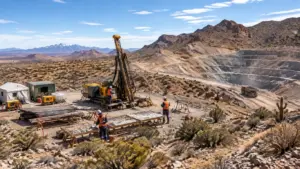
Remote field logistics will be a central consideration as White Cliff expands drilling across Rae.
Rae is still an exploration story, not a mine
The Rae project is located in a remote part of Nunavut, approximately 75 kilometres from Kugluktuk and within the broader regional logistics network linked to Yellowknife.
White Cliff has reported several encouraging drill intervals at the Danvers targets, including:
- 175 metres at 2.5% copper and 8.66 grams per tonne silver
- 90 metres at 4% copper and 7.5 grams per tonne silver
- 58 metres at 3.08% copper and 13.3 grams per tonne silver
- 105 metres at 2.25% copper
- 19.81 metres at 6.64% copper, including 7.62 metres at 11.38% copper
The company has also reported copper intersections at Danvers 2 and Danvers 3, including a 15-metre interval grading 4.8% copper at Danvers 2.
Those results are material for an early-stage explorer, but they do not represent a mineral resource or reserve. White Cliff must still demonstrate continuity, geometry, metallurgy and potential economic scale before Rae can be assessed as a development project.
The Hancock-backed work program will focus on several objectives:
- Increasing drill density at Danvers 1 to support an exploration target and potential maiden resource estimate.
- Testing Danvers 2 and Danvers 3 through step-out drilling.
- Extending sediment-hosted copper targets around the Hulk area.
- Conducting airborne geophysics and downhole electromagnetic surveys.
- Following up regional targets known as Thor, Rocket, Vision and Stark.
The project therefore offers two types of exploration upside: a higher-grade, structurally controlled copper system around Danvers and a broader sediment-hosted copper model that could expand the district’s footprint.

White Cliff’s next technical challenge is to convert strong drill results into a continuous geological model.
Hancock’s rare-earths strategy is built around minority stakes
The White Cliff investment fits a strategy that has become increasingly visible across Hancock’s recent transactions.
Rather than immediately acquiring entire companies, Hancock has generally taken minority positions in producers and developers at different stages of maturity. Reported stakes have included approximately:
| Company | Commodity and location | Reported Hancock exposure |
|---|---|---|
| Lynas Rare Earths | Rare earths, Australia and Malaysia | About 8% |
| Arafura Rare Earths | NdPr, Northern Territory | About 15%–18% |
| MP Materials | Rare earths, United States | About 8% |
| Brazilian Rare Earths | Rare earths, Brazil | About 6% |
| St George Mining | Rare earths and niobium, Brazil | About 6% |
| Rare Earths Americas | Rare earths, United States and Brazil | About 6% |
| White Cliff Minerals | Copper, Nunavut | Proposed 13.5% |
The holdings span established producers such as Lynas Rare Earths and developers such as Arafura Rare Earths. They also cover multiple geographies, including Australia, the United States, Brazil and Canada.
That approach spreads geological and development risk. It also provides exposure to several points on the supply chain, from rare-earth mining and separation to copper exploration and potential future processing.
The strategy is relevant because Western critical-minerals supply remains constrained not only by the availability of ore, but also by processing capacity, permitting and infrastructure. The International Energy Agency has warned that refining and midstream concentration remain key vulnerabilities across several energy-transition commodities. Skillings has examined that issue in its analysis of the critical-minerals supply chain bottleneck.
Gallium, antimony, gold and SpaceX broaden the thesis
The portfolio expansion is not limited to rare earths and copper.
Hancock has also built exposure to gallium, antimony and precious metals, commodities tied to defence manufacturing, electronics, strategic stockpiles and monetary demand. The exact size and structure of some private or less prominently disclosed investments are not publicly detailed, but the direction is clear: the group is targeting materials with strategic value beyond traditional bulk commodities.
The move into SpaceX adds a separate layer. Hancock reportedly acquired approximately 8 million SpaceX shares valued at around US$1.37 billion, according to U.S. regulatory disclosures cited by industry coverage.
That investment is not a mining deal, but it is consistent with a wider interest in aerospace, satellite infrastructure and defence-linked technology. Rare earths, gallium and antimony are all associated with applications that can touch electronics, guidance systems, communications and military equipment.
The result is a portfolio that connects resource extraction with downstream strategic industries. For Hancock, the logic may be less about owning one dominant commodity and more about gaining exposure to the materials and technologies required by a more contested global economy.
Why private capital is moving into Western critical minerals
Private capital has several advantages in early-stage mining.
It can move faster than a diversified public miner constrained by quarterly capital-allocation targets. It can also accept longer development timelines and tolerate a higher proportion of exploration failures, provided the overall portfolio contains enough potential upside.
For junior explorers, a strategic placement can provide more than cash. It can improve access to future financing, attract technical attention and create a potential pathway to larger transactions if exploration succeeds.
But minority investment does not eliminate the main risks. White Cliff still faces the practical challenges of operating in the Arctic, including seasonal access, weather, mobilisation costs, camp logistics and eventual infrastructure requirements.
Copper prices may improve the investment case, but commodity strength cannot compensate for weak geology or an uneconomic project. The critical question for Rae is whether the high-grade intersections form a sufficiently large, continuous and recoverable system.

Nunavut’s scale and remoteness increase both the exploration opportunity and the cost of development.
Base, bull and bear scenarios
| Scenario | What would need to happen | Strategic implication |
|---|---|---|
| Base case | Shareholder approval is secured, drilling expands, and Danvers supports a maiden resource target without yet proving project economics. | Hancock gains credible copper exposure, while White Cliff remains a high-risk explorer. |
| Bull case | Step-out drilling confirms continuity across Danvers, sediment-hosted targets add scale, and regional targets identify multiple mineralised centres. | Rae could become a district-scale copper opportunity and Hancock may gain a stronger strategic position. |
| Bear case | Mineralisation proves discontinuous, logistics and metallurgy weaken the development case, or the placement is delayed or rejected. | Hancock’s financial exposure remains limited, but White Cliff would need another route to sustain exploration. |
The company takeaway
In a Cramer-style shorthand, the White Cliff deal is a strategic option on copper, not proof that Hancock has found its next iron-ore-scale asset.
The attractive part is the asymmetry: A$8.7 million gives Hancock exposure to a potentially meaningful copper discovery while keeping its direct project risk limited. The less attractive part is that Rae remains an exploration project in one of the world’s most challenging operating environments.
For White Cliff, the transaction is more consequential. It provides immediate funding, validation from a high-profile mining investor and a clear work program. The company’s value will now be judged less by the announcement and more by the drill results that follow it.
For Hancock, the larger message is portfolio construction. Rare earths, copper, gallium, antimony, gold and SpaceX point to a private-capital strategy focused on the materials and technologies behind defence, electrification and advanced industry.
That does not make every investment successful. It does show that Hancock is building a position across the Western critical-minerals supply chain : one minority stake at a time.
LinkedIn snippet
Gina Rinehart’s Hancock Prospecting is putting A$8.7 million behind White Cliff Minerals, taking a proposed 13.5% stake in the Nunavut copper explorer. The deal adds copper to a portfolio already spanning rare earths, gallium, antimony, precious metals and SpaceX : a sign that private capital is positioning across the Western critical-minerals supply chain.
X snippet
Hancock Prospecting’s latest move: A$8.7M for a proposed 13.5% stake in Nunavut copper explorer White Cliff Minerals. The deal expands Gina Rinehart’s exposure beyond iron ore into copper, rare earths, gallium, antimony, precious metals and strategic technology.
Sources: White Cliff Minerals ASX announcement; White Cliff Minerals Rae project information; Hancock Prospecting; Hancock’s Rare Earths Americas investment.