By Charles Pitts

Sterling Metals has extended the continuous copper-mineralized core of its MEPS Zone to approximately 700 metres at the Soo Copper Project near Batchewana Bay, Ontario, after a step-out hole returned nearly 400 metres of copper-equivalent mineralization.
The company said drill hole SC-26-26, collared about 300 metres west of the core discovery area, intersected 397.19 metres grading 0.37% copper equivalent (CuEq). The interval included 200 metres at 0.53% CuEq, 101.9 metres at 0.81% CuEq and a higher-grade section of 13.25 metres at 1.82% CuEq.
The results, reported by Sterling and distributed through ACCESS Newswire, extend the MEPS Copper Zone by more than 300 metres to the west. The zone sits within a broader copper-mineralized footprint measuring approximately 1.3 kilometres by 600 metres, which remains open for further drilling.


Illustrative view of copper-bearing porphyry-style mineralization in drill core.

Step-out drilling extends the MEPS system
Sterling reported results from holes SC-26-25 and SC-26-26 as part of a minimum 20,000-metre exploration program at Soo Copper. The holes were drilled west of the MEPS discovery to test the system’s scale, continuity and geological architecture.
SC-26-25 returned 128 metres at 0.31% CuEq, including 82 metres at 0.40% CuEq and 24 metres at 0.86% CuEq. The adjacent SC-26-26 hole produced the longer and more continuous result.

| Drill hole | Interval | Length | Copper grade | CuEq grade |
|---|---|---|---|---|
| SC-26-25 | 157.00–285.00 m | 128.00 m | 0.28% Cu | 0.31% |
| SC-26-25, including | 244.00–268.00 m | 24.00 m | 0.80% Cu | 0.86% |
| SC-26-26 | 8.51–406.05 m | 397.19 m | 0.30% Cu | 0.37% |
| SC-26-26, including | 148.00–348.00 m | 200.00 m | 0.42% Cu | 0.53% |
| SC-26-26, including | 224.10–326.00 m | 101.90 m | 0.65% Cu | 0.81% |
| SC-26-26, including | 282.00–295.25 m | 13.25 m | 1.03% Cu | 1.82% |
Source: Sterling Metals. Reported intervals may not represent true widths.
Sterling’s release said both holes encountered copper-bearing porphyry-style veins within potassically altered mafic volcanic rocks and felsic porphyry. That geological continuity is significant because it links the western step-out drilling to the mineralized framework identified in earlier holes.
Jeremy Niemi, Sterling’s senior vice president of exploration and evaluation, described SC-26-26 as an important step-out that demonstrates the scale and continuity of the system. Assays from hole SC-26-27 remain pending, according to the company.
Why long intervals matter
Long, continuous mineralized intervals can be important in the early assessment of a porphyry copper system because they may indicate that copper is distributed across a broad volume of rock rather than concentrated only in narrow, isolated veins.
That distribution can be relevant to potential bulk-mining concepts. Large-scale open-pit operations typically require sufficient continuity and volume to support the movement and processing of substantial quantities of lower-grade material. A broad mineralized envelope may provide more flexibility in mine sequencing, blending and plant feed than a deposit defined only by narrow high-grade structures.
The SC-26-26 result also begins near the top of bedrock and continues to the end of the hole. Near-surface mineralization can be a positive geological feature for future technical studies because it may reduce the amount of barren material that would need to be removed before reaching mineralized rock.
Those considerations remain preliminary. The reported drill intervals are downhole lengths, and Sterling has not yet established their true widths. The company also noted that grades have not been capped.
Most importantly, exploration results do not establish an economic mineral resource, reserve, mine plan or project economics. Additional drilling, geological modelling, metallurgical testing, engineering studies, environmental work, permitting and economic analysis would be required before any development decision could be considered.
Geological continuity across the footprint
Sterling describes the MEPS system as a porphyry copper system hosted mainly in altered volcanic rocks intruded by multiple phases of felsic porphyry. Stronger copper grades are associated with felsic dykes and sills, magnetite-rich veining and potassic alteration involving biotite and magnetite.
The company said SC-26-26 intersected approximately 65 metres of felsic intrusive rock. Copper sulphides were present both within and near the intrusive unit and in quartz veins, consistent with the mineralization style observed elsewhere at MEPS.
The hole also contained intervals with copper, gold, silver and molybdenum credits. A 13.25-metre section grading 1.82% CuEq contained 1.03% copper, 0.30 grams per tonne gold, 7.60 grams per tonne silver and 837 parts per million molybdenum.
Sterling calculates CuEq using assumed metal prices and recoveries. For these results, the company used three-year trailing average prices of US$4.18 per pound copper, US$2,600 per ounce gold, US$30.54 per ounce silver and US$21.46 per pound molybdenum, with an assumed 80% recovery for each metal.
CuEq values are useful for presenting a combined indication of metal content, but they do not substitute for metallurgical recovery tests or an economic study. Actual recoveries, payable metals, operating costs and processing conditions would determine the commercial value of any future mineral resource.
Soo Copper’s infrastructure position
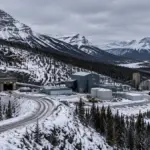
The Soo Copper Project covers more than 35,000 hectares in the Batchewana Copper Belt. Sterling’s project overview places the project about 80 kilometres north of Sault Ste. Marie and near major roads, rail access, deep-water facilities and existing power infrastructure.
The company says the project is approximately 20 kilometres from rail and deep-water access, with nearby highway connections and proximity to copper smelters outside Sudbury. Infrastructure can influence the capital and operating requirements of a potential mine, although proximity alone does not establish that a project will be economic or permitted.
Sterling has also reported a broader, multi-kilometre exploration trend at Soo Copper, including additional porphyry and breccia targets beyond MEPS. The immediate focus, however, remains on defining the geometry, grade distribution and continuity of the MEPS system.

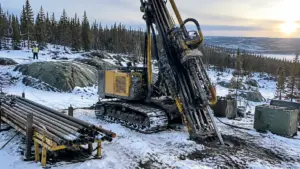
Illustrative view of the type of exploration infrastructure used to test a large copper system.
Copper market context
The drilling results come as the copper market faces renewed concern over future supply. Recent market reporting has placed copper prices near record levels, with LME prices trading around the US$14,000-per-tonne range in periods of strong physical demand.
Analysts have pointed to mine disruptions, declining grades at mature operations, constrained concentrate availability and limited near-term project growth. In an analysis of the market, Sprott Asset Management cited pressure on mine supply and rising demand from power grids, data centers, artificial intelligence infrastructure and electrification.
Forecasts for the copper balance vary. Reporting based on International Copper Study Group estimates has identified the possibility of a refined copper deficit, while other projections allow for a small surplus if scrap supply, refined production or demand assumptions change. The uncertainty does not remove the longer-term concern: new copper mines can take many years to move from discovery through permitting, financing, construction and ramp-up.
That market backdrop increases attention on exploration projects that could eventually contribute new supply. It does not, however, guarantee that any individual discovery will advance to production.
What comes next
Sterling plans to continue drilling at MEPS to test the system along strike, at depth and across the broader mineralized footprint. The company’s next steps will include reviewing pending assays, refining its geological interpretation and determining whether additional drilling can establish a sufficiently consistent volume of mineralization for resource modelling.
For operators and investors tracking the project, the key questions are whether the 700-metre zone continues to expand, how grades vary across the wider 1.3-kilometre-by-600-metre footprint, and whether future drilling can demonstrate reliable true widths and continuity.
The latest results strengthen the geological case that MEPS is a sizeable porphyry-style copper system. They remain exploration results, not an economic resource or mine plan.
Sources: Sterling Metals release, ACCESS Newswire market report, Soo Copper Project overview, Sprott copper market analysis, Skillings copper market coverage.