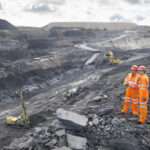
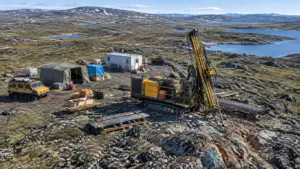
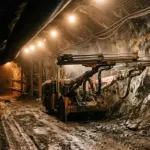
Remote silver-zinc-lead mine infrastructure in a rugged northern setting.

By Mo Shine
Honey Badger Silver’s updated preliminary economic assessment for the Prairie Creek silver-zinc-lead project in Canada’s Northwest Territories has almost tripled the mine’s estimated value, lifting after-tax net present value to about C$1.2 billion from roughly C$299 million in the previous study.
The reset comes as silver prices have tested the US$60–70 per ounce range, while the market faces another structural deficit and continued demand from solar manufacturing, electronics and other industrial applications. For developers, the combination is reshaping the economics of high-grade silver projects, but it is also placing greater focus on price assumptions, permitting and construction risk.
The updated Prairie Creek study is not a feasibility study, and its results remain conceptual. Even so, the scale of the change makes the project a useful reference point for examining the silver price outlook and the sensitivity of new mine supply to higher prices.
Prairie Creek’s valuation reset
Honey Badger’s updated PEA covers the PC Silver Mine, a high-grade underground project containing silver, zinc, lead and copper. According to coverage of the updated assessment by The Northern Miner, the study outlines a 22-year underground operation with average annual production of approximately:

- 2.5 million ounces of silver
- 117 million pounds of zinc
- 95 million pounds of lead
- 1.3 million pounds of copper
On a silver-equivalent basis, production averages about 7.9 million ounces per year, with higher output during the early years of the mine plan.
The updated PEA estimates:

- After-tax NPV at an 8% discount rate: approximately C$1.2 billion
- After-tax internal rate of return: approximately 29.3%
- After-tax life-of-mine free cash flow: approximately C$3.2 billion
- Payback period: approximately 3.1 years
- Mine life: approximately 22 years
By-product credits are central to the economics. The study indicates a negative all-in sustaining cost on a silver-only basis, estimated at approximately negative US$22 per ounce under long-term consensus prices. Zinc, lead and copper revenues effectively absorb a large share of the operating cost base.
That structure can provide protection when silver prices weaken, but it also introduces exposure to base-metal prices, treatment charges, transportation and operating performance. A project with strong silver grades is not insulated from broader concentrate-market conditions.

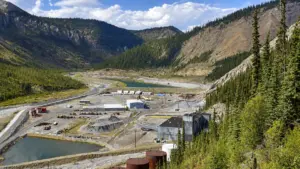
Flotation and concentrate-processing infrastructure illustrates the importance of by-product recovery.
Why the silver market matters
The updated PEA arrives during a period of unusually strong silver-market attention. The Silver Institute’s 2026 market outlook points to a sixth consecutive annual deficit.
The latest estimate places the 2026 shortfall at approximately 46.3 million ounces, based on demand of about 1.113 billion ounces and supply of approximately 1.066 billion ounces. Earlier preliminary estimates placed the deficit closer to 67 million ounces, and some market analysts continue to use a range of roughly 46 million to 67 million ounces depending on their supply and demand assumptions.
Industrial demand remains the key structural support. Solar manufacturers have reduced the amount of silver used per cell through “thrifting,” but total photovoltaic consumption remains substantial. Electronics, electrical equipment, electric vehicles, grid infrastructure and data-center hardware are also expanding the industrial demand base.
The Reuters report on the silver deficit and inventory drawdown highlights the role of above-ground inventories in balancing the market. When mine production and recycling fall short of consumption, the difference must be funded by stocks held in vaults, exchange warehouses, investment products and private holdings.
Declining LBMA vault inventories therefore matter even when they do not immediately create a supply shock. Lower available stocks can increase volatility and reduce the market’s ability to absorb a sudden increase in industrial or investment demand.
Silver projects and price markers
The table below provides a comparison of selected project indicators and the silver-price levels being monitored by developers and analysts.
| Project or market marker | Location | Key metric | Silver-price relevance |
|---|---|---|---|
| Prairie Creek / PC Silver Mine | Northwest Territories, Canada | Updated after-tax NPV of about C$1.2B; 22-year mine plan | Economics based on long-term consensus prices, with higher value at spot prices |
| Zgounder Silver Mine | Morocco | 783 g/t silver over 13 metres from surface in the open-pit area | Near-surface grades can support resource growth and mine-plan flexibility |
| Bowdens Silver Project | New South Wales, Australia | Largest known undeveloped silver deposit in Australia; historic feasibility study outlines 3.4 Moz annual silver production | Approval and financing decisions remain sensitive to silver, zinc and lead prices |
| 2026 official deficit marker | Global | About 46.3 Moz deficit | Indicates demand continues to exceed annual supply |
| Earlier deficit range | Global | About 60–70 Moz in some market estimates | Represents a more bullish inventory-drawdown scenario |
| Bear-case price band | Global | US$60–70/oz | Tests project margins, financing capacity and development schedules |
| Base-case price band | Global | US$70–80/oz | Supports stronger economics for high-grade, polymetallic projects |
| Bull-case price band | Global | US$85–100/oz | Raises operating leverage but may also increase inflation and construction costs |
The figures are not directly comparable: Prairie Creek’s PEA uses its own metal-price deck, exchange rates, capital assumptions and discount rate, while the Zgounder and Bowdens data relate to exploration, permitting or earlier technical studies.
Zgounder adds a grade-growth angle
Aya Gold & Silver’s Zgounder mine in Morocco provides a different example of how companies are responding to higher silver prices: extending the life and flexibility of an operating asset through drilling.
In a Sept. 16 release, Aya reported that surface reverse-circulation hole ZG-RC-24-155 intercepted 783 grams per tonne silver over 13 metres in the open-pit area.
The company also reported several high-grade results in the central area, including:
- 3,501 g/t silver over 3.5 metres
- 4,770 g/t over 2.4 metres
- 1,362 g/t over 8.4 metres
- 762 g/t over 12 metres
These intersections do not automatically translate into additional reserves or production. Their significance depends on continuity, geometry, recovery, dilution and the ability to incorporate the mineralisation into a mine plan. However, shallow high-grade material can be valuable because it may require less underground development and could improve feed flexibility if confirmed through further drilling.

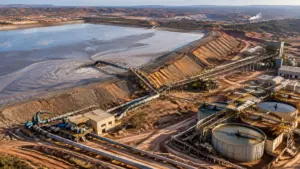
Open-pit and processing infrastructure in the arid Anti-Atlas region.
Bowdens keeps permitting at the centre of the outlook
Silver Mines’ Bowdens project in New South Wales shows why silver-market strength alone is not enough to move a development into construction.
Bowdens is described by Silver Mines as Australia’s largest undeveloped silver deposit. Its historic feasibility study outlines a 16-year open-pit operation producing an average of 3.4 million ounces of silver per year, alongside zinc and lead concentrates.
The project has returned to the NSW Independent Planning Commission after the previous approval was overturned by the NSW Court of Appeal. Public hearings are scheduled, with a determination expected on or before Dec. 9. Silver Mines is targeting a final investment decision in mid-2027, subject to the required approvals, mining leases, financing and technical work.
Morgans has cited a 43-cent target for Silver Mines in its coverage. That figure is an external market estimate rather than a company forecast, and it does not remove the regulatory, social, funding or execution risks that remain attached to the project.

Rural exploration landscape near the Bowdens project in New South Wales.
Silver price scenarios
Base case: US$70–80 per ounce
In the base case, silver remains elevated but below the most aggressive forecasts. A continuing supply deficit, industrial demand and constrained mine growth support prices near the upper end of recent trading ranges.
For Prairie Creek, this environment would preserve the appeal of by-product credits and support the updated PEA’s operating assumptions, provided capital costs and base-metal prices remain controlled. For Bowdens, it would improve the financing backdrop but would not resolve the permitting process.
Bull case: US$85–100 per ounce
A bull case would require stronger investment demand, continued inventory drawdown and limited growth in mine supply. It could also be supported by lower real interest rates or heightened demand for physical metal.
Higher prices would increase revenue potential for high-grade projects. The risk is that developers would face higher equipment, labour, energy and construction costs at the same time. A rising silver price can improve project economics while making project delivery more expensive.
Bear case: US$60–70 per ounce
The bear case assumes stronger macroeconomic headwinds, a stronger U.S. dollar, higher-for-longer interest rates or weaker industrial activity. Silver could remain structurally undersupplied while still trading at the lower end of the range because investment flows and macroeconomic conditions often determine short-term pricing.
At these levels, the most resilient projects are likely to be those with high grades, existing infrastructure, manageable capital requirements and meaningful by-product revenue. Remote projects with large upfront costs would face greater pressure.
What investors and operators should monitor
The Prairie Creek reset shows how quickly project values can change when commodity assumptions, mine plans and by-product credits are updated. But the headline NPV should be read alongside the underlying assumptions.
The most important indicators are:
- Silver-price sensitivity: How does NPV change at US$60, US$70 and US$90 per ounce?
- Base-metal exposure: What proportion of revenue comes from zinc, lead and copper?
- Capital inflation: Has the study been updated for current construction and equipment costs?
- Permitting progress: Can the project move through its remaining regulatory stages?
- Resource confidence: How much of the economic model relies on inferred resources?
- Infrastructure and logistics: Can power, roads, water and concentrate transport support the mine plan?
A PEA is not a reserve statement or a construction decision. It is a preliminary economic model that requires further engineering, drilling, permitting and financing.
For the silver sector, however, the message is clear: sustained prices in the US$60–70 range are already changing the conversation around development projects. If deficits persist and prices move toward the base or bull scenarios, high-grade assets such as Prairie Creek, Zgounder and Bowdens will remain closely watched, not only for their geological potential, but for their ability to convert metal in the ground into permitted, financeable production.
LinkedIn: Silver’s 2026 deficit is reshaping project economics. Honey Badger Silver’s updated Prairie Creek PEA lifts after-tax NPV to about C$1.2 billion, while high-grade drilling at Zgounder and permitting progress at Bowdens show how developers are positioning for a tighter market. The key test is whether prices, costs and approvals move together.
X: Silver’s structural deficit is putting high-grade projects back under the spotlight. Prairie Creek’s updated PEA lifts NPV to about C$1.2B, Aya reports 783 g/t over 13m at Zgounder, and Bowdens returns to the NSW planning process. Price matters, but so do costs, permits and execution.