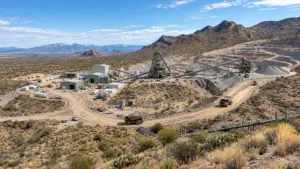
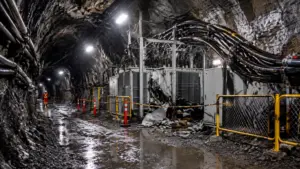
Western Australian hard-rock lithium development infrastructure in the Goldfields region.

Titan Australia Mining, a subsidiary of UAE-headquartered critical minerals group Titan Lithium, has agreed to acquire Global Lithium Resources for about A$333 million, offering shareholders a 73% premium as it seeks control of the Manna Lithium Project in Western Australia.
Under a binding scheme implementation deed, Titan will pay A$1.15 in cash for each Global Lithium share. The offer compares with Global Lithium’s last traded price of A$0.665 on Sept. 18 and values the company on a fully diluted basis.
Global Lithium’s board unanimously recommends the transaction, subject to no superior proposal emerging and an independent expert concluding that the scheme is in shareholders’ best interests.
| Deal term | Detail |
|---|---|
| Acquirer | Titan Australia Mining |
| Target | Global Lithium Resources (ASX: GL1) |
| Offer price | A$1.15 per share in cash |
| Fully diluted value | About A$333 million |
| Premium to last traded price | 73% |
| Project underpinning the deal | 100%-owned Manna Lithium Project |
| Development loan facility | Up to A$120 million |
| Loan interest rate | 7% per annum |
| Expected scheme meeting | Late December 2026 |
| Target implementation | Mid-January 2027 |
Manna project drives the offer
Global Lithium’s principal asset is the 100%-owned Manna Lithium Project, located about 110 km east of Kalgoorlie in Western Australia’s Goldfields region.

Manna has a total indicated and inferred mineral resource estimate of 51.6 million tonnes grading 1.0% lithium oxide, or Li2O. Its ore reserves stand at 20.96 million tonnes grading 0.89% Li2O.

The project’s economics were upgraded last week after Global Lithium reported that its Manna-Nova Operation Integration Study had doubled the project’s post-tax net present value to A$946 million. The study assessed the integration of Manna with the Nova processing plant, which Global Lithium acquired as part of its strategy to advance the project toward production.
The improved project value has come as lithium developers continue to face pressure from volatile prices, uncertain financing conditions and higher construction and operating risks. Market forecasts cited in connection with the transaction place lithium prices at about US$23,150 per tonne, although the timing and strength of any recovery remain uncertain.

The proposed takeover therefore gives Titan access to a defined Western Australian resource and reserve base while allowing Global Lithium shareholders to receive cash before the project reaches construction and production.
Global Lithium Managing Director Dianmin Chen said the board had weighed the immediate value of the offer against the funding requirements and execution risk associated with developing Manna during a volatile lithium market.
“In our view, the offer fairly recognises the value and quality of the Manna Lithium Project and the work our team has done to advance the project, and allows shareholders to realise that value in cash today,” Chen said, according to the company’s transaction announcement.
Titan provides funding during scheme process
Titan will provide Global Lithium with a loan facility of up to A$120 million to keep development work moving while the scheme proceeds.
The facility will be advanced in four tranches and will carry interest of 7% per annum, with bullet repayment at maturity. The funding is intended to support ongoing development and integration work at Manna, including activities associated with the Nova plant strategy.
The facility is significant because Global Lithium would otherwise need to secure additional funding while awaiting shareholder, regulatory and court approvals. For Titan, the arrangement provides a mechanism to maintain project momentum before ownership formally transfers.
The transaction follows an earlier funding relationship between Global Lithium and Jiangsu Lopal Tech, a Hong Kong-listed battery materials company. That relationship had provided another source of support for Manna’s development before Titan’s offer.
Titan Lithium Group founder Vaibhav Jain said the acquisition would support the group’s plan to build an integrated lithium business extending from mining through to battery-grade materials.
“The Manna Lithium Project is a high-quality asset developed by a capable team, and Australia is home to some of the best lithium resources in the world,” Jain said.
Titan has also been building its position in the wider battery supply chain. The group has previously signed a long-term lithium supply framework agreement with Mercedes-Benz, with commercial supply expected to begin in 2028.
Approvals and shareholder vote
The scheme remains subject to several conditions, including approvals from Australia’s Foreign Investment Review Board and the Australian Competition and Consumer Commission.
Global Lithium shareholders must approve the transaction by at least 75% of votes cast and by a majority in number of shareholders present and voting. The scheme also requires approval from the Federal Court of Australia.
Directors who control about 12.5% of Global Lithium’s issued shares have indicated that they intend to vote in favour, subject to the same qualifications applying to the board recommendation.
A scheme meeting is expected to be held in late December, subject to the regulatory timetable. If all conditions are satisfied, implementation is targeted for mid-January 2027.
The scheme is not subject to financing or due diligence conditions, according to the transaction details reported by Mining.com.au. The principal remaining hurdles are regulatory approval, shareholder support, court approval and the independent expert’s assessment.
Premium reflects both asset value and execution risk
The 73% premium is notable in a lithium market where developers have struggled to secure capital at valuations based solely on long-term project economics.
Global Lithium’s improved Manna-Nova study points to substantial potential value, but the project still faces the standard risks associated with construction, commissioning, ramp-up, capital requirements and lithium price volatility. The difference between a project’s modeled net present value and the price paid for its owner reflects those risks, as well as the time required to convert a study into operating cash flow.
The transaction also highlights the strategic value of Australian lithium resources to international critical minerals groups. Western Australia has established mining infrastructure, technical expertise and export links, but new projects remain exposed to cost inflation, permitting requirements and changes in the global battery materials market.
For Titan, the acquisition would add an upstream Australian asset to its effort to build a more integrated lithium platform. For Global Lithium shareholders, the offer provides a defined cash exit before the next phase of project execution.
The proposed deal remains subject to the shareholder and regulatory process. Until implementation, Global Lithium will continue to operate as a listed company and advance Manna under the interim funding arrangement.
What happens next
The immediate milestones are:
- Release of the scheme booklet and independent expert’s report.
- Review by FIRB and the ACCC.
- Global Lithium shareholder vote, expected in late December.
- Federal Court consideration of the scheme.
- Completion and transfer of Global Lithium to Titan, targeted for mid-January 2027.
The transaction comes one day after Global Lithium reported the upgraded Manna-Nova economics, placing the project’s valuation and funding requirements at the center of the takeover debate.
Further context on lithium supply, hard-rock project economics and market risks is available in Skillings’ lithium market analysis and its coverage of lithium industry developments.
Source: Mining.com.au; Global Lithium Resources; Titan Lithium

Hard-rock lithium projects require coordinated mining, crushing and concentration infrastructure before production can begin.

Drill core and spodumene-bearing samples are used to define lithium resource quality and project development assumptions.