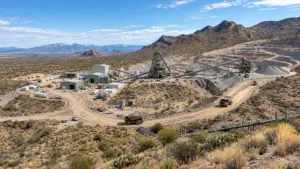
High-altitude drilling at a terraced silver operation in Morocco.

Aya Gold & Silver has reported high-grade, shallow silver mineralization from 97 drill holes at its Zgounder mine in Morocco, including a 13-metre interval grading 783 grams per tonne silver from surface.
The results extend mineralization around the existing open pit and in the central zone as silver trades near $66 an ounce after a sharp rally. For Aya, the drilling adds exploration momentum to an operation already being expanded toward higher annual production. For investors and mining companies, it also highlights the leverage that high-grade silver assets can have when prices rise faster than operating costs.
The strongest near-surface result came from hole ZG-RC-24-155, which cut 13 metres at 783 g/t silver from surface. Other notable intervals included:
| Drill hole | Interval | Silver grade | Depth |
|---|---|---|---|
| ZG-RC-24-155 | 13 m | 783 g/t Ag | From surface |
| ZG-RC-24-354 | 11 m | 501 g/t Ag | From 2 m |
| T28-26-1404 | 12 m | 762 g/t Ag | From 7 m |
| T28-26-1443 | 14 m | 468 g/t Ag | Not specified |
The results were released by Aya in mid-September and covered by The Northern Miner. The company said the program is testing extensions near the open pit and mineralization at depth in the central zone.
Shallow grades could support mine planning
At 783 g/t, the highest-grade interval contains approximately 25.2 troy ounces of silver per tonne of rock, before accounting for recovery, dilution or mining losses. At a silver price of $66 an ounce, that equates to roughly $1,660 in gross contained silver value per tonne.

That calculation is illustrative rather than an economic estimate. Drill intersections are not reserves, and their value depends on true width, metallurgy, recovery, dilution, mining method, processing costs, royalties, taxes and sustaining capital.
Even so, shallow mineralization can be strategically important at an operating open pit. Material close to surface may be less expensive to access than deeper ore, while continuity between existing mining areas can improve mine sequencing and reduce the need for additional stripping or infrastructure.

Aya has not yet established true widths for the reported intervals. Further drilling and geological modeling will be required before the results can be incorporated into updated resources or mine plans.

Processing infrastructure is central to converting high-grade discoveries into payable production.
Zgounder is moving from expansion to execution
Zgounder is Aya’s operating silver mine in Morocco. Its 2,700-tonne-per-day processing plant reached commercial production in December 2024, following a major expansion from the mine’s previous operating scale.
Aya is guiding to 5.2 million to 5.8 million ounces of silver production this year, compared with 4.8 million ounces last year. Average cash costs are guided at approximately $21.50 per ounce, leaving the company exposed to both the upside and volatility of the silver price.
The company’s published Zgounder mine information describes the asset as a high-grade silver operation in Morocco’s Anti-Atlas region. Aya’s broader portfolio also includes the Boumadine polymetallic project and the Imiter Bis exploration property.
The current drilling program totals 30,000 metres, and Aya said it is more than halfway complete. The company is also developing an exploration drift at the 1,825-metre level, with drilling west of the Zgounder fault scheduled to begin in the fourth quarter.
That underground work matters because the latest program is not limited to near-surface open-pit targets. Drilling from underground could improve the company’s understanding of deeper mineralized structures and potentially identify material that supports a longer mine life or a more flexible blend of open-pit and underground feed.

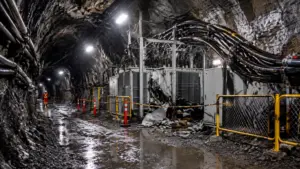
An underground drill platform can test extensions that are difficult to reach from surface.
Resource base provides scale behind the drilling
Zgounder has a reported measured and indicated resource of 18.9 million tonnes grading 165 g/t silver, containing approximately 100.2 million ounces of silver.
The mine also has an inferred resource of about 410,000 tonnes grading 340 g/t silver, or approximately 4.5 million contained ounces.
The distinction between resource categories is important. Measured and indicated material generally has a higher level of geological confidence than inferred material, but neither category automatically represents an economic reserve. Conversion depends on mine planning, engineering, metallurgy and economic assumptions.
The new drill results could support future resource updates if Aya confirms continuity and demonstrates that the mineralization can be extracted and processed economically. The company’s challenge will be to turn high-grade intersections into a consistent production profile without allowing dilution, recovery losses or operating bottlenecks to erode the headline grades.
Boumadine adds a second major growth option
The Zgounder results come shortly after Aya released an updated preliminary economic assessment for its Boumadine project, located about 240 kilometres east of Zgounder.
The study outlined an after-tax net present value of $3.5 billion, an internal rate of return of 93% and a payback period of 0.7 years, using assumptions of $3,500 per ounce gold and $50 per ounce silver. First production is targeted for 2030.
Those figures are highly sensitive to metal prices, capital costs, permitting, construction execution and operating performance. They also reflect a study-stage project rather than an operating mine. The Boumadine project page provides the company’s overview of the asset and its polymetallic exposure.
The combination of a producing silver mine and a large, earlier-stage gold-silver development gives Aya a different profile from a single-asset explorer. Zgounder provides current operating cash flow and production data, while Boumadine offers longer-term growth potential but carries substantially greater development and execution risk.
Silver’s rally is changing the market backdrop
Silver near $66 an ounce creates a favorable price environment for producers with operating leverage, but it also raises expectations. Developers may see stronger project economics, while producers face pressure to demonstrate that higher prices are translating into volume growth, lower unit costs or faster debt reduction.
For Aya, the immediate question is whether Zgounder can deliver its production guidance while the company continues drilling and developing underground access. The next catalysts are likely to include additional assays, progress at the 1,825-metre exploration drift, and further details on drilling west of the Zgounder fault.
The market response was relatively measured. Aya shares fell about 1.5% to C$39.69, giving the company an estimated market capitalization of approximately C$5.7 billion.
That reaction suggests investors may be weighing the new drill results against a valuation that already reflects strong silver prices, operating growth and the potential of Boumadine. High-grade exploration can add value, but the market typically assigns the greatest weight to repeatable production, resource conversion and cost control.

Mineralized drill core must be logged, assayed and modeled before it can influence mine plans.
Market takeaway for Aya and silver developers
The practical takeaway is that high-grade drilling is most valuable when it improves an operating mine’s schedule, feed quality or mine life. Aya has an advantage because Zgounder is already producing and has processing capacity in place. That gives the company a clearer path from exploration result to potential operating impact than a pre-production developer would have.
However, the results do not remove the risks. Silver prices can retreat after a strong rally, exploration intervals may not represent mineable widths, and Boumadine remains years from first production. The company must also manage expansion, underground development, permitting and capital allocation across multiple assets.
Rather than treating the 783 g/t interval as a standalone valuation signal, investors are likely to focus on whether Aya can:
- Sustain production within its 5.2 million-to-5.8 million-ounce guidance;
- Convert drilling into additional measured and indicated resources;
- Maintain cash costs near the current guidance level;
- Demonstrate continuity west of the Zgounder fault;
- Advance Boumadine without weakening the balance sheet or Zgounder execution.
For the wider silver developer group, the episode reinforces a market rule: rising prices reward grade, but operating credibility determines how much of that value reaches shareholders.
Social snippet
LinkedIn/X: Aya Gold & Silver reported 97 drill holes at Morocco’s Zgounder mine, including 13 m at 783 g/t silver from surface. With silver near $66/oz, the results add exploration upside, but production execution, resource conversion and cost control remain the key tests for Aya and other silver developers. Read the analysis
Sources: Aya Gold & Silver, The Northern Miner, and company project disclosures. Drill intersections are reported lengths unless otherwise stated; true widths have not been determined.