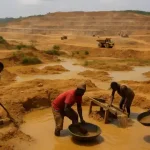
When Zambia’s President Hakainde Hichilema pledged to triple national copper production to 3 million tonnes by 2031, international investors cheered. But behind the bullish forecasts, a more sobering truth emerges: Zambia—and much of the global mining sector—faces a shortage of skilled people to actually deliver the boom. From Australia’s Pilbara to Chile’s Atacama Desert and Canada’s northern camps, operators report the same bottleneck: too few workers with the right mix of trades, digital, and automation skills, just as artificial intelligence and electrification reshape the sector.

Zambia: Tripling Copper Without the People?
Zambia’s 3-million-ton strategy is seen as pivotal for the energy transition, given copper’s central role in EVs and renewables. Yet a new World Bank analysis warns that local training pipelines remain dangerously thin. The report cites under-resourced TVET colleges and a shortage of instructors across geology, metallurgy, and mine safety. Without reform, the report argues, Zambia risks falling short of its own ambition—even as companies like Ivanhoe Mines and First Quantum expand projects in the Copperbelt.
The policy framework assumes a pipeline of engineers and operators that does not exist at present scale. The result: exploration programs are advancing faster than workforce readiness, leaving execution risk squarely on the table.
Australia: Record Pipelines, Scarcer People
Australia’s mining sector is sitting on a record project pipeline, but skills shortages are eroding productivity. The Australian Bureau of Statistics reports four consecutive years of multi-factor productivity decline, with labor productivity down about 3% since 2021–22. Cost blowouts linked to scarce trades and technical workers are now a recurring feature of feasibility studies.
The government’s March 2025 Occupation Shortage Report confirms the trend: mining remains among the hardest-hit sectors, with acute demand for electricians, diesel fitters, and instrumentation technicians. Competition with construction and energy further stretches the labor pool in Western Australia and Queensland.
More Read

Chile: World-Class Copper, Tight Human Capital
Chile, the world’s copper giant, faces the same problem in sharper relief. A CCM–Eleva workforce study (2023–2032) projects more than 34,000 replacement and growth hires will be needed this decade, particularly in operations, maintenance, and digital functions. The study warns of persistent mismatches between training supply and evolving skills needs, threatening Chile’s status as a reliable supplier to global markets.

Canada: An Aging Workforce Meets a Digital Mine
Canada’s Mining Industry Human Resources Council (MiHR) highlights a double headwind: demographic attrition and digital disruption. The sector is already losing experienced workers to retirement, while demand for AI, automation, and networking skills grows across operations. MiHR’s most recent outlook foresees tens of thousands of hires over the decade, with many concentrated in extraction and maintenance. The Mining Association of Canada’s 2025 industry report warns that adding digital competencies to already strained trades is stretching companies’ training budgets.
The AI Acceleration: Autonomy Without Talent Is a Mirage
Globally, the number of autonomous haul trucks jumped 84% year-on-year to mid-2025, according to sector filings, with China leading deployments. Battery-electric fleet trials in the Pilbara with Caterpillar and Komatsu show what’s at stake: high-voltage electricians, software-savvy maintainers, and data engineers are suddenly indispensable.
More Read
The World Economic Forum’s Future of Jobs 2025 report underlines the risk: technology adoption is racing ahead of workforce readiness. In mining, this means autonomy rollouts risk becoming capital-intensive white elephants if the human skills aren’t there to integrate, operate, and maintain them.
What’s Working—and What’s Next
Some early signals are promising. In Australia, micro-credential programs designed by employers for mine-control and AHS dispatch cut training time from years to months. Zambia is piloting mobile training hubs near Copperbelt communities, co-funded by miners and OEMs. Cross-training diesel fitters into battery-electric maintainers is gaining traction in both Canada and Chile.
Still, the gap is structural. Experts argue that by 2028, national skills compacts for critical-minerals regions must integrate visas, portable credentials, and dual-system apprenticeships tied directly to autonomous and electrified operations. Without such reforms, productivity losses seen in Australia may become the norm worldwide.
Skillings Analysis
- Execution risk has shifted: Feasibility studies now hinge as much on people as on ore grades or capital.
- AI adoption amplifies the gap: The limiting reagent isn’t algorithms, but the human capabilities to apply them.
- Policy will matter more: Countries that align training, immigration, and investment incentives fastest will dominate the EV metals race.
Bottom Line
Mining’s bottlenecks once revolved around ore grades and capex. In the AI age, the constraint is people—specifically, the technicians, engineers, and digital specialists who can electrify fleets and run autonomous systems at scale. For Zambia, Canada, Chile, and Australia, the path to securing supply isn’t just more drilling—it’s making skills feasibility as central as resource feasibility. The next quarter’s earnings calls will show which operators are already pricing that reality into their strategies.