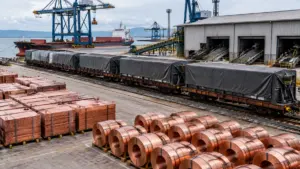
Here's the thing nobody wants to admit: copper just hit $13,300 per metric ton on the London Metal Exchange, and most of the mining industry still hasn't figured out how to respond to what's actually driving this rally.

This isn't about Chinese infrastructure spending. It's not about electric vehicles alone. And it's certainly not following any playbook from previous commodity cycles.
This is about artificial intelligence eating copper at a pace that makes traditional demand forecasting look quaint.
The Numbers Behind the Rally
Copper reached an all-time high of $13,300 per metric ton on January 6, 2026. That's a 22% surge from under $11,000 per tonne at the close of November 2025. The intraday peak hit $13,387 on the LME, while Comex March delivery futures climbed to $6.20 per pound, trading as high as $6.583.
Per pound. That's not a typo.

The rally represents a 50% year-on-year increase when measured against early 2025 levels. Federal Reserve Chair Jerome Powell's comments about the U.S. economy's "firm footing" added fuel, but the structural driver is far more specific: data centers are consuming copper faster than the global mining industry can expand production.


AI Infrastructure is Rewriting Copper Demand
The conventional wisdom holds that electrification and electric vehicles drive copper demand. That's still true. But it misses the velocity of what's happening in AI infrastructure.

A single large-scale AI data center requires approximately 3,000 metric tons of copper. Per facility. That's for cooling systems, power distribution, backup systems, and the massive electrical infrastructure needed to run GPU clusters that consume 50-100 megawatts continuously.
Industry projections estimate AI data centers alone will demand 500,000 metric tons of copper annually by 2030. That's roughly equivalent to the entire annual output of a major copper-producing nation like Peru.
Meta Platforms and Microsoft both reported earnings in early 2026 confirming continued massive spending on AI infrastructure buildout. These aren't pilot projects. They're firing up entire new facilities every quarter. Amazon, Google, and a growing roster of sovereign AI initiatives are following the same trajectory.
The strategic calculus here isn't subtle: whoever controls advanced AI compute capacity has geopolitical and economic leverage. That means copper demand from this sector isn't price-elastic the way consumer electronics or even construction might be. These facilities get built regardless of copper prices because the alternative: falling behind in AI capability: is unacceptable.
Supply Can't Keep Up With This Velocity
The International Copper Study Group projects a refined copper deficit of 150,000 tons for 2026. J.P. Morgan estimates the deficit at 330,000 tons: more than double the ICSG forecast.
That's not a rounding error. That's a structural gap.
Chile's Codelco, the world's largest copper producer, has essentially flat production. They're not expanding meaningfully. Major new projects in Peru, the Democratic Republic of Congo, and elsewhere face permitting delays, infrastructure bottlenecks, and political risk that adds years to development timelines.
The copper mining industry operates on 10-15 year project cycles from discovery to first production. You can't spin up a new copper mine the way you'd launch a software platform. Geology doesn't compress. Permitting doesn't accelerate because demand surged.

Meanwhile, Beijing loosening restrictions on homebuilders has raised hopes for increased construction-related copper demand in China. If Chinese property development rebounds even modestly, it compounds the supply deficit. China accounts for roughly half of global refined copper consumption.
Those two clocks: AI infrastructure buildout velocity and mining industry response time: do not sync. The deficit widens before it narrows.
Why This Rally Might Not Last
Goldman Sachs expects copper prices to decline to $11,000 per metric ton by the end of 2026. Their argument: prices have "overshot" fundamental levels, which they peg around $11,500 per tonne.
The bank cites three factors that could trigger a correction:
Weaker Chinese consumption that's "more acute than the 2024 buyers strike." If Chinese demand falters despite loosened homebuilder restrictions, the price rally loses a key pillar.
Reduced U.S. stockpiling as import economics become less attractive at these elevated price levels. Refiners and manufacturers who built inventory in late 2025 may slow purchases.
Demand destruction and scrap supply response. Higher prices dampen demand growth while incentivizing more scrap recovery and recycling. That margin adjusts, though not instantly.
Goldman Sachs specifically points to U.S. refined copper tariff clarity as a "catalyst for a correction." Uncertainty around trade policy has kept some buyers on the sidelines or overstocked as a hedge. Resolution: regardless of direction: could prompt inventory adjustments.
J.P. Morgan takes a more bullish view, projecting copper will average around $12,075 per metric ton for the full year, with a peak of $12,500/mt in Q2. Their deficit estimate at 330,000 tons supports sustained elevated pricing even with modest corrections.
Copper prices have already begun retreating from the January highs. Late January saw pullbacks as traders took profits and reassessed whether the rally had outpaced fundamentals.

The Uncomfortable Middle Ground
Here's what makes this particularly nasty: both the bulls and bears might be right.
Copper could correct to $11,000-$11,500 by year-end if Chinese demand disappoints and U.S. stockpiling normalizes. That's a meaningful pullback from $13,300 highs.
But even at $11,000, copper would still be trading well above historical averages and reflecting structural tightness. The deficit doesn't disappear. AI infrastructure buildout doesn't pause. The supply response doesn't accelerate.
In other words, a correction doesn't mean the underlying tension resolves. It just means prices revert closer to what the physical market can justify before speculative positioning drove the January spike.
The mining industry faces a needle that's almost impossible to thread: ramping production fast enough to meet demand without overbuilding into a future correction. Project timelines don't allow for that precision. You commit capital now based on long-term price assumptions, knowing short-term volatility will whipsaw margins.
What This Means for Operators and Investors
Operators in copper-intensive sectors: construction, manufacturing, electrical equipment, data center developers: face sustained input cost pressure even if prices correct from peak levels. Hedging strategies and long-term supply contracts matter more than usual given the deficit outlook.
For mining companies and exploration plays, elevated copper prices improve project economics and attract capital. But the correction risk means you're not investing in a one-way bet. Projects that pencil at $13,000 copper still need to work at $11,000 to survive the volatility.
Investors watching commodity markets should note the divergence between short-term price action and medium-term structural deficits. Copper's rally to $13,300 likely overshot near-term fundamentals. But the supply-demand imbalance driving the rally remains intact.
The question isn't whether copper demand will outpace supply. The question is how much pain gets distributed across the value chain as prices oscillate while the industry slowly closes the gap.
There's not enough copper to go around. That reality doesn't change whether prices are at $13,300 or $11,000. The only variable is who absorbs the shortage cost: and for how long.