Here’s the thing nobody wants to admit: the biggest mining news of the week isn’t about what got built.

It’s about what fell apart.
Rio Tinto and Glencore just walked away from a $260 billion merger that would have created the world’s largest copper producer. And if you think this was just another routine M&A breakdown over spreadsheets and earnouts, you’re missing the point entirely.
This wasn’t about valuation.
It was about who controls the copper.

The Rio-Glencore Collapse: A Fight Over the Future
The headlines will tell you the deal died because Glencore wanted 40% ownership and Rio wanted to keep both the chair and CEO positions. That’s technically true. But it’s also wildly incomplete.


Glencore argued Rio materially undervalued its copper business. Which is fascinating, because copper isn’t just another commodity right now. It’s the commodity. The one metal standing between the AI revolution and the power grid’s capacity to handle it.

Rio wanted a 69–31 split. Glencore demanded 60–40.
Call it a “valuation disagreement” if you want. That’s not what it is.
That’s a control fight with numbers attached.
Neither blinked.
The result? Glencore shares cratered 11% in London. Rio dropped 2.5%. And the market just watched roughly $260 billion in potential mining M&A evaporate in less than 24 hours.
This is the third time these two have tried to merge. Previous attempts collapsed in 2008, 2014, and now 2024. Under UK M&A rules, they can’t talk again for six months unless a rival bidder emerges or Glencore formally requests to reopen negotiations.
Here’s what makes this particularly telling: the combined entity would have controlled about 7% of global copper output, alongside dominant positions in iron ore and coal. That’s not just scale. That’s strategic positioning in a market where copper demand is already outpacing supply.
And now? That consolidation isn’t happening.
Which means the copper market stays fragmented. Which means pricing power stays distributed. Which means the AI data center buildout: which needs copper like it needs oxygen: just got a lot more complicated.
Barrick’s North American Spinoff: Reading the Tea Leaves
Meanwhile, Barrick Gold is quietly preparing to split off its North American assets into a separate entity—and just as quietly made Mark Hill the permanent CEO.
On the surface, this looks like classic portfolio optimization. Take the safe-haven Nevada operations, the Fourmile development, and the other Tier-1 North American assets, bundle them into “NewCo,” and let the market assign a premium valuation to that geopolitical stability.
The market’s first reaction, though, wasn’t “premium.” It was a slap: Barrick dropped 6.6% in Toronto.
But let’s be honest about what’s really happening here.

Barrick is separating the assets that don’t come with coup risk, permitting nightmares in emerging markets, or the kind of sovereign complications that keep CFOs awake at night.
This isn’t a value play. It’s a retreat.
The gold sector has been navigating an increasingly hostile operating environment in key jurisdictions. Mali, Burkina Faso, the DRC: these aren’t just footnotes in annual reports anymore. They’re material risks to operational continuity.
By carving out North America, Barrick is essentially creating two different risk profiles under two different banners. One for investors who want pure-play exposure to stable jurisdictions. One for investors willing to take on higher geopolitical risk for higher-grade deposits.
The strategic calculus here isn’t subtle: North American gold assets are trading at a discount relative to their operational stability. Separating them could unlock a valuation premium that the current consolidated structure can’t capture.
But it also signals something less comfortable. The era of mining majors confidently operating across every jurisdiction on Earth: no matter the risk: is over. Or at least, it’s being repriced.
Ionic Rare Earths IPO: The Monopoly Is Cracking
And then there’s the Ionic Rare Earths IPO, which is getting far less attention than it deserves.
Here’s why it matters: rare earths have been China’s strategic ace for years. Beijing controls roughly 90% of global processing capacity and has weaponized export restrictions when it suits them. The West has talked endlessly about diversifying rare earth supply chains.
Ionic represents the “finally doing something about it” phase.

The company is developing rare earth projects outside China’s orbit. The IPO signals that capital markets are finally willing to fund alternatives to Chinese supply: even if those alternatives come with longer timelines, higher costs, and execution risk.
This isn’t charity. Investors are pricing in the strategic premium of non-Chinese rare earth capacity in a world where critical mineral supply chains are national security issues.
The rare earths story ties directly back to copper, lithium, and every other critical mineral. The same dynamic is playing out across the board: concentrated supply, rising demand, and a scramble to build redundancy into systems that were optimized for efficiency, not resilience.
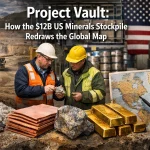
And then there’s Project Vault: the $12B US stockpile fund that’s not just buying material—it’s marshaling allies (EU, Japan, Mexico) to make sure the next supply shock isn’t a press release. It’s a leverage event.
China still has the stranglehold. But the stranglehold is loosening. Slowly. Expensively. But unmistakably.
What It All Means: Critical Minerals or Nothing
The common thread running through all three of these stories?
Control.
Rio and Glencore couldn’t agree on who controls the copper. Barrick is separating assets to give investors clearer control over their risk exposure. Ionic is building rare earth supply that isn’t controlled by Beijing.
The mining M&A environment is volatile right now, but the volatility isn’t random. It’s the market trying to figure out how to price strategic control in a world where copper deficits are structural, rare earth supply is geopolitically contested, and gold remains the only real hedge against monetary chaos.
The “Critical Minerals” narrative isn’t just the only game in town. It’s the only game that matters.

Everything else: iron ore, coal, bulk commodities: is just keeping the lights on. The real action is in the metals that electrify, digitize, and defend.
Rio-Glencore falling apart means those copper assets stay fragmented. Barrick spinning off North America means gold investors finally get clean exposure to stable jurisdictions. Ionic going public means rare earth supply chains are being rebuilt from scratch.
None of these are small stories. They’re the structure of the next decade taking shape in real time.
And if you’re waiting for certainty before making a call, you’re already late.
The Market Is Telling You Something
The mining sector right now is a strange combination of brutal pragmatism and wild optimism.
Brutal pragmatism: Rio and Glencore walking away because neither could stomach giving up control. Barrick carving out geographically safe assets because geopolitical risk is now unhedgeable.
Wild optimism: Ionic’s IPO getting funded despite the fact that building a non-Chinese rare earth supply chain is expensive, slow, and fraught with execution risk.
Both things can be true.
The takeaway? The copper crunch is real. The rare earth supply chain is being rewritten. Gold is defensive positioning for a world that feels increasingly unstable.
And the companies that control the assets: not just own them, but control them: are going to be the ones that matter.
Rio and Glencore couldn’t figure that out. Barrick is betting it can.
We’ll see who was right.