Here’s the thing nobody wants to admit: the entire electrification revolution: EVs, wind turbines, industrial automation: runs on magnets that only one country knows how to make at scale. And that country isn’t particularly interested in helping us build competing supply chains.

China controls roughly 90% of global rare earth permanent magnet production. Not mining. Not refining. The actual magnets themselves. The neodymium-iron-boron (NdFeB) magnets that power everything from Tesla motors to offshore wind generators to the servo drives in advanced manufacturing equipment.
That’s not a supply chain vulnerability. That’s a single point of failure.
But a small lab in Florida thinks it’s found the workaround. Advanced Magnet Lab (AML) isn’t trying to out-manufacture China at the NdFeB game. They’re redesigning the game entirely: targeting alternative permanent magnet chemistries that don’t require neodymium, don’t need Chinese processing expertise, and can be sourced from friendly jurisdictions.
The question isn’t whether it’s technically possible. It’s whether it’s commercially viable before the next trade war escalation makes the decision for us.
More Read

The NdFeB Bottleneck Nobody Wants to Talk About


Every permanent magnet motor uses the same basic recipe: neodymium, iron, boron, with some dysprosium and terbium thrown in for high-temperature stability. The chemistry is well-understood. The problem is the manufacturing.
NdFeB magnets require sintering at precisely controlled temperatures, specific grain boundary engineering, and coating processes to prevent oxidation. China has spent three decades perfecting this at massive scale. Their magnet manufacturers can hit tolerances and throughput rates that Western facilities simply can’t match without billions in capex and years of trial-and-error.
More Read

Which is why every Western OEM: European automakers, American industrial equipment manufacturers, Japanese robotics companies: sources their high-performance magnets from Chinese suppliers. Even the Pentagon relies on Chinese rare earth magnets for certain defense applications, which is deeply ironic given that we’re simultaneously running security screenings on Chinese 5G equipment.
The US Department of Energy has thrown money at domestic NdFeB production. MP Materials is building out processing capacity in California. Urban Mining Company is trying to crack rare earth recycling. But here’s the uncomfortable reality: you’re still competing on China’s terms, in China’s commodity market, using chemistry that China has already optimized.
AML’s bet is different. They’re not trying to build a better NdFeB supply chain. They’re trying to make NdFeB obsolete for specific high-value applications.
Samarium Nitride and Manganese-Bismuth: The Alternative Chemistry Play
AML’s core innovation isn’t mining or refining. It’s materials science. They’re developing permanent magnets using samarium nitride (SmN) and manganese-bismuth (MnBi) compounds: chemistries that offer comparable magnetic performance to NdFeB in certain applications without requiring neodymium or dysprosium.
Samarium nitride is particularly interesting. It has strong magnetic anisotropy, meaning it naturally wants to magnetize in specific crystallographic directions. That’s useful for motor applications where you need predictable, stable magnetic fields. The problem has always been synthesis: making phase-pure SmN at scale is brutally difficult.
AML’s approach borrows from superconducting wire manufacturing. Instead of trying to sinter bulk magnets like traditional NdFeB production, they’re growing thin SmN films on flexible substrates using chemical vapor deposition techniques. Think of it as printing magnets layer by layer rather than casting them in molds.

The manganese-bismuth work follows similar logic. MnBi has decent magnetic properties and excellent thermal stability: it actually gets stronger at elevated temperatures, unlike NdFeB which degrades above 150°C. That makes it attractive for industrial motors that run hot: mining equipment, steel mill drives, oil and gas pumps.
The catch is that MnBi is mechanically brittle. It shatters easily. AML’s solution is to embed MnBi particles in polymer composites, creating flexible magnet sheets that can be formed into complex geometries. It’s not as powerful as sintered NdFeB, but for applications where thermal stability and form factor matter more than raw magnetic strength, it’s competitive.
And here’s the strategic kicker: samarium and bismuth can be sourced from US-friendly jurisdictions. You don’t need to route your supply chain through China.
The US-Japan Sourcing Strategy
AML’s sourcing strategy is straightforward: work backward from allied geographies. Samarium can be extracted as a byproduct from existing US rare earth operations: MP Materials’ Mountain Pass mine in California already produces samarium concentrate as a secondary output. It’s currently sold off as a low-value byproduct because there’s no domestic demand.
Japan has bismuth processing capacity from its historic zinc and lead smelting operations. Manganese is available from multiple sources including Gabon, Australia, and South Africa. None of these supply lines run through China.
The US-Japan partnership makes sense for another reason: Japan has deep expertise in precision materials manufacturing. Their experience with semiconductor materials, advanced ceramics, and thin-film deposition directly translates to the kind of controlled synthesis processes AML needs.
This isn’t about reinventing rare earth mining. It’s about redesigning the magnet production workflow to use different inputs that don’t require Chinese supply chains or Chinese process know-how.

Target Market: High-Value Industrial Motors
AML isn’t trying to compete in EV traction motors. Not yet. The automotive market requires massive scale, brutal cost targets, and automotive-grade reliability testing that takes years to validate. That’s a $15 billion market dominated by established Chinese suppliers with proven track records.
Instead, AML is targeting industrial motor applications where performance, reliability, and supply security matter more than unit cost. We’re talking:
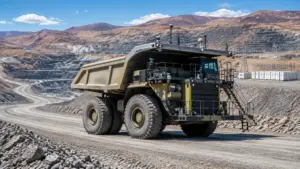
- Mining equipment motors: Haul truck drives, grinding mill motors, conveyor systems. These operate in extreme environments where thermal stability matters.
- Oil and gas pumps: Downhole motors, pipeline compression, offshore platform equipment. Supply security is a genuine concern when your equipment needs to run for 20 years in remote locations.
- Industrial automation: Servo motors for manufacturing robots, CNC machine tools, packaging equipment. European and Japanese manufacturers are highly motivated to diversify away from Chinese magnet suppliers.
- Defense applications: Actuators, guidance systems, power generation. The Pentagon is explicitly looking for non-Chinese alternatives.
These markets are smaller. But they’re higher-margin. And the procurement officers actually care about supply chain resilience, not just price-per-kilogram.
The Wire Production Parallel
AML’s manufacturing approach deliberately mirrors superconducting wire production because that’s a proven pathway to scaling up precision materials. Superconducting wire manufacturers figured out how to deposit thin films of exotic compounds onto long substrates at commercial scale. They solved the quality control problems, the thermal management issues, the substrate handling.
That infrastructure and expertise already exists. AML is essentially adapting it for magnetic materials instead of superconductors.
This matters because it means they’re not starting from zero on manufacturing scale-up. They can license existing deposition equipment, hire engineers who already understand the process challenges, and leverage supply chains that already exist for substrate materials and precursor chemicals.
It’s not a guaranteed path to success. But it’s a hell of a lot more practical than trying to build a competing NdFeB sintering facility from scratch.
What Happens Next
Here’s the reality check: AML’s magnets won’t replace NdFeB in high-volume consumer applications anytime soon. EVs will continue using Chinese magnets. Consumer electronics will continue using Chinese magnets. That horse has left the barn.
But for industrial and defense applications where supply security genuinely matters, alternative magnet chemistries start looking attractive. Especially if trade tensions escalate further or China decides to weaponize rare earth exports again like they did in 2010.
The strategic calculus here isn’t subtle. Western manufacturers and governments are actively looking for ways to reduce Chinese leverage in critical supply chains. Magnets are near the top of that list, right after semiconductors and batteries.
AML represents a specific bet: that redesigning around the bottleneck is faster and cheaper than trying to replicate China’s NdFeB dominance. For operators in mining, energy, and manufacturing, it’s worth watching. Because the companies that crack alternative magnet chemistries first will own a very lucrative niche market.
And if trade restrictions tighten further, that niche could become the mainstream very quickly.
The uncomfortable truth is that supply chain resilience costs money. It requires accepting slightly lower performance or slightly higher prices in exchange for diversification. Most companies won’t make that trade voluntarily.
But the ones that do: the ones that start qualifying alternative magnet suppliers before they’re forced to: will have significant operational advantages when the next supply disruption hits.
Which it will. The only question is timing.