Here’s what most people miss about rare earth elements: the problem isn’t finding them: it’s getting them out of the ground, processed, and into the supply chain without depending on a single country that controls 70% of global production.

That country is China. And Greenland might be the Arctic answer everyone’s been waiting for.
But before you assume this is another “Greenland will save us” headline, let’s look at the actual numbers, the real timeline, and the obstacles that could keep these deposits locked under ice for another decade.
The Deposits Are Real (And Massive)
Greenland isn’t just “resource-rich in theory.” The island hosts two of the largest rare earth deposits on the planet:
Kvanefjeld holds over 11 million metric tons of rare earth reserves, making it the third-largest known land deposit globally. It also contains 370,000 metric tons of heavy rare earths: the strategic elements (dysprosium, terbium, europium) that power military tech, EVs, and wind turbines.
More Read

Tanbreez is even larger in scale, with consistent ore grades between 0.4–0.6% total rare earth oxides and significant heavy rare earth enrichment. For context, most rare earth projects struggle to hit 0.3% grades economically.


These aren’t exploration-stage “maybe someday” projects. The geology is mapped. The reserves are quantified. Greenland ranks eighth globally in rare earth reserves: ahead of countries that are already producing.
More Read
So why isn’t Greenland mining rare earths right now?
The Infrastructure Problem No One Talks About
Here’s the reality:
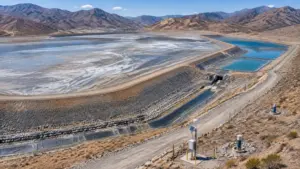
Not because the deposits aren’t there. Not because companies aren’t interested. But because building a mine in the Arctic isn’t the same as opening a pit in Nevada or Western Australia.
The infrastructure challenges are blunt:
- Only southwestern ports operate year-round. Shipping ore during the Arctic winter requires ice-class vessels and higher logistics costs.
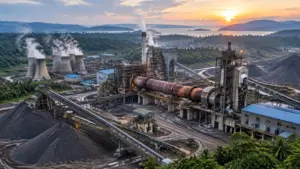
- Companies must build their own transport and energy infrastructure. There’s no grid to plug into. No highway network to truck ore. You’re building a self-contained industrial base from scratch.
- Harsh climate and geography. High snowfall, limited daylight in winter, and frequent weather disruptions affect everything from drilling schedules to worker safety.
And here’s the kicker: Greenland mining projects have to compete for capital against Canadian, Australian, and U.S. projects that already have roads, power, ports, and regulatory frameworks that don’t require starting from zero.
That’s not a Greenland-specific problem: it’s an investor allocation problem. Money flows to lower execution risk unless the strategic upside is undeniable.

The U.S. Is Betting Real Money (Finally)
In June 2025, the Trump administration issued a $120 million Letter of Interest from the U.S. Export-Import Bank to Critical Metals’ Tanbreez project. It was the administration’s first overseas mining investment: a clear signal that rare earth supply chain diversification isn’t just a talking point anymore.
Critical Metals is targeting initial production around 2026, with output scaling from 85,000 tonnes of rare earth oxides per year to 425,000 tonnes after expansion. If that timeline holds, Tanbreez could be producing strategic heavy rare earths before the end of this decade.
Separately, GreenRoc Mining received a 30-year exploitation license in December 2025 for the Amitsoq graphite deposit, which targets battery supply chains and defense applications. Graphite isn’t a rare earth element, but it’s another critical mineral where China controls processing: so the diversification theme is broader than just REEs.
This is not speculative exploration capital. This is U.S. government-backed financing moving into Arctic resource development with a stated goal: reduce dependence on Chinese rare earth supply.
The Uranium Ban That’s Freezing Billions
Here’s where geopolitics and local politics collide.
In December 2021, Greenland enacted a uranium mining ban after a national election centered on environmental concerns. That ban effectively killed the Kvanefjeld project: the third-largest rare earth deposit in the world: because the ore body contains both rare earths and uranium.
Energy Transition Minerals, the company behind Kvanefjeld, has been in litigation since 2022, seeking $11.5 billion in compensation. The project has been active for over a decade. Feasibility studies are complete. The resource is proven.
But it’s frozen.

This is the geopolitical tension that doesn’t make headlines: Greenland’s government wants economic development and sovereignty, but local opposition to uranium mining is strong enough to block the most advanced rare earth project on the island.
Even if the ban is repealed, the legal uncertainty has already spooked investors. Projects don’t survive a decade of regulatory whiplash without burning through capital and losing momentum.
What This Actually Means for Rare Earth Supply Chain
If Greenland mining projects come online: and that’s still an “if”: the impact on global rare earth supply would be significant but not immediate.
Here’s the realistic scenario:
Short-term (2026–2028): Tanbreez and possibly one other project begin initial production. Output is modest: enough to prove the model works, not enough to shift global market share materially.
Mid-term (2028–2032): If infrastructure gets built (ports, power, roads) and capital keeps flowing, Greenland could supply 5–10% of global rare earth demand, with a heavy focus on the strategic elements (heavy rare earths) that matter most for defense and clean energy.
Long-term (post-2032): Greenland becomes a cornerstone of Western rare earth strategy: if the uranium ban gets resolved, if companies can compete on cost with Chinese producers, and if downstream processing capacity gets built (either in Greenland or allied nations).
The biggest variable isn’t geology. It’s political and financial execution.
China didn’t dominate rare earths because it has the only deposits. It dominated because it built the entire value chain: from mine to magnet: while the West outsourced processing for cheaper costs. Greenland mining only matters if it’s paired with refining, separation, and manufacturing capacity outside China.
Otherwise, you’re just shipping ore to China for processing, which defeats the strategic purpose.
The Elephant in the Arctic: Climate vs. Supply Security
There’s a strange irony here.
Rare earth elements are essential for the energy transition: wind turbines, EV motors, grid batteries. But mining them in Greenland means Arctic development, higher emissions from logistics, and environmental risks in one of the world’s most fragile ecosystems.

The debate isn’t “should we mine critical minerals?” It’s “where do we accept the trade-offs?” because doing nothing means locking in dependence on a single-source supply chain controlled by a geopolitical rival.
Greenland’s government knows this. So does Washington, Brussels, and Ottawa. The question is whether the political will to build Arctic mining infrastructure can survive the inevitable environmental and regulatory battles.
The Bottom Line
Greenland mining will change the rare earth supply chain: but not overnight, and not without serious execution risk.
The deposits are world-class. The strategic logic is sound. U.S. government financing is moving. But infrastructure gaps, regulatory uncertainty, and competition from lower-risk jurisdictions mean this transformation is still years away from realization.
If you’re watching rare earth markets, Greenland is the long game. The projects to watch are Tanbreez (nearest to production), Kvanefjeld (stuck in legal limbo but strategically critical), and whatever junior explorers can navigate the political and climate challenges without running out of cash.
The rare earth supply chain won’t shift until someone builds the mines, the ports, the power, and the processing capacity. Greenland has the rocks. The rest is execution.
Join the Mission
The rare earth supply chain story is moving fast: from Greenland to Africa to the U.S. domestic push. We’re tracking every development, every policy shift, and every project that could break China’s dominance.
Join the mission on Rumble for weekly breakdowns on critical minerals, resource geopolitics, and the mining projects that matter.

Support MineWatch – Help us keep the research independent and the analysis unfiltered.