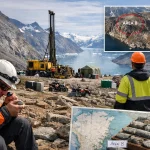
Here’s the thing nobody wants to admit: when Mick Davis puts money on the table, the rest of the mining world pays attention.

The man who built Xstrata into a $50 billion powerhouse just made his first major move since launching Red Arc Minerals. The target? A 20% stake in Zanaga Iron, a long-stalled iron ore project in the Democratic Republic of Congo. The price? Up to $25 million in staged capital, with an option to scale that into an 87.5% controlling position for another $125 million.
This isn’t a courtesy investment. This is Davis signaling that African iron ore: specifically, the high-grade concentrate needed for direct reduced iron production: is about to matter a lot more than the market currently prices in.
The Deal Structure: Staged Capital, Strategic Optionality
Red Arc Minerals signed a binding term sheet with Zanaga Iron (ZIOC) to inject capital in five equal sub-tranches. Each tranche funds engineering studies, metallurgical work, and pre-production activities designed to push the project toward a final investment decision.
The structure is deliberately non-dilutive to existing ZIOC shareholders. Red Arc earns its 20% stake by funding Jumelles, the subsidiary that owns the Zanaga project, rather than issuing new equity at the parent level. That’s a technical detail, but it matters: it means current shareholders don’t get wiped out while the project gets funded.
More Read



Here’s the kicker: Red Arc has an 18-month option to exercise a second phase. For $125 million, they can increase their stake from 20% to 87.5%, effectively taking control of the asset. Zanaga Iron retains a 1% net sales revenue royalty on concentrate sales, with Red Arc holding the right to buy back half of that royalty for $50 million.
That’s not just investment. That’s option value layered on strategic control, with a royalty backstop if the project scales.
More Read

Why Mick Davis, Why Now
Mick Davis doesn’t need an introduction in mining circles. Over 40 years, he’s raised more than $35 billion from global capital markets and managed $120 billion in corporate transactions. He was CEO of Xstrata during its expansion from a $500 million zinc smelter into a diversified mining giant before its eventual merger with Glencore. Before that, he was CFO of BHP Billiton.
He’s not chasing speculative plays. He’s chasing scale.
Red Arc Minerals was founded to identify undervalued, high-quality assets in jurisdictions that institutional capital tends to avoid due to perceived risk. The DRC checks that box. So does iron ore in a world pivoting toward electric arc furnace steelmaking, which requires higher-grade feedstock than traditional blast furnaces.
Davis sees what the market doesn’t yet: the iron ore quality gap is widening. Blast furnaces can tolerate lower-grade material. Electric arc furnaces, increasingly favored for their lower carbon footprint, cannot. They need high-grade pellets or direct reduced iron made from high-grade concentrate.
Zanaga Iron’s deposit is designed for that market.
The Geopolitical Context: US-China Competition in Africa
Let’s be direct: this project sits at the center of a geopolitical contest.
The Democratic Republic of Congo is one of the most resource-rich countries on the planet. It produces roughly 70% of the world’s cobalt, significant volumes of copper, and holds untapped reserves of manganese, lithium, and iron ore. China has spent the last 15 years locking in supply agreements, building infrastructure, and financing mining projects across the region.

The United States, meanwhile, is trying to claw back influence. The White House’s Critical Minerals Blitz, led by Commerce Secretary Howard Lutnick, is explicitly designed to reduce dependence on Chinese supply chains. Iron ore doesn’t make the official “critical minerals” list, but high-grade iron ore for DRI production is increasingly treated as strategically important, particularly as Western steelmakers decarbonize.
Red Arc’s move into Zanaga isn’t just a mining play. It’s a bet that Western capital: and Western political backing: will eventually flow into African mineral projects that bypass Chinese infrastructure. Davis is positioning ahead of that shift.
The Iron Ore Market: Why High-Grade Matters
Global iron ore supply is not in crisis. Seaborne volumes remain robust, dominated by Vale, Rio Tinto, and BHP. But the type of iron ore matters more than ever.
Electric arc furnaces (EAFs) are gaining market share in steelmaking because they’re more flexible, more energy-efficient, and easier to decarbonize than blast furnaces. EAFs use scrap steel and direct reduced iron as feedstock. DRI requires high-grade iron ore pellets: typically 67% iron content or higher.
The problem? Most new iron ore supply over the past decade has come from lower-grade deposits optimized for blast furnace operations. The DRI feedstock market is in structural deficit, and that deficit is widening as more steel producers pivot toward EAF routes.
Zanaga’s deposit reportedly grades in the mid-60% range, making it viable for pellet production and DRI feedstock. That’s the sweet spot.
China controls most of the world’s DRI production capacity, but Western steelmakers: especially in Europe: are scrambling to secure non-Chinese feedstock. Zanaga, if developed, would be positioned to supply that market.
The Financial Calculus: $25M Now, $125M Later
Red Arc’s staged investment structure is designed to derisk the project incrementally. The first $25 million funds the studies and engineering work needed to define the scope, scale, and capital requirements for full-scale development. If the numbers work, Red Arc exercises the option. If they don’t, they walk away with a minority stake.
That’s textbook optionality. Davis isn’t betting the farm. He’s buying the right to bet the farm later, once the technical and financial parameters are locked in.

For Zanaga Iron, the deal solves a critical problem: capital. The company has been stuck in pre-development for years, unable to attract the funding necessary to push the project forward. CEO Martin Knauth has publicly stated that the Red Arc partnership accelerates the timeline toward a final investment decision.
The royalty structure adds another layer. If Red Arc exercises the $125 million option and takes control, Zanaga Iron still retains a 1% revenue stream on all concentrate sales. That’s a perpetual cash flow with no ongoing capital risk. And if the project scales, Red Arc can buy back half the royalty for $50 million, which Zanaga can then redeploy into other opportunities.
It’s a win-win structure, assuming the project gets built.
What Happens Next
The transaction is subject to due diligence, definitive agreements, shareholder approval, and regulatory sign-off. None of that is guaranteed, particularly in the DRC, where regulatory processes can be unpredictable.
But assuming the deal closes, the next 18 months will determine whether Zanaga becomes a producing asset or remains a stranded resource. Red Arc will need to complete feasibility studies, secure offtake agreements, line up project financing, and navigate the political landscape in Kinshasa.
That’s a needle that’s almost impossible to thread for most junior miners. But Mick Davis isn’t most miners. He’s built a career on structuring complex deals in difficult jurisdictions and bringing them to fruition.
If he’s backing Zanaga, it’s because he sees a viable path from paper to production. The market will figure that out eventually. By then, Red Arc will already own the asset.
The Broader Trend: Capital Returning to African Iron Ore
Zanaga isn’t an isolated deal. Capital is slowly returning to African iron ore projects after a decade-long drought. Guinea’s Simandou project, backed by Rio Tinto and the Guinean government, is finally moving toward production. Liberia’s Bea Mountain and Bong Range projects are attracting fresh investment. Mauritania’s Guelb Moghrein expansion is underway.
The common thread? These are all high-grade deposits designed for the DRI and EAF markets. They’re not competing with the Pilbara giants on volume. They’re competing on quality.
Red Arc’s entry into Zanaga validates that thesis. It also signals that institutional capital: real money, not exploration budgets: is willing to back African iron ore projects again, provided the geology, logistics, and geopolitics align.
The clock is already ticking on Red Arc’s 18-month option window. If Davis exercises it, Zanaga moves from speculative asset to development-stage project. If he doesn’t, the market will know the project didn’t pencil out.
Either way, the next chapter in African iron ore just got a lot more interesting.