Decarbonizing mining fleets has turned into a parade of shiny demos. Battery-electric haul trucks photograph well. Hydrogen fuel cells sound inevitable. Then you get to the actual mine: brutal duty cycles, long ramps, remote logistics, and a fleet you can’t just scrap because a slide deck says “net zero.”

That’s why Komatsu’s $2 million Joint Development Agreement with AFC Energy matters: it’s a retrofit-minded ammonia-cracking pathway that treats decarbonization like an operations problem, not a hype cycle.
This isn’t vaporware. It’s a commercially-focused partnership between a $43 billion equipment manufacturer and a British power company pushing on-board ammonia cracking as a practical bridge: decarbonize existing heavy fleets without waiting for perfect hydrogen infrastructure or battery breakthroughs.
The Retrofit Bridge: Ammonia Cracking Over Hydrogen or Battery Hype
AFC Energy’s pitch is deceptively simple: crack liquid ammonia into hydrogen on-board the engine, then combust that hydrogen in a lightly modified internal combustion diesel platform.
Not a fuel cell. Not a full powertrain replacement. A retrofit.
More Read

That’s the point. Most mines don’t need another “platform.” They need a pathway that works with the iron already on-site: engines, maintenance practices, duty cycles, uptime expectations, and capex realities.


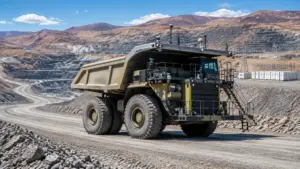
That distinction matters. Komatsu isn’t designing an entirely new engine architecture here. They’re integrating AFC’s proprietary ammonia cracking technology into existing industrial diesel engines: the kind already powering 980E haul trucks, dozers, and auxiliary equipment across every major mining jurisdiction on earth.
More Read

The strategic calculus here isn’t subtle: if you can convert ammonia to hydrogen in real-time and feed it into a conventional combustion chamber with minimal modifications, you’ve created a bridge pathway that meets fleets where they actually are. No forced early retirement of diesel assets. No greenfield hydrogen ecosystem just to move rock tomorrow.
This is why the retrofit angle matters more than “pure hydrogen” narratives. Hydrogen as a fuel is fine. Hydrogen as an infrastructure project is where timelines and budgets go to die: storage, compression or liquefaction, distribution, dispensing, permitting, and a safety-and-maintenance stack most brownfield sites never asked for.
Ammonia is already produced at scale globally. It’s transportable as a liquid at relatively modest pressures. And critically for remote mine sites, it can be stored on-site without the cryogenic complexity of liquid hydrogen or the weight penalty of compressed gas cylinders. As a hydrogen carrier, it’s boring in the ways operators like: shippable, storable, and plan-able.
Why This Matters for Operations
Let’s talk about what this actually means on the ground.
Most Scope 1 emissions at an open-pit mine come from diesel combustion in haul trucks. A single ultra-class truck: think a Komatsu 930E or a Cat 797: can burn through 400 liters of diesel per operating hour. Per truck. That’s not a typo.
Electrification works beautifully for underground applications and short-haul surface operations. But for long-ramp, high-altitude, continuous-duty haulage? The energy density of batteries becomes a problem. Fast.

Hydrogen fuel cells offer better range, but they require greenfield infrastructure investment that makes CFOs wince. You need storage, distribution, dispensing systems, safety protocols, and maintenance crews trained on an entirely new technology stack. For a brownfield site with 15 years of reserve life left, that’s a tough sell.
Battery-electric hype runs into a different wall: charging power, grid constraints, uptime penalties, and the sheer weight-and-thermal management complexity when you scale batteries to ultra-class haulage. Great for specific use cases. Not a universal answer.
Ammonia combustion via on-board cracking sidesteps both issues by shifting the “new” part to a contained subsystem and keeping the rest familiar. The fuel itself is a known quantity: industrial ammonia is already shipped to mine sites for use in explosives production and heap leach operations. The engine modifications are incremental rather than transformative. And most importantly, the retrofit pathway means operators aren’t forced into a binary choice between keeping diesel assets running until phase-out or writing off eight-figure capital investments prematurely.
The Technology Under the Hood
AFC Energy’s ammonia cracking system is the critical piece here. The company has been developing hydrogen-from-ammonia fuel cell technology for industrial applications since 2006, but this partnership pivots toward combustion rather than electrochemical conversion.
The cracking process itself is endothermic: it requires heat input to break the nitrogen-hydrogen bonds in ammonia molecules. Conveniently, internal combustion engines produce waste heat in abundance. AFC’s design integrates the cracking reactor with the engine’s thermal management system, using exhaust heat to drive the ammonia dissociation reaction.
What comes out is a hydrogen-rich gas stream that can be injected into the combustion chamber alongside a pilot injection of diesel or another ignition source. The hydrogen burns cleaner than straight diesel, produces zero particulates, and emits only water vapor and nitrogen oxides as combustion byproducts.

The NOx issue is real, but it’s manageable. Selective catalytic reduction systems: already standard on Tier 4 diesel engines: can knock down nitrogen oxide emissions to regulatory thresholds. The net result is a combustion event that’s functionally carbon-free at the tailpipe, assuming the ammonia itself is produced via green synthesis pathways.
The $2 Million Question
The contract value is worth unpacking. $2 million isn’t transformational money for Komatsu: this is a company that reported $24.8 billion in revenue last fiscal year. But the agreement is milestone-based, which tells you this is a staged development program with clear technical gates and performance validation requirements.
AFC Energy isn’t just selling Komatsu a licensing deal. They’re jointly designing, testing, and validating an integrated ammonia-to-power platform that has to meet industrial duty cycle requirements. That means thousands of hours of engine testing, emissions validation, thermal cycling, altitude performance verification, and cold-start reliability trials.
The partnership also includes the Industrial Power Alliance, a consortium AFC launched specifically to commercialize ammonia cracking technology for heavy industrial applications. That’s a signal this isn’t just about mining: Komatsu’s construction equipment, marine propulsion, and stationary power divisions are all potential deployment vectors.
What Happens Next
Here’s where it gets operationally interesting. Komatsu has already committed to achieving carbon neutrality across its entire product lineup by 2050. That’s a 26-year runway to transition a global fleet of diesel-powered equipment to zero-carbon alternatives.
Battery-electric machines will capture a portion of that transition: particularly in confined spaces and shorter-duty applications. But for high-horsepower, long-duration operations in remote locations, ammonia combustion might be the only scalable pathway that doesn’t require either breakthrough battery chemistry or a completely rebuilt hydrogen infrastructure.

AFC Energy has been positioning ammonia as a hydrogen carrier for years, but the mining sector represents the first major industrial vertical where the economics might actually work without subsidies. Diesel is expensive. Carbon taxes are rising. And operators are under increasing pressure from investors, regulators, and stakeholders to demonstrate credible decarbonization timelines.
An ammonia-fueled haul truck doesn’t solve every problem. Green ammonia production is still scaling up. The cost premium over diesel remains significant. And there are legitimate safety questions around handling anhydrous ammonia at mine sites: this is a toxic, corrosive substance that requires respect.
But compared to the alternatives? It’s starting to look like the least-bad option for a sector that moves 50 billion tonnes of material annually and can’t simply electrify its way out of the carbon problem.
The Bigger Strategic Picture
Komatsu isn’t the only OEM exploring ammonia. MAN Energy Solutions has been testing ammonia combustion in large-bore marine engines. Wärtsilä is developing dual-fuel ammonia propulsion systems for shipping. And several Japanese industrial conglomerates: including Mitsubishi Heavy Industries: have publicly committed to ammonia as a core pillar of their hydrogen economy strategies.
Mining sits at the intersection of all these trends. The sector is energy-intensive, diesel-dependent, and increasingly accountable for Scope 1 emissions reductions. It operates in remote locations where grid connections are impractical and renewable power integration is complex. And it’s facing regulatory pressure that’s only going to intensify as governments tighten carbon pricing mechanisms and phase out fossil fuel subsidies.

If AFC Energy and Komatsu can prove out ammonia combustion at industrial scale: meaning 90%+ uptime, comparable power output to diesel, and total cost of ownership within striking distance of baseline: they’ll have validated a transition pathway that’s reproducible across the entire global mining fleet.
That’s not a small thing. That’s potentially a roadmap for decarbonizing one of the hardest-to-abate sectors in the industrial economy.
The Reality Check
Let’s be clear: this is still development-stage technology. The $2 million agreement funds design and testing, not deployment. There’s no commercial ammonia-powered haul truck operating in production anywhere on earth right now. And the gap between a validated engine design and a field-ready, mine-proven piece of equipment is measured in years, not months.
But the fact that Komatsu: a company that sells equipment based on reliability, not innovation theatre: is putting capital and engineering resources behind this tells you the industry is taking ammonia seriously as a diesel alternative.
The clock is already ticking. Mines opening in 2030 will need to demonstrate carbon reduction pathways from day one. Retrofitting existing fleets will buy time, but it won’t be enough. At some point, the industry needs a scalable, bankable, zero-carbon heavy equipment platform that works in the real world.
Ammonia combustion might not be the perfect solution. But it’s starting to look like the best available option for an industry that’s running out of time to find alternatives.