Fortescue just put the world’s largest land-mobile batteries on rails in the Pilbara. Two battery-electric locomotives, each packing 14.5 megawatt-hours of capacity, are now hauling iron ore across Western Australia’s red dust. This isn’t a pilot project or a demonstration unit. These are production locomotives replacing diesel power on one of the planet’s busiest heavy-haul networks.

The machines, supplied by Progress Rail: a Caterpillar subsidiary: represent the sharp end of Fortescue’s $6.2 billion decarbonization push. The company is betting that electrifying heavy industry at scale isn’t just possible, it’s the only path forward. And they’re putting real money behind that thesis.
The Specs That Matter
Each locomotive operates as an eight-axle unit purpose-built for the punishment of Pilbara iron ore haulage. The 14.5 MWh battery capacity puts these machines in a different category than anything currently moving on land. To put that in perspective, a Tesla Semi: considered cutting-edge for road transport: carries roughly 1 MWh. These locomotives are hauling fifteen times that capacity.

Together, the two units will eliminate approximately one million litres of diesel consumption annually from Fortescue’s fleet of 70 locomotives. That’s not symbolic. That’s material impact on both emissions and operating costs. Diesel fuel in remote mining operations doesn’t come cheap, and the price volatility alone creates planning headaches for operators.
More Read

The locomotives capture between 40 and 60 percent of energy through regenerative braking. In heavy-haul operations with loaded trains descending grades, that’s not a minor feature: it’s fundamental to making the economics work. The units support high-power charging at up to 2.8 megawatts, which compresses turnaround times and keeps the asset utilization rates competitive with diesel alternatives.

Delivery Timeline and Real-World Operation
The first locomotive arrived in June 2025. The second touched down in Port Hedland in late December 2025. Both are now operational, which means Fortescue has crossed the threshold from announcement to execution. That timeline matters. Mining companies announce a lot of ambitious decarbonization targets. Actually commissioning the hardware is a different conversation.
Progress Rail’s involvement brings credibility. This isn’t a startup betting on unproven technology. Caterpillar has been building locomotives for decades. They understand duty cycles, maintenance intervals, and the brutal realities of operating equipment in remote environments where downtime costs millions.
More Read

The Energy Infrastructure Behind the Metal
The locomotives draw power from Fortescue’s Pilbara Energy Connect transmission and generation project, which delivers renewable electricity to operations in real time. This is the critical piece that often gets overlooked in electrification discussions. You can’t electrify a rail network without grid-scale power generation and distribution infrastructure.

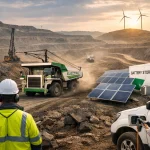
Fortescue currently operates the 100-megawatt North Star Junction solar farm. The company is constructing the 190-megawatt Cloudbreak solar farm and has plans for a 644-megawatt facility at Turner River. That’s not incremental renewable capacity. That’s industrial-scale solar deployment specifically designed to power mining operations.
The transmission infrastructure represents its own engineering challenge. Distributing renewable power across the Pilbara’s distances requires substantial investment in substations, transformers, and high-voltage lines. Fortescue is essentially building a private utility network to support its decarbonization strategy.
The $6.2 Billion Bet on Zero Emissions
The battery locomotives sit within a much larger capital allocation. Fortescue has committed $6.2 billion to achieving “real zero” emissions across its Pilbara operations by 2030. That’s not an aspirational target hedged with offsets and carbon credits. The company is explicitly going after operational emissions.
The rail electrification is one piece of a three-pronged equipment strategy. Fortescue signed a $2.8 billion agreement with Liebherr for zero-emission mining vehicles. That deal covers haul trucks, excavators, and other mobile equipment. The company also placed a $400 million order with China’s XCMG for additional electric equipment.
These aren’t symbolic purchases. They’re fleet replacement decisions that lock in capital and operational pathways for decades. Fortescue is betting that battery-electric technology is mature enough to handle Pilbara duty cycles, and they’re willing to absorb the risk of being first at scale.
Green Iron and the Broader Strategy
Fortescue aims to produce its first green iron by the end of June 2026. That milestone matters for commodity markets. If the company can demonstrate that iron ore can be extracted, processed, and transported using renewable energy, it creates a differentiated product in markets increasingly sensitive to embedded carbon.

European steelmakers face tightening emissions regulations. Asian mills are under growing pressure from customers demanding lower-carbon steel. Green iron: produced with renewable energy from mine to port: could command a premium. Whether that premium is large enough to justify the capital expenditure remains an open question, but Fortescue is positioning to find out.
The company’s chairman, Andrew Forrest, has been explicit about the strategic calculus. He views decarbonization not as a compliance exercise but as a competitive advantage. That framing shifts the conversation from cost center to revenue opportunity.
What the Industry Is Watching
Other mining companies are watching Fortescue’s execution closely. Anglo American, Rio Tinto, and BHP have all announced electrification initiatives, but none have deployed battery-electric locomotives at this scale. Fortescue is effectively running the field trial that will inform industry-wide decisions.
The key metrics operators are tracking:
- Maintenance intervals compared to diesel locomotives
- Battery degradation rates under heavy-haul conditions
- Charging infrastructure reliability and uptime
- Total cost of ownership over a 10-15 year lifecycle
- Operational flexibility during maintenance windows and peak demand periods
If the locomotives deliver on performance and economics, expect rapid adoption across the Pilbara. If they underperform or require excessive maintenance, it will slow electrification timelines industry-wide. Fortescue is absorbing the first-mover risk, but they’re also positioning for first-mover advantage if the technology proves out.
The Realities Nobody Is Ignoring
Battery-electric locomotives solve some problems and create others. The upfront capital cost is significantly higher than diesel equivalents. Battery replacement cycles remain uncertain under Pilbara conditions: extreme heat, dust, and constant high-load operation. Charging infrastructure requires grid connections and renewable generation that don’t exist in most mining regions.

Fortescue has the advantage of operating in a concentrated geography with existing infrastructure. Companies operating in more remote locations face different economics. Building transmission lines and solar farms to power scattered mine sites costs more per unit of production capacity.
The technology also requires different skill sets from maintenance crews. Battery systems, power electronics, and charging infrastructure demand electrical engineering expertise that traditional diesel mechanics don’t possess. That’s a workforce transition issue that compounds in regions with tight labor markets.
The 2030 Clock
Fortescue’s 2030 “real zero” target creates a forcing function. The company now has less than four years to electrify its entire Pilbara operation. That timeline is aggressive by any standard. It requires sustained capital deployment, zero major technical failures, and regulatory cooperation.
The benefit of an aggressive public timeline is accountability. Fortescue can’t quietly walk back commitments or push deadlines without market consequences. That focus tends to drive execution discipline, which is why the company has moved from announcements to commissioned assets faster than most peers.
The locomotives are now operating in production. That’s the proof point that matters. Everything else is engineering, capital allocation, and operational execution: all of which Fortescue has demonstrated competence in over decades of Pilbara expansion.
What Happens If This Works
If Fortescue successfully electrifies its Pilbara operations by 2030, the ripple effects hit multiple industries. Battery manufacturers gain validation for heavy-industrial applications. Equipment suppliers see demand for electric mining equipment accelerate. Renewable energy developers gain a blueprint for industrial-scale deployment.
The iron ore market could bifurcate between conventional and green production, with pricing premiums for lower-carbon material. Steel mills investing in electric arc furnaces would have a supply chain partner delivering cleaner feedstock. That alignment between mining and steelmaking decarbonization could accelerate both.

The failure case is equally instructive. If the technology doesn’t deliver on performance or economics, it signals that heavy industry decarbonization requires different pathways: possibly hydrogen, possibly continued fossil fuel use with carbon capture. Either way, Fortescue’s bet provides data that the entire sector needs.
The locomotives are rolling. The batteries are charging. The emissions are dropping. Everything else is execution.