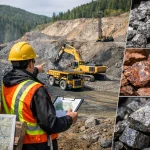
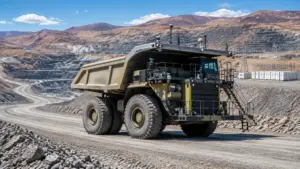
Newmont just greenlit a $3 billion overhaul that will reshape Canadian copper supply for the next two decades. The Red Chris mine in British Columbia is transitioning from open-pit to underground block cave operations, extending its life by over a decade and boosting Canada’s annual copper output by more than 15%.

That’s not incremental. That’s structural.
The feasibility study drops in the second half of 2026. Production starts in the early 2030s. And between now and then, the world’s copper deficit is only getting worse.
The Block Cave Play
Red Chris has been running as an open-pit operation for more than 10 years. The surface ore runs out in 2028. Without the underground expansion, the mine goes dark.

More Read

Block caving changes that equation entirely. The technique allows Newmont to access deeper mineral veins that can’t be touched through surface mining. It’s capital-intensive, technically complex, and requires years of engineering. But once operational, block cave mines deliver consistent, high-volume production with lower unit costs than open-pit alternatives.

The economics are compelling. Red Chris sits 80 kilometers south of Dease Lake in traditional Tahltan First Nation territory. The infrastructure is already in place. The metallurgy is well-understood. And the resource is proven at depth.
What’s not compelling is the timing gap.
More Read

Between the open-pit winding down and the underground operation ramping up, there’s a two-to-three-year production void. That means Red Chris goes from producing copper to producing nothing right as global markets are screaming for supply.
Newmont knows this. They’re pushing development capital hard. The company expects to deploy $1.4 billion in 2026 alone as it advances engineering and permitting. That’s an aggressive timeline for a project of this scale.
Employment and Economics
The project will employ approximately 1,500 workers during steady-state operations. Peak construction hits 1,800 workers.
Those aren’t contractor estimates. They’re operational requirements. Block cave mining demands specialized skills: ground control engineers, ventilation specialists, materials handling experts. These roles don’t come cheap, and they don’t get filled overnight.
Currently, Red Chris employs more than 200 Tahltan members and generates $100 million annually for the Tahltan Nation Development Corporation. The underground expansion deepens that relationship. Under the Section 7 consent-based decision-making agreement between the provincial government and the Tahltan First Nation, the project requires an amendment to the mine’s environmental certificate.
That’s not a rubber stamp process. It’s a negotiation that carries real veto power.
The economic multiplier extends beyond direct employment. Red Chris is one of five mine projects across Canada on the federal government’s Major Projects Office list. Ottawa is watching this closely. So is British Columbia. Both levels of government are betting on copper to anchor their critical minerals strategies.
The irony: Canada’s regulatory timelines are part of the reason global copper supply can’t keep pace with AI-driven demand. Even when projects make economic sense, permitting delays push production years into the future.
The Newmont Calculation
Newmont didn’t develop Red Chris from scratch. The company acquired it, along with Brucejack, when it purchased Newcrest Mining for $23 billion in 2023. That deal was about securing copper optionality in stable jurisdictions.

Red Chris operates as a joint venture with Imperial Metals, which holds a 30% stake. That structure matters. Imperial brings local knowledge and operational experience. Newmont brings capital, technical expertise, and global marketing reach.
The $3 billion price tag reflects current cost inflation in mining construction. Labor, steel, concrete, equipment: everything costs more in 2026 than it did when Newmont ran the initial scoping studies. But copper prices have also moved higher, and long-term demand projections keep climbing.
Newmont is effectively betting that copper fundamentals in the 2030s justify today’s capital deployment. Given the 800-kiloton supply deficit markets are already facing, that’s not a reckless bet.
Environmental and Regulatory Angles
Once operational, the underground mine is expected to cut greenhouse gas emissions by over 70% compared to the open-pit operation. That’s a function of eliminating diesel-powered haul trucks moving overburden and switching to conveyor systems and underground electric equipment.
The emission reduction isn’t just good PR. It’s a strategic necessity. Mining companies operating in Canada face increasing pressure to decarbonize operations. Provincial and federal governments are tightening emission standards. Carbon pricing is rising. And institutional investors are demanding lower-carbon portfolios.
Newmont is positioning Red Chris as a low-carbon copper source at a time when buyers are starting to differentiate between high-carbon and low-carbon supply. That premium doesn’t exist yet in spot markets, but it’s emerging in long-term offtake agreements.
The regulatory path forward hinges on the environmental certificate amendment. British Columbia’s mine permitting process has improved in recent years, but it remains unpredictable. The Section 7 consent mechanism adds another layer of complexity: and another potential delay point.
If the Tahltan Nation withholds consent, the project doesn’t proceed. Full stop.
That dynamic makes the $100 million in annual revenue the mine generates for the Tahltan Nation Development Corporation particularly relevant. The relationship is already established. The economic benefits are already flowing. But consent isn’t guaranteed, and negotiations over the underground expansion will test that partnership.
What Happens When Production Restarts
Assuming permitting stays on track and construction begins in 2027-2028, Red Chris underground comes online in the early 2030s. By then, the global copper market will look very different than it does today.
Electrification will be further advanced. Data center construction will have accelerated. Electric vehicle penetration will be higher. And the supply-demand imbalance will be even more pronounced than it is now.
Red Chris won’t solve that deficit. No single project can. But it represents the kind of brownfield expansion that offers the fastest path to new supply. The infrastructure exists. The resource is known. The metallurgy is proven. The only questions are capital, permitting, and execution.

Newmont has the balance sheet to fund the project. The company generated $12.4 billion in revenue in 2023 and maintains investment-grade credit ratings. The $3 billion commitment is material, but it’s not existential.
The real constraint is time. Even if everything goes perfectly, Red Chris won’t produce an ounce of copper until the early 2030s. That’s five to seven years away. In the interim, the market has to find supply elsewhere: or demand has to adjust.
Neither outcome looks likely.
The Broader Canadian Context
Red Chris is part of a larger shift in Canadian mining. After years of underinvestment, copper projects are finally attracting capital. The federal government’s critical minerals list, provincial incentives, and improved regulatory coordination are all contributing factors.
But Canada still faces structural challenges. Labor shortages are acute. Construction costs are elevated. Permitting timelines remain longer than competing jurisdictions. And resource nationalism concerns: while less severe than in Latin America or Africa: still create friction.
Newmont’s $3 billion bet signals that these challenges are manageable. The company could have deployed that capital in Nevada, Australia, or Peru. It chose British Columbia. That says something about jurisdiction risk, resource quality, and long-term stability.
It also says something about copper supply. Projects this size don’t get approved unless the commodity outlook justifies the spend. Newmont isn’t building Red Chris underground for 2026 copper prices. It’s building for 2035 copper prices.
And those projections look very different than today’s spot market.
The Strategic Takeaway
The Red Chris underground expansion is a $3 billion response to a supply crisis that hasn’t peaked yet. Newmont is locking in future production at a time when copper availability is becoming the binding constraint on energy transition timelines.
The project won’t produce copper for years. But the decision to proceed now reflects where the market is headed, not where it currently sits. That gap: between present supply and future demand: is what’s driving capital deployment across the sector.
Red Chris is one data point. But it’s a significant one. Canada’s copper production is about to take a step-function increase. The question is whether that increase arrives soon enough to matter.