By Charles Pitts

Nobody wants to admit that digging rocks out of the ground is actually the easy part.
For the last decade, the United States has been obsessed with “permitting reform” and “onshoring mines,” as if discovering a massive lithium deposit or a rare earth vein is the finish line. It isn’t. Not even close. You can have all the spodumene or neodymium in the world sitting in a stockpile in Nevada or Texas, but if you have to ship it to a Chinese refinery to make it useful, you don’t have a supply chain. You have a hostage situation.
This is the “missing middle”: the brutal gap between raw extraction and finished high-tech components. And right now, Oklahoma is making a $7 billion bet that it can become the nation’s primary solution to that problem.
The Strategic Calculus of the ‘Missing Middle’
The missing middle refers to the refining, processing, and metallurgical steps that transform raw ore into the magnets, battery chemicals, and high-purity metals required for modern warfare and the global battery revolution.
More Read

China currently controls over 90% of this middle ground. They didn’t win this through superior geology; they won it through decades of aggressive industrial policy and a willingness to handle the “nasty” part of the process: the chemical leaching, the high-heat smelting, and the complex separation of elements.

While the rest of the world looked away, China built the midstream. Now, in 2026, the U.S. is playing a desperate game of catch-up. Oklahoma, surprisingly, has emerged as the most aggressive player on the board.
The state isn’t just throwing tax breaks at companies. It is positioning its existing oil and gas infrastructure, its low energy costs, and its central logistics as the “Safe Haven” for midstream processing. This isn’t a theory anymore. The money is already on the ground.
More Read

USA Rare Earth: The Stillwater Magnet Play
If you want to understand why Stillwater, Oklahoma, is suddenly a focal point for the Department of Defense, look at USA Rare Earth (USAR).
The math here is grim. Even if the U.S. successfully ramps up rare earth mining: like the Per Geijer project in Sweden is attempting in Europe: the material almost always ends up in China for processing into permanent magnets. Without those magnets, you don’t have F-35s, you don’t have wind turbines, and you definitely don’t have a domestic EV industry.
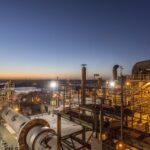
USAR’s Stillwater plant is designed to be the first integrated “mine-to-magnet” facility in the U.S. By the spring of 2026, this plant is slated to begin converting rare earth oxides into high-performance sintered neodymium-iron-boron (NdFeB) magnets.
The federal government isn’t just cheering from the sidelines. The Commerce Department has committed $1.6 billion to USAR. That includes a $1.3 billion senior secured loan and $277 million in direct funding. In exchange, the government takes an 8-16% stake. That’s not a rounding error; that’s a national security intervention.
The goal? Daily extraction of 40,000 tons of material by the 2030s, fed through a supply chain that bypasses the South China Sea entirely. It’s an ambitious timeline, sure, but it’s the only way to break the stranglehold.
Stardust Power and the Muskogee Lithium Loop
While USA Rare Earth handles the magnets, Stardust Power is tackling the lithium bottleneck in Muskogee.
Everyone talks about “lithium mining,” but the real value is in the refinery. Most of the world’s lithium is refined into battery-grade lithium carbonate or hydroxide in facilities that the U.S. has ignored for forty years. Stardust Power’s Muskogee refinery is a direct attempt to fix this.
The strategic logic here isn’t subtle. Muskogee offers access to the Port of Muskogee and the McClellan-Kerr Arkansas River Navigation System. This allows for the cheap, bulk transport of raw materials from brine operations across the mid-continent and the fast-tracking lithium deals happening internationally.
Refining is a high-energy, high-input business. By placing these facilities in Oklahoma, companies are betting on the state’s ability to provide stable, low-cost power: something that states like California or even Nevada struggle with as their grids face increasing pressure.

The $4 Billion Aluminum Anchor: EGA in Oklahoma
Perhaps the most massive, and overlooked, piece of the puzzle is the Emirates Global Aluminium (EGA) $4 billion aluminum smelter.
Aluminum is the “forgotten” critical mineral. We take it for granted because it’s in soda cans, but it’s also the backbone of aerospace and high-tension power lines. The U.S. primary aluminum industry has been in a death spiral for decades, crippled by high energy costs and global oversupply.
EGA’s investment represents a fundamental shift. This isn’t just another factory; it’s a massive infrastructure bet. Aluminum smelting is incredibly energy-intensive. EGA’s decision to plant a $4 billion flag in Oklahoma suggests they believe the U.S. is finally serious about protecting its primary metal production through the use of strategic energy reserves and targeted industrial subsidies.
When you combine the EGA project with USAR and Stardust Power, you start to see the $7 billion picture. This isn’t just a collection of random projects. It’s a deliberate clustering of midstream processing.
Why Oklahoma? The “Flyover” Advantage
For decades, coastal investors looked at Oklahoma as “flyover country”: good for oil, gas, and wheat, but not the “high-tech” future. They were wrong.
The “Missing Middle” requires three things that Oklahoma has in spades:
- Energy Resilience: You cannot run a rare earth processing plant or an aluminum smelter on a “maybe” power grid. Oklahoma’s mix of traditional gas and growing renewables provides the baseload stability these facilities require.
- Regulatory Speed: In the mining world, time is the ultimate killer. Oklahoma has positioned itself as a “fast-track” jurisdiction, contrasting sharply with the decades-long permitting nightmares in other states.
- Industrial Legacy: The skills required to run an oil refinery or a large-scale chemical plant are exactly the skills needed for critical mineral refining. The workforce is already there.
We saw a similar trend in our analysis of Nevada’s mining jurisdiction, but Oklahoma is playing a different game. Nevada is about the rocks; Oklahoma is about the chemistry.
The 2026 Inflection Point
March 2026 marks the inflection point for this strategy. The initial federal outlays from the $7+ billion critical minerals fund: part of the broader strategic spending bills: are starting to hit the ground.
But there’s a catch. The clock is already ticking. China has already begun implementing export controls on gallium and germanium, and they’ve signaled that rare earth processing technology is a “protected national secret.”
The “Missing Middle” isn’t just an economic opportunity; it’s a race against a closing door. If the USAR facility in Stillwater doesn’t hit its production targets by the end of this year, the downstream manufacturers: the guys building the EV motors and the missile guidance systems: will have no choice but to keep sending their money to Beijing.
There’s no room for error. Per facility. That’s not a typo. These plants need to be perfect from day one because the strategic consequences of failure are terminal for U.S. energy independence.
The Investor Perspective: Realism Over Hype
If you’re an operator or an investor, you need to look past the press releases. The “Missing Middle” is a high-CAPEX, high-risk environment.
The volatility in prices: as seen in our latest gold and silver market reports: shows that the transition to a domestic supply chain will be expensive and messy. We are moving from a “lowest cost” global model to a “highest security” domestic model. That means the end products will likely be more expensive, at least in the short term.
However, the alternative: remaining dependent on a geopolitical rival for the components of your entire economy: is no longer an option.
Oklahoma’s $7 billion bet is a recognition of this reality. By focusing on the processing, the state is securing the most valuable, and most defensible, part of the supply chain. It’s a strategy that other states would be wise to study, assuming there’s any room left in the market by the time they get started.

Summary: The New Industrial Heartland
The “Missing Middle” was the Achilles’ heel of American industry for thirty years. We were happy to let others do the dirty work of refining while we focused on the “shiny” software and design.
2026 is the year that chickens come home to roost.
Between EGA’s $4B aluminum play, Stardust Power’s lithium refinery, and USAR’s Stillwater magnet plant, Oklahoma has essentially built a $7 billion wall against foreign supply chain disruptions. It’s not a pretty process. It’s loud, it’s chemically intensive, and it’s incredibly expensive.
But it’s also the only way forward. For those who thought the “mining boom” was just about finding new deposits, welcome to the new reality. The real fight isn’t for the minerals in the ground; it’s for the factories that turn those minerals into power. And right now, Oklahoma is winning.
For more in-depth analysis of the global mining landscape, explore our October 2024 and January 2025 reviews.