The world’s “green” energy transition is fundamentally a thirsty one. We talk about copper as the bedrock of electrification, but we rarely talk about the billions of gallons of water required to pull that copper out of the driest places on Earth. In the high-altitude deserts of Chile and Peru, the industry is hitting a wall. Conventional aquifers are tapped out. Glaciers are receding. Local communities are rightfully protective of what little fresh water remains.

The narrative often focuses on “peak copper” or declining grades. Those are real issues. But the immediate, existential threat to the copper pipeline isn’t a lack of ore; it’s a lack of water.
Without a massive, technologically complex pivot to seawater, the copper boom dies in the desert.
The Geography of Scarcity
Chile and Peru account for nearly 40% of global copper production. Most of this comes from the Atacama Desert and the high Andean plateaus. These regions receive less than a few millimeters of rain a year. Traditionally, mines pumped water from underground aquifers or diverted mountain streams.
That era is over.
More Read

Governments are tightening the screws. In Chile, the state copper commission (Cochilco) has made it clear: the future is wet, but the water won’t be fresh. By 2026: this year: desalination is projected to provide half of the total water demand for the country’s copper miners. That’s a massive industrial shift in a very short window.


High-altitude copper operations face extreme water scarcity.
Desalination: The Billion-Dollar Straw
The industry’s answer is to build a massive, synthetic circulatory system. This starts at the coast with Reverse Osmosis (RO) plants.
More Read

The scale here is staggering. Take Minera Escondida, the world’s largest copper mine. They aren’t just dabbling in water tech; they’ve built a US$3.4 billion water supply system. Their newest plant delivers 2,500 liters per second. To put that in perspective: that is enough to fill 85 Olympic-sized swimming pools every single day.
The tech itself: Reverse Osmosis: isn’t new, but the application is. Seawater is sucked in through self-cleaning screens, forced through 120 high-pressure dual-layer filters of sand and anthracite, and then slammed against semi-permeable membranes. This strips the salt and minerals, leaving industrial-grade fresh water.
But getting the salt out is only the first half of the nightmare.
The 3,000-Meter Vertical Climb
Here is where the engineering gets truly aggressive. Desalination plants sit at sea level. Most major copper projects, like Collahuasi or those in the Vicuña District, sit at altitudes between 3,000 and 4,800 meters.
You aren’t just moving water across a desert; you’re fighting gravity on a colossal scale.
The infrastructure required to move this water is as expensive as the mines themselves. We’re talking about 150- to 200-kilometer pipelines made of high-grade steel, powered by 12,000-horsepower pumping stations. These aren’t small pumps. They are industrial monsters that consume massive amounts of electricity just to keep the water flowing uphill.
This creates the “water-energy trade-off.” To solve the water crisis, mines are significantly increasing their energy demand. If that energy comes from coal or diesel, the “green” credentials of the copper being produced start to look a little shaky. This is why we’re seeing a simultaneous explosion in solar and wind PPA (Power Purchase Agreements) across the Atacama. You can’t have the water without the power.

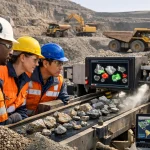
Advanced processing facilities now integrate desalination and renewable energy.
Closed-Loop Systems: Wringing the Sponge
Building a bigger straw isn’t enough. You also have to stop leaking. The push toward closed-loop systems is the second pillar of the Andean water strategy.
In a standard copper processing circuit, water is used to move crushed ore through flotation cells. Historically, much of this water was lost to evaporation in tailings ponds or soaked into the ground.
Today’s mandates are forcing a change. Antofagasta Minerals, for example, is aiming for 90% of its water use to come from seawater or recirculated sources. This involves thickening tailings: removing as much water as possible before the waste is stored: and capturing every drop of runoff.

Illustration of a high-pressure reverse osmosis membrane used in mining desalination.
It’s expensive. It’s technically demanding. But it’s the only way to keep the social license to operate. If you’re a CEO looking at a 20-year mine life, you can’t afford to be the reason a local village runs out of drinking water. The political risk is simply too high.
The Cost of Survival
Let’s talk numbers. None of this is cheap. Antofagasta’s Los Pelambres recently inaugurated a US$2 billion desalination plant. That’s capital that isn’t going into exploration or new excavators. It’s “stay-in-business” capital.
For investors, this changes the calculus. A project with a high copper grade but no water access is effectively worthless. On the flip side, companies that have already sunk the capital into desalination infrastructure: like BHP at Escondida or the owners of Collahuasi: now have a massive competitive moat. They have secured their primary reagent for the next three decades.
This is also driving consolidation. Small-to-mid-cap players can’t afford a $1.5 billion pipeline. We are likely to see more “water sharing” agreements, where multiple mines in a district chip in for a single massive desalination hub and pipeline network. It’s the only way the math works.

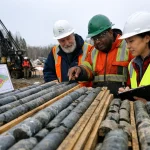
Exploration in high-altitude frontier environments requires early water-scarcity planning.
What Happens Next: The 2026 Inflection Point
We are currently at the inflection point. The projects planned five years ago are coming online now.
But the pressure isn’t letting up. As ore grades decline, you have to process more rock to get the same amount of copper. More rock means more water. Even with 90% recirculation, the “makeup water” required is increasing.
And then there’s the brine. Desalination produces a highly concentrated salt byproduct. Discharging this back into the ocean without destroying local ecosystems is the next regulatory hurdle. Some companies are looking at artificial aquifer recharge: pumping treated water back into the ground to stabilize water tables: but that’s still in the early stages.
The copper industry is fundamentally being forced to become a water management industry that happens to sell metal.
The Bottom Line
If you want to understand the future of copper supply, stop looking at the price of the metal and start looking at the price of a cubic meter of water in Antofagasta.
The “Andean Thirst” isn’t a temporary drought; it’s the new baseline. Desalination tech has saved the pipeline for now, but the trade-off is higher Capex, higher Opex, and a permanent reliance on high-energy infrastructure.
For the big players, it’s the cost of doing business. For the smaller explorers, it’s a barrier to entry that might be insurmountable without a major partner.
The copper is there. The technology to get the water there exists. But the days of “easy” water are dead and buried.

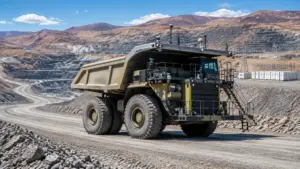
Even the most advanced machinery is useless without a reliable water supply.
The strategy here isn’t subtle: build the infrastructure or lose the mine. As we move deeper into 2026, the divide between the “water-haves” and the “water-have-nots” will define the winners of the copper super-cycle. It’s that simple.
And for those watching projects like Oyu Tolgoi or the big African pits, don’t think this is just a South American problem. Water scarcity is a global mining headwind. Chile just happened to be the first to hit the wall.